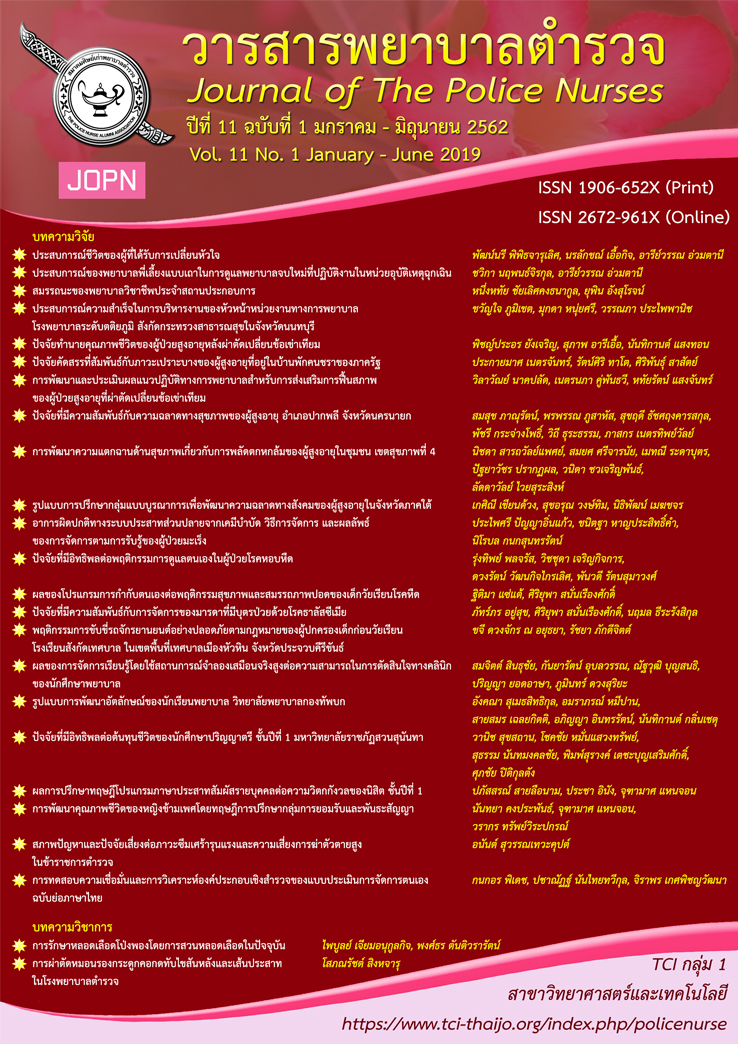
การทดสอบความเชื่อมั่นและการวิเคราะห์องค์ประกอบเชิงสำรวจของแบบประเมินการจัดการตนเอง ฉบับย่อภาษาไทย
คำสำคัญ:
ความเชื่อมั่น, การวิเคราะห์องค์ประกอบเชิงสำรวจ, แบบประเมินการจัดการตนเอง ฉบับย่อภาษาไทยบทคัดย่อ
การวิจัยนี้เป็นการวิจัยเชิงพรรณนาเพื่อทดสอบความเชื่อมั่นและวิเคราะห์องค์ประกอบเชิงสำรวจของแบบสอบถามการจัดการตนเองที่ได้รับการแปลเป็นภาษาไทยจากต้นฉบับคือ The Patient Activation Measure (PAM) เพื่อเป็นหลักฐานเชิงประจักษ์ที่จะนำมาใช้ในบริบทของคนไทย อาศัยกระบวนการแปลที่ได้มาตรฐานตามขั้นตอน แล้วจึงนำแบบสอบถามที่ได้ไปผ่านการพิจารณาจากผู้เชี่ยวชาญจำนวน 5 ท่าน และนำไปทดลองใช้กับผู้ป่วยโรคกระดูกและข้อจำนวน 300 ราย วิเคราะห์ข้อมูลทางสถิติเพื่อหาค่าความเชื่อมั่นและผลการวิเคราะห์องค์ประกอบเชิงสำรวจ
ผลการศึกษาพบว่า แบบสอบถามต้นฉบับที่แปลเป็นภาษาไทยที่ผ่านการทดสอบความเที่ยงด้วยวิธีการทางสถิติมีค่า Cronbach’s alpha coefficient โดยรวมทั้งฉบับเท่ากับ .74 ความเชื่อมั่นรายข้ออยู่ระหว่าง .71–.83 ซึ่งอยู่ในระดับดี ผลการวิเคราะห์องค์ประกอบเชิงสำรวจโดยใช้ค่าสถิติ Kaiser-Myer-Olkin’s measures of sampling adequacy (KMO) ได้เท่ากับ .85 ค่าสถิติของบาร์เลทท์ (Bartlet’s test of sphericity) มีค่าไคสแควร์ (χ2) เท่ากับ 916.10 ซึ่งมีระดับนัยสำคัญทางสถิติที่ระดับ .05 ผลการสกัดองค์ประกอบได้องค์ประกอบทั้งหมด 4 องค์ประกอบ ค่าไอเกนอยู่ระหว่าง 1.06-4.23 และมีค่าความแปรปรวนสะสมร้อยละ 58.18 แสดงว่า แบบสอบถามการจัดการตนเองฉบับแปลมีความเหมาะสมในการนำไปใช้ในผู้ป่วยไทยที่เป็นโรคกระดูกและข้อ
Downloads
เอกสารอ้างอิง
Brislin, R. W., Lonner, W. J., & Berry, J. W. (1986). Field methods in cross-cultural research. Beverly Hills: SAGE.
Creer, T. L., & Holroyd, K. A. (2006). Self-management of chronic conditions: the legacy of Sir William Osler. Chronic Illness, 2(1), 7-14.
Greene, J., Hibbard, J. H., & Tusler, M. (2005). How much do health literacy and patient activation contribute to older adults' ability to manage their health? AARP Public Policy Institute Washington, DC.
Hibbard, J. H., Mahoney, E. R., Stock, R., & Tusler, M. (2007). Do increases in patient activation result in improved self-management behaviors? Health services research, 42(4), 1443-1463.
Hibbard, J. H., Mahoney, E. R., Stockard, J., & Tusler, M. (2005). Development and testing of a short form of the patient activation measure. Health services research, 40(6), 1918-1930.
Hibbard, J. H., Stockard, J., Mahoney, E. R., & Tusler, M. (2004). Development of the patient activation measure (PAM): Conceptualizing and measuring activation in patients and consumers. Health services research, 39(4), 1005-1026.
Kaemkate, W. (2014). Handout of exploratory factor analysis.
Mukoro, F. (2012). Summary of the evidence on performance of the patient activation measure (PAM). NHS Kidney Care, 1-22.
Nantaga, S. (2011). Instrument translation for cross-cultural research: Technique and Issues to be considered. Thai journal of Nursing Council, 26(1), 19-28.
Nongyoaw, P. (2007). Effects of a telephone education program on self-care behavior for rehabilitative fractured femur patients. Songklanagarind Medical Journal, 25(1), 19-27.
Ritklar, R. (2012). Effects of a self-management program on self-managment behaviors, dyspnea, activities of daily living, and quality of life among patients with congestive heart failure. Nursing Jornal, 3(1), 65-76.
Skolasky, R. L., Mackenzie, E. J., Riley, L. H., & Wegener, S. T. (2009). Psychometric properties of the patient activation measure among individuals presenting for elective lumbar spine surgery. Quality of Life Research, 18(10), 1357-1366.
Skolasky, R. L., Mackenzie, E. J., Wegener, S. T., & Riley, L. H. (2008). Patient activation and adherence to physical therapy in persons undergoing spine surgery. spine, 33(21), E784-E791.
Supamas, A. (2008). Statistical analysis for social science and behavioral research: Techniques for using the program lisrel. Bangkok: Mission Media.
The National Statistical Office. (2010). Survey on health and welfare.
Wiwat, T. (2009). The content improvements of the Thai version of the minnesota living with heart failure questionnaire using cognitive interview. Thai Pharmaceutical and Health Science Journal, 4(2), 227-235.
Wirojcharoenwong, W. (2015). A explorator factor analysis of computer self-efficacy. RMUTP Research Journal Special Issue The 5th Rajamangala University of Technology National Conference.
ดาวน์โหลด
เผยแพร่แล้ว
รูปแบบการอ้างอิง
ฉบับ
ประเภทบทความ
สัญญาอนุญาต
ผลงานที่ได้ตีพิมพ์แล้วจะเป็นลิขสิทธิ์ของวารสารพยาบาลตำรวจ