
ประสิทธิผลของโปรแกรมพหุปัจจัยที่ปรับเปลี่ยนต่อผลลัพธ์สุขภาพของผู้สูงอายุโรคข้อเข่าเสื่อมในชุมชน : การศึกษาเปรียบเทียบ
คำสำคัญ:
ข้อเข่าเสื่อม, ผู้สูงอายุ, โปรแกรมพหุปัจจัยที่ปรับเปลี่ยน, ผลลัพธ์สุขภาพบทคัดย่อ
การวิจัยกึ่งทดลองแบบสองกลุ่มวัดซ้ำนี้ มีวัตถุประสงค์เพื่อศึกษาและเปรียบเทียบผลลัพธ์ด้านผู้ป่วยและผลลัพธ์ทางคลินิกของผู้สูงอายุโรคข้อเข่าเสื่อมระดับเล็กน้อยและระดับปานกลาง ก่อนและหลังได้รับโปรแกรมพหุปัจจัยที่ปรับเปลี่ยน (Modified Multifactorial Intervention Program: mMUFIP) เป็นเวลา 8 และ 12 สัปดาห์ ตัวอย่างเป็นผู้สูงอายุ จำนวน 83 คน แบ่งเป็นกลุ่มข้อเข่าเสื่อมระดับเล็กน้อย จำนวน 38 คน และระดับปานกลาง จำนวน 45 คน โดยทั้งสองกลุ่มได้รับโปรแกรม mMUFIP ประกอบด้วย การให้ความรู้ การควบคุมน้ำหนัก การออกกำลังกาย และการเยี่ยมบ้าน เครื่องมือวิจัย ได้แก่ แบบประเมินสมรรถภาพการรู้คิด 6CIT) การทดสอบความสามารถในการทรงตัว (FRT) แบบประเมินผลลัพธ์ทางคลินิก และประเมินสุขภาวะทางจิต (AIMS2-SF) วิเคราะห์ข้อมูลด้วยสถิติเชิงพรรณนา Chi-square test, Independent t-test และ Repeated Measures ANOVA กำหนดนัยสำคัญทางสถิติที่ระดับ .05
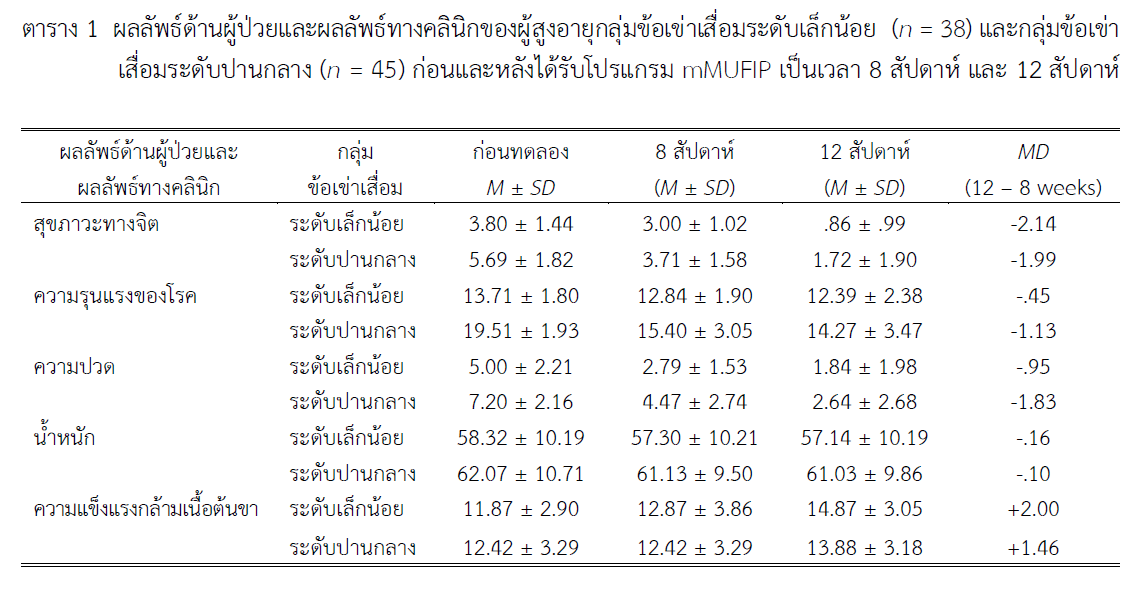
ผลการศึกษาพบว่า ผู้สูงอายุโรคข้อเข่าเสื่อมทั้งสองกลุ่มมีอายุเฉลี่ย 69.33 ปี (SD = 5.55) และมีลักษณะพื้นฐานไม่แตกต่างกันอย่างมีนัยสำคัญทางสถิติ (p > .05) โดยหลังได้รับโปรแกรม mMUFIP พบว่าทั้ง สองกลุ่มมีสุขภาวะทางจิตดีขึ้น โดยมีคะแนนเฉลี่ยลดลงจาก 3.80 ± 1.44 เป็น .86 ± .99 ในกลุ่มข้อเข่าเสื่อมระดับเล็กน้อย และจาก 5.69 ± 1.82 เป็น 1.72 ± 1.90 ในกลุ่มข้อเข่าเสื่อมระดับปานกลาง และมีความแตกต่างระหว่างกลุ่มและการเปลี่ยนแปลงตามระยะเวลา และปฏิสัมพันธ์ระหว่างเวลาและกลุ่มอย่างมีนัยสำคัญทางสถิติ (p < .05) ด้านความรุนแรงของโรค พบว่าทั้งสองกลุ่มมีคะแนนลดลงตามระยะเวลา โดยกลุ่มข้อเข่าเสื่อมระดับเล็กน้อยลดจาก 13.71 ± 1.80 เป็น 12.39 ± 2.38 และกลุ่มข้อเข่าเสื่อมระดับปานกลางลดจาก 19.51 ± 1.93 เป็น 14.27 ± 3.47 โดยมีความแตกต่างระหว่างกลุ่ม การเปลี่ยนแปลงตามเวลา และปฏิสัมพันธ์ระหว่างเวลาและกลุ่มอย่างมีนัยสำคัญทางสถิติ (p < .05) ด้านความปวด พบว่า คะแนนลดลงจาก 5.00 ± 2.21 เป็น 1.84 ± 1.98 ในกลุ่มข้อเข่าเสื่อมระดับเล็กน้อย และจาก 7.20 ± 2.16 เป็น 2.64 ± 2.68 ในกลุ่มข้อเข่าเสื่อมระดับปานกลาง โดยมีความแตกต่างระหว่างกลุ่มและการเปลี่ยนแปลงตามระยะเวลา อย่างมีนัยสำคัญทางสถิติ (p < .05) สำหรับน้ำหนักตัวและความแข็งแรงของกล้ามเนื้อต้นขา พบว่า ทั้งสองกลุ่มมีการเปลี่ยนแปลงไปในทิศทางที่ดีขึ้นตามระยะเวลาอย่างมีนัยสำคัญทางสถิติ (p < .05) แต่ ไม่พบความแตกต่างระหว่างกลุ่ม และไม่พบปฏิสัมพันธ์ระหว่างเวลาและกลุ่ม (p > .05)
ดังนั้น โปรแกรม mMUFIP มีประสิทธิผลในการส่งเสริมสุขภาวะทางจิต ลดความรุนแรงของโรค ความปวด และน้ำหนักตัว พร้อมทั้งเพิ่มความแข็งแรงของกล้ามเนื้อต้นขาในผู้สูงอายุโรคข้อเข่าเสื่อม จึงสามารถนำไปประยุกต์ใช้ในการดูแลผู้สูงอายุในชุมชนเพื่อส่งเสริมผลลัพธ์ด้านสุขภาพได้อย่างเหมาะสม
Downloads
เอกสารอ้างอิง
Alghadir, A. H., Anwer, S., Iqbal, A., & Iqbal, Z. A. (2018). Test–retest reliability, validity, and minimum detectable change of visual analog, numerical rating, and verbal rating scales for measurement of osteoarthritic knee pain. Journal of Pain Research, 11, 851–856. https://doi.org/10.2147/JPR.S158847
Altman, R., Asch, E., Bloch, D., Bole, G., Borenstein, D., Brandt, K., . . . Wolfe, F. (1986). Development of criteria for the classification and reporting of osteoarthritis: Classification of osteoarthritis of the knee. Arthritis and Rheumatism, 29(8), 1039–1049. https://doi.org/10.1002/art.1780290816
Aree-Ue, S., & Piyakhachornrot, N. (2008). Effects of an information and home exercise program for patients with knee osteoarthritis. Thai Journal of Nursing Council, 23(3), 72–84.
Aree-Ue, S., & Piyakhachornrot, N. (2017). Self-management program in patients with knee osteoarthritis. Thai Journal of Nursing Research, 21(3), 45–56.
Aree-Ue, S., Saraboon, Y., & Belza, B. (2017). Long-term adherence and effectiveness of a multicomponent intervention for community-dwelling overweight Thai older adults with knee osteoarthritis: 1-year follow up. Journal of Gerontological Nursing, 43(4), 40–48. https://doi.org/10.3928/00989134-20170111-09
Aree-ue, S., & Youngcharoen, P. (2020). Thai version of the 6-item cognitive impairment test: Psychometric testing. Rama Nursing Journal, 26(2), 193–202.
Bichsel, D., Liechti, F. D., Schlapbach, J. M., & Wertli, M. M. (2022). Cross-sectional analysis of recommendations for the treatment of hip and knee osteoarthritis in clinical guidelines. Archives of physical medicine and rehabilitation, 103(3), 559-569.https://doi.org/10.1016/j.apmr.2021.07.801
Brooke, P., & Bullock, R. (1999). Validation of a 6 item cognitive impairment test with a view to primary care usage. International Journal of Geriatric Psychiatry, 14(11), 936–940. https://doi.org/10.1002/(SICI)1099-1166(199911)14:11<936::AID-GPS39>3.0.CO;2-1
Chen, J., Chen, X., Wang, T., Li, M., Dai, H., Shang, S., . . . Huang, C. (2025). Global burden of knee osteoarthritis from 1990 to 2021: Trends, inequalities, and projections to 2035. PLOS One, 20(6), e0320115. https://doi.org/10.1371/journal.pone.0320115
Chen, T., Chen, W., Xu, T., Wang, H., Zhang, Y., Wang, L., Zhu, S., Tao, H., & Yang, X. (2026). Osteoarthritis: Epidemiology, pathogenesis, and treatment. MedComm, 7, e70727. https://doi.org/10.1002/mco2.70727
Coaccioli, S., Sarzi-Puttini, P., Zis, P., Rinonapoli, G., & Varrassi, G. (2022). Osteoarthritis: New insights on pathophysiology. Journal of Clinical Medicine, 11(20), 6013. https://doi.org/10.3390/jcm11206013
Culvenor, A. G., Øiestad, B. E., Hart, H. F., Stefanik, J. J., Guermazi, A., & Crossley, K. M. (2019). Prevalence of knee osteoarthritis features on magnetic resonance imaging in asymptomatic uninjured adults: A systematic review and meta-analysis. British Journal of Sports Medicine, 53(20), 1268-1278. http://dx.doi.org/10.1136/bjsports-2018-099257
Department of Older Persons. (2023). Situation of the Thai older persons 2022. Bangkok, Thailand: Amarin Corporations Public Company Limited. Retrieved from https://thaitgri.org/?wpdmpro=situation-of-the-thai-older-persons-2022
Duncan, P. W., Weiner, D. K., Chandler, J., & Studenski, S. (1990). Functional reach: A new clinical measure of balance. Journal of Gerontology, 45(6), M192–M197. https://doi.org/10.1093/geronj/45.6.M192
Elmajee, M., Mersal, M., Zehra, B., Ben Nafa, W., Elsayed, A., Embaby, O., Elbioumy, A., Elmahdi, A., Embabi, A., & Youssef, M. (2025). Knee osteoarthritis: Current insights into pathophysiology and non-surgical management options. Cureus, 17(10), e95302. https://doi.org/10.7759/cureus.95302
Ferreira, R. M., Martins, P. N., & Gonçalves, R. S. (2024). Non-pharmacological and non-surgical interventions to manage patients with knee osteoarthritis: An umbrella review 5-year update. Osteoarthritis and Cartilage Open, 6(3), 100497. https://doi.org/10.1016/j.ocarto.2024.100497
GBD 2021 Osteoarthritis Collaborators. (2023). Global regional, and national burden of osteoarthritis, 1990–2020 and projections to 2050: A systematic analysis for the Global Burden of Disease Study 2021. The Lancet Rheumatology, 5(9), e508–e522. https://doi.org/10.1016/S2665-9913(23)00163-7
Gill, S. D., de Morton, N. A., & Mc Burney, H. (2012). An investigation of the validity of six measures of physical function in people awaiting joint replacement surgery of the hip or knee. Clinical Rehabilitation, 26(10), 945–951. https://doi.org/10.1177/0269215511434993
Gray, B., Eyles, J. P., Grace, S., Hunter, D. J., Østerås, N., Quicke, J., . . . Bowden, J. L. (2022). Best evidence Osteoarthritis Care: what are the Recommendations and what is needed to improve practice? Clinics in Geriatric Medicine, 38(2), 287-302. https://doi.org/10.1016/j.cger.2021.11.003
Guillemin, F., Coste, J., Pouchot, J., Ghezail, M., Bregeon, C., & Sany, J. (1997). The AIMS2-SF: A short form of the Arthritis Impact Measurement Scales 2. Arthritis & Rheumatism, 40(7), 1267–1274. https://doi.org/10.1002/art.1780400711
Hall, M., Hinman, R. S., Wrigley, T. V., Kasza, J., Lim, B. W., & Bennell, K. L. (2018). Knee extensor strength gains mediate symptom improvement in knee osteoarthritis: secondary analysis of a randomised controlled trial. Osteoarthritis and Cartilage, 26(4), 495-500. https://doi.org/10.1016/j.joca.2018.01.018
Hunter, D. J., & Bierma-Zeinstra, S. M. A. (2019). Osteoarthritis. The Lancet, 393(10182), 1745–1759. https://doi.org/10.1016/S0140-6736(19)30417-9
Hurley, M., Dickson, K., Hallett, R., Grant, R., Hauari, H., Walsh, N., . . . Bennell, K. (2018). Exercise interventions and patient beliefs for people with hip, knee or hip and knee osteoarthritis: A mixed methods review. Cochrane Database of Systematic Reviews, 4, CD010842. https://doi.org/10.1002/14651858.CD010842.pub2
International Council of Nurses. (2021). Nurses: A voice to lead - A vision for future healthcare. Geneva, Switzerland.
Jan, M. H., Lin, C. H., Lin, Y. F., Lin, J. J., & Lin, D. H. (2009). Effects of weight-bearing versus nonweight-bearing exercise on function, walking speed, and position sense in participants with knee osteoarthritis: A randomized controlled trial. Archives of Physical Medicine and Rehabilitation, 90(6), 897-904. https://doi.org/10.1016/j.apmr.2008.11.018
Kanjanaworawong, P. (1996). Quality of life of the elderly with osteoarthritis of the knee (Master’s thesis). Mahidol University, Bangkok, Thailand.
Katz, J. N., Arant, K. R., & Loeser, R. F. (2021). Diagnosis and treatment of hip and knee osteoarthritis. JAMA, 325(6), 568–578. https://doi.org/10.1001/jama.2020.22171
Leventhal, H., Brissette, I., & Leventhal, E. A. (2003). Common-sense model of self-regulation. In L. Cameron & H. Leventhal (Eds.), The self-regulation of health and illness behavior (pp. 42–65). Routledge.
Leszczynski, P., Lisinski, P., Kwiatkowska, B., Blicharski, T., Drobnik, J., & Pawlak-Bus, K. (2025). Clinical expert statement on osteoarthritis: Diagnosis and therapeutic choices. Reumatologia, 63(2), 104–115. https://doi.org/10.5114/reum/199980
Li, G-Z., Ji, R-J., Xu, C. P., Yang, L-J., & Moreira, P. (2025). On patient quality of life: Impacts of knee osteoarthritis on pain, anxiety, depression, fatigue and sleep disorders. Nursing Open, 12(7), e70264. https://doi.org/10.1002/nop2.70264
Liu, H., Qin, L., Liu, Y., Meng, X., Li, C., & He, M. (2025). Knee osteoarthritis rehabilitation: An integrated framework of exercise, nutrition, biomechanics, and physical therapist guidance - a narrative review. European Journal of Medical Research, 30(1), 826. https://doi.org/10.1186/s40001-025-03083-4
Lu, H., Wang, L., Zhou, W., Jin, S., Chen, H., Su, Y., . . . Shang, S. (2022). Bidirectional association between knee osteoarthritis and depressive symptoms: Evidence from a nationwide population-based cohort. BMC Musculoskeletal Disorders, 23, 213. https://doi.org/10.1186/s12891-022-05137-8
McCaffery, M., & Pasero, C. (1999). Pain: Clinical manual (2nd ed.). St. Louis, MO: Mosby.
Messier, S. P., Mihalko, S. L., Legault, C., Miller, G. D., Nicklas, B. J., DeVita, P., . . . Loeser, R. F. (2013). Effects of intensive diet and exercise on knee joint loads, inflammation, and clinical outcomes among overweight and obese adults with knee osteoarthritis: The IDEA randomized clinical trial. Jama, 310(12). 1263–1273. https://doi.org/10.1001/jama.2013.277669
Messier, S. P., Beavers, D. P., Queen, K., Mihalko, S. L., Miller, G. D., Losina, E., . . . Callahan, L. F. (2022). Effect of diet and exercise on knee pain in patients with osteoarthritis and overweight or obesity: A randomized clinical trial. JAMA, 328(22),2242–2251. https://doi.org/10.1001/jama.2022.21893
National Health Security Office. (2023). Annual report 2023. Bangkok, Thailand.
Oral, A., Arman, S., Tarakci, E., Patrini, M., Arienti, C., Etemadi, Y., . . . Negrini, S. (2022). A systematic review of clinical practice guidelines for persons with osteoarthritis. A “Best Evidence for Rehabilitation” (be4rehab) paper to develop the WHO’s Package of Interventions for Rehabilitation. International Journal of Rheumatic Diseases, 25(4), 383-393. https://doi.org/10.1111/1756-185X.14292
Samahito, S., Bhatharobhas, V., & Sasimontolkul, S. (2013). Physical fitness test and norms for the Thai elderly aged 60-89 years. Bangkok, Thailand: Office of Sports Science, Department of Physical Education, Ministry of Tourism and Sports.
Saraboon, Y., Aree-Ue, S., & Maruo, S. J. (2015). Multifactorial intervention program in knee osteoarthritis. Orthopaedic Nursing, 34(5), 296–308. https://doi.org/10.1097/NOR.0000000000000180
Stanhope, M., & Lancaster, J. (2022). Public health nursing: Population-centered health care in the community (11th ed.). St. Louis, MO: Elsevier.
Suputthitada, A., Boonsinsukh, R., & Satthananon. (2016). Handbook for elderly care: Walking well without falls. Nonthaburi, Thailand: Health Systems Research Institute.
Vanitcharoenkul, E., Adulkasem, N., Unnanuntana, A., & Chotiyarnwong, P. (2026). Symptomatic knee osteoarthritis in older Thai adults: Prevalence, risk factors, and associations with osteoporosis, sarcopenia, and fall risk - A nationwide cross-sectional study. BMC Public Health, 26, 1603. https://doi.org/10.1186/s12889-026-27158-x
Wang, F., Zhang, X., Tong, X., Zhang, M., Xing, F., Yang, K., . . . Duan, Z. (2021). The effects on pain, physical function, and quality of life of quadriceps strengthening exercises combined with Baduanjin qigong in older adults with knee osteoarthritis: A quasi-experimental study. BMC Musculoskeletal Disorders, 22(1), 313. https://doi.org/10.1186/s12891-021-04179-8
World Health Organization. (2023). Osteoarthritis. Retrieved from https://www.who.int/news-room/fact-sheets/detail/osteoarthritis
Youngcharoen, P., Saraboon, Y., & Aree-Ue, S. (2020). Factors influencing health status in older people with knee osteoarthritis. Japan Journal of Nursing Science, 17(1), e12262. https://doi.org/10.1111/jjns.12262
Zhao, W., Long, Y., & Wang, Y. (2024). Osteoarthritis: An integrative overview from pathogenesis to management. Malaysian Journal of Pathology, 46(3), 369.
ดาวน์โหลด
เผยแพร่แล้ว
รูปแบบการอ้างอิง
ฉบับ
ประเภทบทความ
สัญญาอนุญาต
ลิขสิทธิ์ (c) 2026 วารสารพยาบาลตำรวจและวิทยาศาสตร์สุขภาพ

อนุญาตภายใต้เงื่อนไข Creative Commons Attribution-NonCommercial-NoDerivatives 4.0 International License.
ผลงานที่ได้ตีพิมพ์แล้วจะเป็นลิขสิทธิ์ของวารสารพยาบาลตำรวจ