ปัจจัยทำนายพฤติกรรมส่งเสริมสุขภาพของหญิงตั้งครรภ์
คำสำคัญ:
พฤติกรรมส่งเสริมสุขภาพ, หญิงตั้งครรภ์, การรับรู้ประโยชน์, การสนับสนุนทางสังคม, การรับรู้ความสามารถของตนบทคัดย่อ
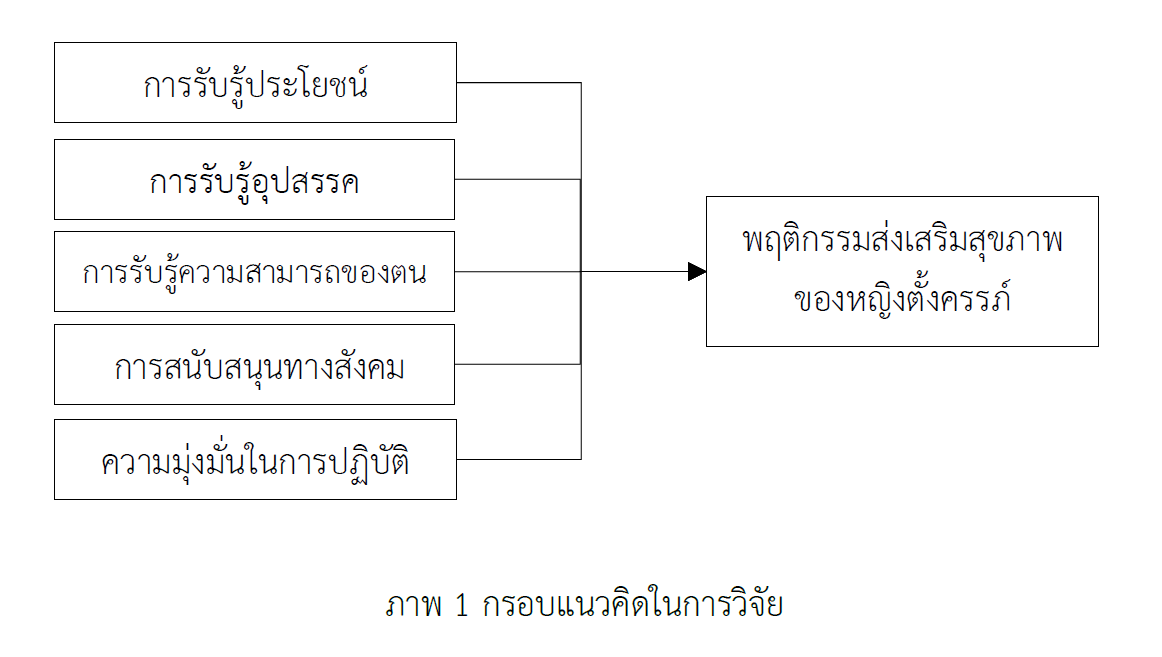
งานวิจัยเชิงทำนายนี้มีวัตถุประสงค์เพื่อศึกษาพฤติกรรมส่งเสริมสุขภาพของหญิงตั้งครรภ์ และศึกษาปัจจัยทำนายพฤติกรรมส่งเสริมสุขภาพของหญิงตั้งครรภ์ ตัวอย่าง คือ หญิงตั้งครรภ์ที่มารับบริการฝากครรภ์ ณ หน่วยฝากครรภ์ โรงพยาบาลภูมิพลอดุลยเดช กรมแพทย์ทหารอากาศ จำนวน 166 ราย ได้มาด้วยวิธีการสุ่มอย่างง่าย เครื่องมือที่ใช้ในการวิจัย ประกอบด้วย แบบสอบถามข้อมูลส่วนบุคคล แบบสอบถามพฤติกรรมส่งเสริมสุขภาพ แบบสอบถามการรับรู้ประโยชน์ การรับรู้อุปสรรค การรับรู้ความสามารถของตน การสนับสนุนทางสังคม และความมุ่งมั่นในการปฏิบัติพฤติกรรมส่งเสริมสุขภาพ ผ่านการตรวจสอบความตรงเชิงเนื้อหา และมีความเที่ยงจากค่าสัมประสิทธิ์แอลฟาของครอนบาคเท่ากับ .86, .98, .83, .90, .82, และ .71 ตามลำดับ วิเคราะห์ข้อมูลโดยใช้สถิติเชิงพรรณนาและการวิเคราะห์ถดถอยพหุคูณแบบ Enter
ผลการศึกษาพบว่า หญิงตั้งครรภ์ที่มารับบริการฝากครรภ์มีพฤติกรรมส่งเสริมสุขภาพอยู่ระดับสูง (M = 121.65, SD = 11.89) ความมุ่งมั่นในการปฏิบัติพฤติกรรมส่งเสริมสุขภาพ การรับรู้ประโยชน์ การสนับสนุนทางสังคม และการรับรู้ความสามารถของตน สามารถร่วมกันทำนายพฤติกรรมส่งเสริมสุขภาพของหญิงตั้งครรภ์ได้อย่างมีนัยสำคัญทางสถิติที่ระดับ .05 โดยสามารถอธิบายความแปรปรวนของพฤติกรรมส่งเสริมสุขภาพของหญิงตั้งครรภ์ ได้ร้อยละ 36.1 (R = .601, R² = .361, Adjusted R² = .341, F(5,160) = 18.109, p < .05) โดยความมุ่งมั่นในการปฏิบัติพฤติกรรมส่งเสริมสุขภาพเป็นปัจจัยที่มีอิทธิพลสูงสุด (Beta = .382, p < .05)
ข้อเสนอแนะจากการศึกษา พยาบาลผดุงครรภ์ควรส่งเสริมความมุ่งมั่นในการปฏิบัติพฤติกรรมส่งเสริมสุขภาพ การรับรู้ประโยชน์ การสนับสนุนทางสังคม และการรับรู้ความสามารถของตน เพื่อส่งเสริมให้หญิงตั้งครรภ์มีพฤติกรรมส่งเสริมสุขภาพที่เหมาะสม
Downloads
เอกสารอ้างอิง
Aqtam, I., & Darawwad, M. (2018). Health promotion model: An integrative literature review. Open Journal of Nursing, 8(07), 485-503. https://doi.org/10.4236/OJN.2018.87037
Bandura, A. (1997). Self-efficacy: The exercise of control (Vol. 11). New York: W. H. Freeman.
Basharpoor, S., Heidarirad, H., Soleimani, E., & Degdar, B. (2017). The role of health-promoting behaviors in predicting the quality of life of pregnant women. Journal of Research Development in Nursing and Midwifery, 14(1), 36-43.
Bashirian, S., Barati, M., Khazaei, S., Jenabi, E., Gholami, L., & Shirahmadi, S. (2025). Determinants of tooth brushing behavior among pregnant women: An application of the Pender’s health promotion model. Health Education and Health Promotion, 11(1), 53-61. https://doi.org/10.58209/hehp.11.1.53
Cunningham, F. G., Leveno, K. J., Dashe, J. S., Hoffman, B. L., Spong, C. Y., & Casey, B. M. (2022). Williams obstetrics (26th ed.). McGraw Hill.
Chasse, J. (2017). Reducing Infant morbidity with adolescent mothers. Obstetrics & Gynecology International Journal, 8(2), 1-6.
Cohen, J. (1988). Set correlation and contingency tables. Applied Psychological Measurement, 12(4), 425-434. https://doi.org/10.1177/014662168801200410
DeVellis, R. F. (2017). Scale development: Theory and applications (4th ed.). Sage publications.
Hair Jr, J. F., Black, W. C., Babin, B. J., & Anderson, R. E. (2014). Multivariate data analysis (7th ed.). Harlow, Essex: Pearson.
Huang, M-Z., Sun, Y-C., Gau, M-L., Puthussery, S., & Kao, C-H. (2019). First-time mothers’ experiences of pregnancy and birth following assisted reproductive technology treatment in Taiwan. Journal of Health, Population and Nutrition, 38(1), 10. https://doi.org/10.1186/s41043-019-0167-3
Jalili Bahabadi, F., Estebsari, F., Rohani, C., Rahimi Khalifeh Kandi, Z., Sefidkar, R., & Mostafaei, D. (2020). Predictors of health-promoting lifestyle in pregnant women based on Pender’s health promotion model. International Journal of Women's Health, 12, 71-77. https://doi.org/10.2147/IJWH.S235169
Kongvattananon, P., Phochai, S., & Thongbai, W. (2020). Factors predicting healthcare behaviors of pregnant migrant laborers. The Bangkok Medical Journal, 16(1), 39-43. https://doi.org/10.31524/bkkmedj.2020.11.008
McLeish, J., Harvey, M., Redshaw, M., & Alderdice, F. (2021). A qualitative study of first time mothers' experiences of postnatal social support from health professionals in England. Women and Birth, 34(5), e451-e460. https://doi.org/10.1016/j.wombi.2020.10.012
Memon, M. A., Ting, H., Cheah, J. H., Thurasamy, R., Chuah, F., & Cham, T. H. (2020). Sample size for survey research: Review and recommendations. Journal of Applied Structural Equation Modeling, 4(2). 1-20. https://doi.org/10.47263/JASEM.4(2)01
Ministry of Public Health. (2026). Department of Health points out that “gestational diabetes” increases the risk of premature birth; recommends controlling BMI and planning for a quality pregnancy.
Ngamchay, C., Tachasuksri, T., & Siriarunrat, S. (2020). Predicting factors of eating behaviors among pregnant women working in industrial factories. The Journal of Faculty of Nursing Burapha University, 28(1), 48-59.
Ngwazini, C. (2022). Implementation of Nola Pender’s “Clinical Assessment for Health Promotion Plan” to increase patient self-efficacy, weight loss and health promoting behaviors such as improving nutrition and increased physical activity in obese women in a weight loss clinic (Doctor of Nursing Practice Final Manuscripts, 213). University of San Diego. https://doi.org/10.22371/07.2022.043
Organisation for Economic Co-operation and Development. (2024). Health at a Glance: Asia/Pacific 2024: Preterm birth and low birth weight. Retrieved from https://www.oecd.org/en/publications/health-at-a-glance-asia-pacific-2024_51fed7e9-en/full-report/preterm-birth-and-low-birth-weight_49541696.html
Pender, N. J., Murdaugh, C. L., & Parsons, M. A. (2015). Health promotion in nursing practice (7th ed.). Boston: Pearson.
Rahimi Khalifeh Kandi, Z., Estebsari, F., Jalilibahabadi, F., Sheikh Milani, A., Estebsari, K., & Mostafaei, D. (2022). Predictors of health-related quality of life of pregnant women based on Pender’s model constructs. Health Education and Health Promotion, 10(2), 277-283.
Shahabi, N., Javdan, G., Hosseini, Z., Aghamolaei, T., Ghanbarnejad, A., & Behzad, A. (2024). A health promotion model-based intervention to enhance treatment adherence in patients with type 2 diabetes. BMC Public Health, 24(1), 1943. https://doi.org/10.1186/s12889-024-19452-3
Shin, D., & Lee, K. W. (2021). High pre-pregnancy BMI with a history of gestational diabetes mellitus is associated with an increased risk of type 2 diabetes in Korean women. PLoS ONE, 16(6), e0252442. https://doi.org/10.1371/journal.pone.0252442
Sohrabi, Z., Kazemi, A., Farajzadegan, Z., & Janighorban, M. (2023). Body perception in pregnant women: A qualitative study. BMC Pregnancy and Childbirth, 23(1), 165. https://doi.org/10.1186/s12884-023-05467-y
Srisawad, K. (2018). Health promoting behavior in pregnancy. Journal of Research in Nursing-Midwifery and Health Sciences, 38(2), 95-109.
Switzer, G. E., Wisniewski, S. R., Belle, S. H., Dew, M. A., & Schultz, R. (1999). Selecting, developing, and evaluating research instruments. Social Psychiatry and Psychiatric Epidemiology, 34(8), 399-409. https://doi.org/10.1007/s001270050161
Tamteangtrong, R., Sangin, S., & Deoisres, W. (2017). Factors predicting nutritional health-promoting behaviors among pregnant adolescents. The Journal of Faculty of Nursing Burapha University 25(1), 49-60.
UNICEF. (2022). Antenatal care data. Retrieved from https://data.unicef.org/resources/dataset/antenatal-care/
Waltz, C. F., Strickland, O., & Lenz, E. R. (2017) Measurement in nursing and health research. Springer Publishing Company. https://doi.org/10.1891/9780826170620
World Bank. (2025). Maternal mortality ratio (modeled estimate, per 100,000 live births) – Thailand. World Development Indicators. Retrieved from https://data.worldbank.org/indicator/
World Health Organization. (2025). Maternal mortality ratio (per 100,000 live births). WHO Global Health Observatory. Retrieved from
Yismaw, A. E., Gelagay, A. A., & Sisay, M. M. (2019). Survival and predictors among preterm neonates admitted at University of Gondar comprehensive specialized hospital neonatal intensive care unit, Northwest Ethiopia. Italian Journal of Pediatrics, 45(1), 4. https://doi.org/10.1186/s13052-018-0597-3
ดาวน์โหลด
เผยแพร่แล้ว
รูปแบบการอ้างอิง
ฉบับ
ประเภทบทความ
สัญญาอนุญาต
ลิขสิทธิ์ (c) 2026 วารสารพยาบาลตำรวจและวิทยาศาสตร์สุขภาพ

อนุญาตภายใต้เงื่อนไข Creative Commons Attribution-NonCommercial-NoDerivatives 4.0 International License.
ผลงานที่ได้ตีพิมพ์แล้วจะเป็นลิขสิทธิ์ของวารสารพยาบาลตำรวจ