ปัจจัยทำนายความสุขในการทำงานของพยาบาลวิชาชีพ โรงพยาบาลเอกชนเครือข่ายแห่งหนึ่ง
คำสำคัญ:
ความสุขในการทำงาน, ความแข็งแกร่งทางจิตใจ, การทำงานเป็นทีม, บรรยากาศจริยธรรมในงาน, ความมีอิสระเชิงวิชาชีพบทคัดย่อ
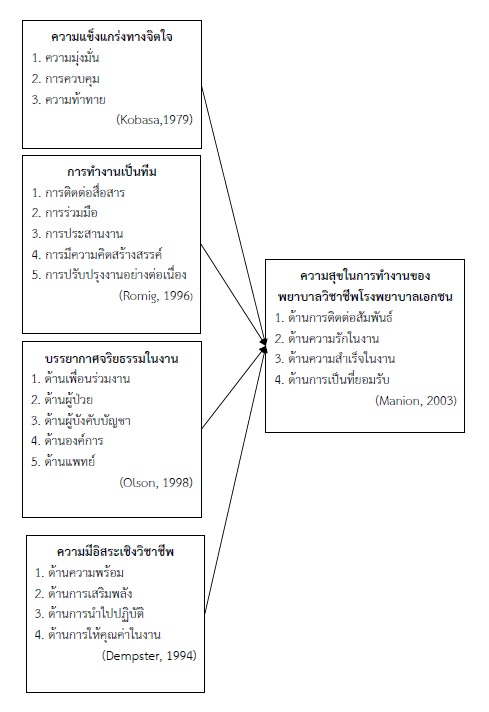
การวิจัยเชิงพยากรณ์ครั้งนี้มีวัตถุประสงค์เพื่อ 1) ศึกษาระดับความสุขในการทำงานของพยาบาลวิชาชีพ โรงพยาบาลเอกชนเครือข่ายแห่งหนึ่ง 2) ศึกษาความสัมพันธ์ระหว่างความแข็งแกร่งทางจิตใจ การทำงานเป็นทีม บรรยากาศจริยธรรมในงาน ความมีอิสระเชิงวิชาชีพ และความสุขในการทำงานของพยาบาลวิชาชีพ โรงพยาบาลเอกชนเครือข่ายแห่งหนึ่ง และ 3) ศึกษาอำนาจการทำนายของความแข็งแกร่งทางจิตใจ การทำงานเป็นทีม บรรยากาศจริยธรรมในงาน และความมีอิสระเชิงวิชาชีพต่อความสุขในการทำงานของพยาบาลวิชาชีพ โรงพยาบาลเอกชนเครือข่ายแห่งหนึ่ง ตัวอย่างเป็นพยาบาลวิชาชีพจำนวน 192 คน ได้มาจากการสุ่มตัวอย่างแบบหลายขั้นตอน เครื่องมือที่ใช้ในการวิจัย ประกอบด้วย แบบสอบถามความแข็งแกร่งทางจิตใจ การทำงานเป็นทีม บรรยากาศจริยธรรมในงาน ความมีอิสระเชิงวิชาชีพ และความสุขในการทำงาน ตรวจสอบความตรงเชิงเนื้อหาโดยผู้ทรงคุณวุฒิได้ค่าดัชนีความตรงเชิงเนื้อหาอยู่ระหว่าง.90-1.00และมีค่าสัมประสิทธิ์แอลฟาของครอนบาคอยู่ระหว่าง .90 - .96 เก็บรวบรวมข้อมูลผ่านระบบอิเล็กทรอนิกส์ วิเคราะห์ข้อมูลด้วยสถิติเชิงพรรณนา สัมประสิทธิ์สหสัมพันธ์แบบเพียร์สัน และการวิเคราะห์การถดถอยพหุคูณแบบขั้นตอน กำหนดนัยสำคัญทางสถิติที่ระดับ .05
ผลการวิจัยพบว่า พยาบาลวิชาชีพมีความสุขในการทำงานโดยรวมอยู่ในระดับมาก (M = 4.25, SD = .41) ตัวแปรที่ศึกษาทั้งหมดมีความสัมพันธ์ทางบวกกับความสุขในการทำงานอย่างมีนัยสำคัญทางสถิติที่ระดับ .05 (r = .769 - .844, p < .05) ความมีอิสระเชิงวิชาชีพ การทำงานเป็นทีม ความแข็งแกร่งทางจิตใจ และบรรยากาศจริยธรรมในงาน สามารถร่วมกันทำนายความสุขในการทำงานของพยาบาลวิชาชีพได้อย่างมีนัยสำคัญทางสถิติที่ระดับ .05 (Beta = .354, .240, .227 และ .193 ตามลำดับ; p < .05) โดยสามารถอธิบายความแปรปรวนของความสุขในการทำงานได้ร้อยละ 83.4 (R² = .834)
ผลการวิจัยสะท้อนว่า ความสุขในการทำงานของพยาบาลวิชาชีพได้รับอิทธิพลจากทั้งปัจจัยส่วนบุคคลและปัจจัยด้านองค์กร โดยเฉพาะความมีอิสระเชิงวิชาชีพและการทำงานเป็นทีม ผู้บริหารทางการพยาบาลจึงควรส่งเสริมการตัดสินใจเชิงวิชาชีพ พัฒนาสมรรถนะการทำงานเป็นทีม เสริมสร้างความแข็งแกร่งทางจิตใจ และสร้างบรรยากาศจริยธรรมเชิงบวกในองค์กร เพื่อส่งเสริมความสุขในการทำงานที่จะนำไปสู่การคงอยู่ในวิชาชีพ การยกระดับคุณภาพการพยาบาล และผลลัพธ์ด้านบริการสุขภาพที่มีประสิทธิภาพและยั่งยืน
Downloads
เอกสารอ้างอิง
Asegid, A., Belachew, T., & Yimam, E. (2014). Factors influencing job satisfaction and anticipated turnover among nurses in Sidama Zone Public Health Facilities, South Ethiopia. Nursing Research and Practice, 2014, 909768. http://dx.doi.org/10.1155/2014/909768
Azeem, S. M. (2010). Personality hardiness, job involvement and job burnout among teachers. International Journal of Vocational and Technical Education, 2(3), 36-40.
Baker, D. P., Day, R., & Salas, E. (2006). Teamwork as an essential component of high-reliability organizations. Health Services Research, 41(4p2), 1576–1598. http://dx.doi.org/10.1111/j.1475-6773.2006.00566.x
Burns, N., & Grove, S. K. (2005). The practice of nursing research: Conduct, critique, and utilization (5th ed.). St. Louis, MO: Elsevier Saunders.
Dempster, J. S. (1994). Autonomy: A professional issue of concern for nurse practitioners. Nurse Practitioner Forum, 5(4), 227–232.
Epstein, E. G., & Delgado, S. (2010). Understanding and addressing moral distress. The Online Journal of Issues in Nursing, 15(3), Manuscript1. https://doi.org/10.3912/OJIN.Vol15No03Man01
Hart, S. E. (2005). Hospital ethical climates and registered nurses' turnover intentions. Journal of Nursing Scholarship, 37(2), 173-177.
Jantarasri, D. (2012). Relationships between self-esteem, empowerment, teamwork, and happiness in working of professional nurses at regional hospitals in the eastern region (Master’s thesis). Burapha University, Chon Buri. https://doi.org/10.1177/0149206315575554
Kalisch, B. J., Lee, H., & Salas, E. (2010). The development and testing of the nursing teamwork survey. Nursing Research, 59(1), 42-50.
Ketsamun, P. (2016). A meta-analysis of antecedent variables of work happiness as perceived by professional nurses (Master’s thesis). Chulalongkorn University, Bangkok, Pathumwan.
Kobasa, S. C. (1979). Stressful life events, personality, and health: An inquiry into hardiness. Journal of Personality and Social Psychology, 37(1), 1–11.
Kramer, M., & Schmalenberg, C. E. (2003). Magnet hospital nurses describe clinical autonomy. Journal of Nursing Administration, 33(10), 534-542.
Krobmukh, K. (2025). Happiness in life among professional nurses in an affiliated private hospital in Nonthaburi Province. Thai Journal of Nursing, 75(1), 59–68.
Manion, J. (2003). Joy at work: Creating a positive workplace. Journal of Nursing Administration, 33(12), 652–659.
Mrayyan, M. T. (2006). Comparison of nurses’ autonomy and job satisfaction in Jordanian hospitals. Journal of Nursing Management, 14(4), 252-262. https://doi.org/10.1111/j.1365-2934.2006.00591.x
Nantsupawat, A., Nantsupawat, R., Kulnaviktikul, W., McHugh, M. D., & Aiken, L. H. (2011). Impact of nurse work environment and staffing on hospital nurse and quality of care in Thailand. Journal of Nursing Scholarship, 43(4), 426–432.
Nilkitsaranont, P. (2020). Business/industry trends 2020-2022: Private hospital business. Retrieved from https://www.krungsri.com/th/research/industry/industry-outlook/services/private-hospitals/io/io-private-hospitals
Olson, L. L. (1998). Hospital nurses' perceptions of the ethical climate of their work setting. Image: The Journal of Nursing Scholarship, 30(4), 345–349.
Ongkhana, K. (2006). The relationship between personal factors, self-esteem, work environment and happiness at work of staff nurses, private hospitals, Bangkok Metropolis (Master of nursing science program). Faculty of Nursing, Chulalongkorn University, Bangkok, Pathumwan.
Phakdeechanuan, K., Kellett, U., Henderson, S., Corones-Watkins, K., Saito, A., & Thiangchanya, P. (2024). Addressing registered nurse retention and attrition in Thailand hospitals: An integrative review. Asia-Pacific Journal of Public Health, 37(1), 1–13. https://doi.org/10.1177/10105395241282972
Polit, D. F., & Beck, C. T. (2006). Essentials of nursing research: Methods, appraisal, and utilization (6th ed.). Philadelphia, PA: Lippincott Williams & Wilkins.
Polit, D. F., & Beck, C. T. (2010). Generalization in quantitative and qualitative research: Myths and strategies. International Journal of Nursing Studies, 47(11), 1451–1458. https://doi.org/10.1016/j.ijnurstu.2010.06.004
Romig, D. A. (1996). Breakthrough teamwork: Key to success in a changing world. Alexandria, VA: American Society for Training and Development.
Sathaporwajnana, A. (2008). The relationship between family support, ethical work climate and happiness at work of professional nurses, hospitals under the Ministry of Public Health, Bangkok Metropolis (Master of nursing science program). Faculty of Nursing, Chulalongkorn University, Bangkok, Pathumwan.
Sawatdipanich, N. (2012). Translation of research instruments for cross-cultural research: Techniques and issues for consideration. The Journal of Thailand Nursing and Midwifery Council, 26(1), 19–29.
Siripanichana, C., Suksawat, J., & Mekkhajorn, N. (2024). Factors affecting happiness at work of personnel in the Office of the Permanent Secretary for Justice, Ministry of Justice. Ratchaphruek Journal, 22(1), 34–49.
Laschinger, H. K., & Finegan, J. (2005). Empowering nurses for work engagement and health in hospital settings. JONA: The Journal of Nursing Administration, 35(10), 439–449.
Sperber, A. D. (2004). Translation and validation of study instruments for cross-cultural research. Gastroenterology, 126(1), 124–128. https://doi.org/10.1053/j.gastro.2003.10.016
Srisatidnarakul, B. (2012). Sample size in research: Sampling and statistics used for data analysis. Bangkok: Chulalongkorn University Printing House.
Tontun, W. (2016). Factors influencing happiness at work of professional nurses in nursing department of an affiliated private hospital in Bangkok Metropolis. Christian University Journal, 22(4), 565–573.
Ulrich, B., Buerhaus, P. I., Donelan, K., Norman, L., & Dittus, R. (2007). Magnet status and the quality of nurse work environments. Nursing Economics, 25(6), 321-329.
Victor, B., & Cullen, J. B. (1988). The organizational bases of ethical work climates. Administrative Science Quarterly, 33(1), 101–125. https://doi.org/10.2307/2392857
Weston, M. J. (2010). Strategies for enhancing autonomy and control over nursing practice. The Online Journal of Issues in Nursing, 15(1), Manuscript 2. https://doi.org/10.3912/OJIN.Vol15No01Man02
ดาวน์โหลด
เผยแพร่แล้ว
รูปแบบการอ้างอิง
ฉบับ
ประเภทบทความ
สัญญาอนุญาต
ลิขสิทธิ์ (c) 2026 วารสารพยาบาลตำรวจและวิทยาศาสตร์สุขภาพ

อนุญาตภายใต้เงื่อนไข Creative Commons Attribution-NonCommercial-NoDerivatives 4.0 International License.
ผลงานที่ได้ตีพิมพ์แล้วจะเป็นลิขสิทธิ์ของวารสารพยาบาลตำรวจ