การบูรณาการความรอบรู้ด้านสุขภาพและสุขภาพดิจิทัลกับการป้องกันการตั้งครรภ์ซ้ำในมารดาวัยรุ่นหลังคลอด : การทบทวนวรรณกรรมเชิงพรรณนา
คำสำคัญ:
ความรอบรู้ด้านสุขภาพ, สุขภาพดิจิทัล, การคุมกำเนิด, การตั้งครรภ์ซ้ำ, มารดาวัยรุ่นหลังคลอดบทคัดย่อ
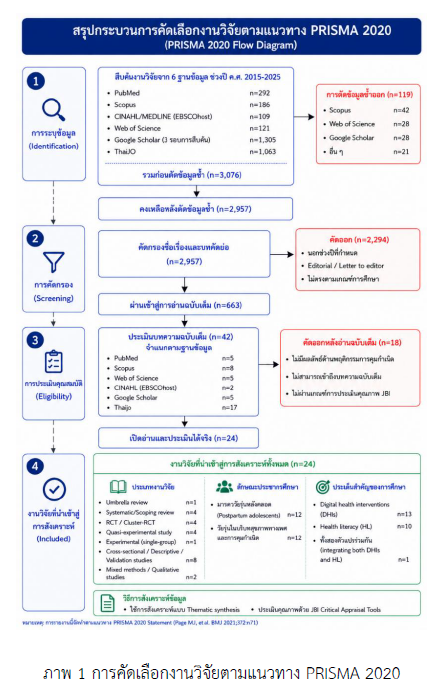
การทบทวนวรรณกรรมเชิงพรรณนานี้ มีวัตถุประสงค์ 1) เพื่อสังเคราะห์หลักฐานเชิงประจักษ์เกี่ยวกับความสัมพันธ์ระหว่างความรอบรู้ด้านสุขภาพและสุขภาพดิจิทัลกับพฤติกรรมการคุมกำเนิดในมารดาวัยรุ่นหลังคลอด และ 2) เพื่อเสนอแนวทางสำหรับการพยาบาลเพื่อป้องกันการตั้งครรภ์ซ้ำในมารดาวัยรุ่นหลังคลอด ซึ่งในการทบทวนวรรณกรรมครั้งนี้ใช้วิธีการตามแนวทาง PRISMA ใช้ฐานข้อมูล PubMed, Scopus, CINAHL, Web of Science, Google Scholar และ ThaiJO ครอบคลุมงานวิจัยที่ตีพิมพ์เผยแพร่ระหว่างปี ค.ศ. 2015 - 2025 ได้งานวิจัยทั้งหมด 3,076 เรื่อง เข้าสู่กระบวนการคัดกรองตามเกณฑ์คุณสมบัติและประเมินคุณภาพด้วยเครื่องมือ JBI Critical Appraisal Tools ได้งานวิจัยที่ผ่านเกณฑ์ จำนวน 24 เรื่อง ประกอบด้วย Umbrella review จำนวน 1 เรื่อง Systematic/Scoping review จำนวน 4 เรื่อง Randomized controlled trial (RCT)/Cluster-RCT จำนวน 4 เรื่อง Quasi-experimental จำนวน 4 เรื่อง Experimental แบบ Single-group จำนวน 1 เรื่อง Descriptive/ Cross-sectional/ Validation studies จำนวน 8 เรื่อง และ Mixed methods/ Qualitative studies จำนวน 2 เรื่อง ทั้งหมดนี้ศึกษาในกลุ่มมารดาวัยรุ่นหลังคลอด (postpartum adolescents) จำนวน 12 เรื่อง วัยรุ่นในบริบทสุขภาพทางเพศและการคุมกำเนิด จำนวน 12 เรื่อง โดยแบ่งเป็นงานที่ศึกษาความรอบรู้ด้านสุขภาพ 10 เรื่อง สุขภาพดิจิทัล 13 เรื่อง และศึกษาสองตัวแปรร่วมกัน จำนวน 1 เรื่อง
ผลการสังเคราะห์พบว่า ความรอบรู้ด้านสุขภาพระดับปฏิสัมพันธ์และระดับวิพากษ์มีความสัมพันธ์กับการใช้วิธีการคุมกำเนิดที่มีประสิทธิภาพสูงอย่างต่อเนื่อง โดยการคุมกำเนิดชนิดออกฤทธิ์ยาวแบบกลับคืนได้ และสุขภาพดิจิทัล เช่น การมีเครื่องมือดิจิทัลที่สนับสนุนการตัดสินใจ ระบบติดตาม และการสื่อเชิงโต้ตอบ จะช่วยสนับสนุนการเรียนรู้ของมารดาวัยรุ่นหลังคลอดให้มีการรับรู้ความสามารถตนเองและส่งเสริมการมารับบริการอย่างต่อเนื่อง อย่างไรก็ตาม หลักฐานส่วนใหญ่มาจากงานวิจัยต่างประเทศ ซึ่งอาจมีบริบทที่แตกต่างจากมารดาวัยรุ่นไทย และยังขาดการติดตามผลในระยะยาวที่มากกว่า 12 เดือน
การบูรณาการตัวแทรกแซงสุขภาพดิจิทัลร่วมกับการส่งเสริมความรอบรู้สุขภาพระดับปฏิสัมพันธ์และระดับวิพากษ์เป็นวิธีการสำคัญที่จะช่วยให้มารดาวัยรุ่นหลังคลอดสามารถเข้าถึง กลั่นกรอง เปรียบเทียบทางเลือก และตัดสินใจเลือกได้อย่างถูกต้อง เหมาะสม ภายใต้หลักฐานเชิงประจักษ์ที่ถูกต้อง นอกจากนี้ ยังควรพัฒนาสมรรถนะดิจิทัลของพยาบาลให้สามารถช่วยมารดาวัยรุ่นหลังคลอดในการตัดสินใจคุมกำเนิดได้อย่างเหมาะสมและป้องกันการตั้งครรภ์ซ้ำในอนาคต
Downloads
เอกสารอ้างอิง
Ajzen, I. (1991). The theory of planned behavior. Organizational Behavior and Human Decision Processes, 50(2), 179–211.
Babalola, S., Loehr, C., Oyenubi, O., Akiode, A., & Mobley, A. (2019). Efficacy of a digital health tool on contraceptive ideation and use in Nigeria: Results of a cluster-randomized control trial. Global Health: Science and Practice, 7(2), 273-288. https://doi.org/10.9745/GHSP-D-19-00066
Borji-Navan, S., Maleki, N., & Keramat, A. (2024). Efficacy of digital health interventions used for adolescents’ sexual health: An umbrella review. Health Science Reports, 7(12), e70212. https://doi.org/10.1002/hsr2.70212
Chernick, L. S., Bugaighis, M., Daylor, V., Hochster, D., Rosen, E., Schnall, R., . . . Bell, D. L. (2024). A digital sexual health intervention for urban adolescent and young adult male emergency department patients: User-centered design approach. JMIR Formative Research, 8(1), e55815. https://doi.org/10.2196/55815
Cherie, N., Wordofa, M. A., & Debelew, G. T. (2024). Effectiveness of an interactive mobile health intervention (IMHI) to enhance the adoption of modern contraceptive methods during the early postpartum period among women in Northeast Ethiopia: A cluster randomized controlled trial. PLOS ONE, 19(11), e0310124. https://doi.org/10.1371/journal.pone.0310124
Department of Health, Ministry of Public Health. (2022). Annual report on adolescent pregnancy situation in Thailand 2022. Ministry of Public Health.
Dowling, R., Howell, E. M., Dasco, M. A., & Schwartzman, J. (2025). Digital adolescent sexual and reproductive health in low-and middle-income countries: A scoping review. Youth, 5(1), 15. https://doi.org/10.3390/youth5010015
Ippoliti, N., Sekamana, M., Baringer, L., & Hope, R. (2021). Using human-centered design to develop, launch, and evaluate a national digital health platform to improve reproductive health for Rwandan youth. Global Health: Science and Practice, 9(Suppl. 2), S244–S260. https://doi.org/10.9745/GHSP-D-21-00220
Jonas, K., Duby, Z., Maruping, K., Harries, J., & Mathews, C. (2022). Rumours, myths, and misperceptions as barriers to contraceptive use among adolescent girls and young women in South Africa. Frontiers in Reproductive Health, 4, 960089. https://doi.org/10.3389/frph.2022.960089
Laar, A. S., Harris, M. L., Khan, M. N., & Loxton, D. (2024). Views and experiences of young people on using mHealth platforms for sexual and reproductive health services in rural low-and middle-income countries: A qualitative systematic review. PLOS Digital Health, 3(12), e0000362. https://doi.org/10.1371/journal.pdig.0000362
Longhini, J., Rossettini, G., & Palese, A. (2022). Digital health competencies among health care professionals: Systematic review. Journal of Medical Internet Research, 24(8), e36414. https://doi.org/10.2196/36414
Nutbeam, D. (2008). The evolving concept of health literacy. Social Science & Medicine, 67(12), 2072–2078. https://doi.org/10.1016/j.socscimed.2008.09.050
Rattanaviboon, P., & Puektes, S. (2020). Effect of an empowerment program combined with infographic-based education on contraceptive implant decision-making for repeat pregnancy prevention among adolescents. Thai Red Cross Nursing Journal, 13(2), 241–256.
Rosenstock, I. M. (1974). The health belief model and preventive health behavior. Health Education Monographs, 2(4), 354-386. https://doi.org/10.1177/109019817400200405
Santibenchakul, S., Thanativakul, K., & Jaisamrarn, U. (2022). An educational video on long-acting reversible contraception as a counseling tool for postpartum adolescents. Contraception and Reproductive Medicine, 7(1), 24. https://doi.org/10.1186/s40834-022-00195-8
Sze, Y. Y., Berendes, S., Russel, S., Bellam, L., Smith, C., Cameron, S., & Free, C. J. (2023). A systematic review of randomised controlled trials of the effects of digital health interventions on postpartum contraception use. BMJ Sexual & Reproductive Health, 49(1), 50-59.
https://doi.org/10.1136/bmjsrh-2022-201468
Unger, J. A., Ronen, K., Perrier, T., DeRenzi, B., Slyker, J., Drake, A. L., . . . John-Stewart, G. (2018). Short message service communication improves exclusive breastfeeding and early postpartum contraception in a low- to middle-income country setting: A randomised trial. BJOG: An International Journal of Obstetrics and Gynaecology, 125(12), 1620–1629. https://doi.org/10.1111/1471-0528.15337
Vongxay, V., Thongmixay, S., Stoltenborg, L., Inthapanyo, A., Sychareun, V., Chaleunvong, K., & Essink, D. R. (2022). Validation of the questionnaire on sexual and reproductive health literacy for adolescents age 15 to 19 years in Lao People's Democratic Republic. Health Literacy Research and Practice, 6(1), 37-50. https://doi.org/10.3928/24748307-20220207-01
Wong, J. Y. H., Zhang, W., Wu, Y., Choi, E. P. H., Lo, H. H. M., Wong, W., . . . Fong, D. Y. T. (2021). An interactive web-based sexual health literacy program for safe sex practice for female Chinese university students: Multicenter randomized controlled trial. Journal of Medical Internet Research, 23(3), e22564. https://doi.org/10.2196/22564
World Health Organization. (2020). Classification of digital health interventions v1.0: A shared language to describe the uses of digital technology for health. Geneva, Switzerland: World Health Organization. Retrieved from https://www.who.int/
World Health Organization. (2024). Adolescent pregnancy. Geneva, Switzerland: World Health Organization. Retrieved from https://www.who.int/news-room/fact-sheets/detail/adolescent-pregnancy
ดาวน์โหลด
เผยแพร่แล้ว
รูปแบบการอ้างอิง
ฉบับ
ประเภทบทความ
สัญญาอนุญาต
ลิขสิทธิ์ (c) 2026 วารสารพยาบาลตำรวจและวิทยาศาสตร์สุขภาพ

อนุญาตภายใต้เงื่อนไข Creative Commons Attribution-NonCommercial-NoDerivatives 4.0 International License.
ผลงานที่ได้ตีพิมพ์แล้วจะเป็นลิขสิทธิ์ของวารสารพยาบาลตำรวจ