DEVELOPMENT OF COMPETENCY-ENHANCEMENT PROGRAM FOR NURSE CARE MANAGERS IN CARING FOR DEPENDENT OLDER ADULTS IN THE HEALTH REGION 10
Keywords:
nurse care managers, competency-enhancement program for elderly care, dependent older adults, knowledge, perceived self-competencyAbstract
The objectives of this research and development study were to develop a competency-enhancement program for nurse care managers in caring for dependent older adults and to examine the effects of the program on the perceived self-competency and knowledge of nurse care managers in providing care for dependent older adults. The sample consisted of 72 registered nurses assigned to provide care for older adults in Health Region 10. They were divided into two groups: 36 participants in the experimental group, who received the competency-enhancement program for nurse care managers in caring for dependent older adults, and 36 participants in the control group, who received the usual competency-enhancement activities. The research instrument was the competency-enhancement program for caring for dependent older adults. The data collection instruments included a personal information form, the perceived self-competency questionnaire, and the test of knowledge related to caring for dependent older adults. Data were analyzed using percentages, means, and mean-difference testing with the dependent and independent t-tests.
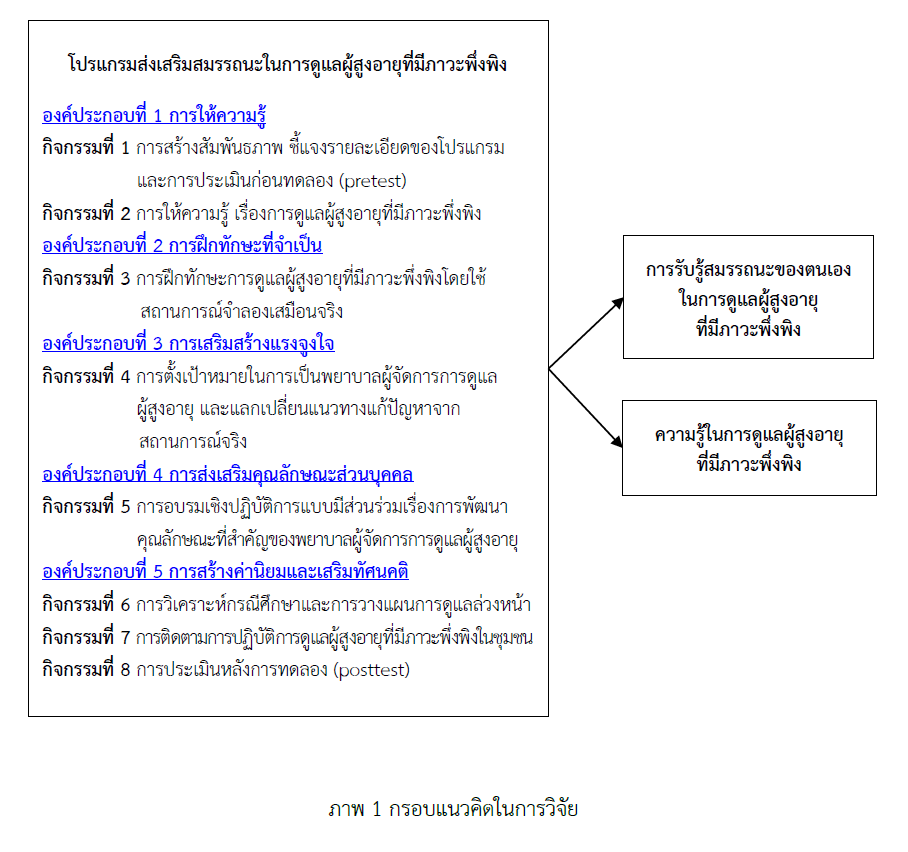
The study found that the competency-enhancement program for caring for dependent older adults consisted of five components: knowledge provision, essential skill training, motivation enhancement, personal attribute development, and the promotion of appropriate values and attitudes. The program demonstrated a high content validity index of 0.94, indicating its appropriateness and feasibility for enhancing the competency of nurse care managers in caring for dependent older adults. The experimental group that participated in the competency-enhancement program demonstrated significantly higher perceived self-competency and knowledge related to caring for dependent older adults compared to their pre-program levels (p < .05). In addition, the experimental group showed significantly higher self-competency and knowledge related to caring for dependent older adults than the control group (p < .05).
Downloads
References
Akhara, S. (2025). Developing a model for long-term care services for the elderly who are dependent Under the participation of the community RenuNakhon Hospital NakhonPhanom Province. Journal of Environmental Education Medical and Health, 10(3), 75-83.
Bandura, A. (1997). Self-efficacy: The exercise of control. W. H. Freeman.
Chianwichai., K. (2020). Identity of the nurse care manager of the elderly in long term care. Thai Red Cross Nursing Journal, 13(2), 29-38.
Cohen, J. (1992). Quantitative methods in psychology: A power primer. Psychological Bulletin. 112(1), 155-159.
Dunbar, G., Kawar, L. N., & Scruth, E. A. (2019). The transition from expert to novice and back to expert: ensuring competent and safe practice. Clinical Nurse Specialist, 33(3), 106-109.
González‐García, A., Pinto‐Carral, A., Pérez‐González, S., & Marqués‐Sánchez, P. (2021). Nurse managers’ competencies: A scoping review. Journal of Nursing Management, 29(6), 1410-1419. https://doi.org/10.1111/jonm.13380
Holton III, E. F., & Robinson, P. A. (2020). The adult learner: The definitive classic in adult education and human resource development. Routledge. New York.
Ikeda‐Sonoda, S., Okochi, J., Ichihara, N., & Miyata, H. (2021). The effectiveness of care manager training in a multidisciplinary plan‐do‐check‐adjust cycle on prevention of undesirable events among residents of geriatric care facilities. Geriatrics & Gerontology International, 21(9), 842-848. https://doi.org/10.1111/ggi.14228
Kiljunen, O., Välimäki, T., Kankkunen, P., & Partanen, P. (2017). Competence for older people nursing in care and nursing homes: An integrative review. International Journal of Older People Nursing, 12(3), e12146. https://doi.org/10.1111/opn.12146
Kumsom, C., Lagampan, S., & Boonyamalik, P. (2019). Factors influencing caring practices for dependent older adults in the long-term care system: Roi Et province. Thai Red Cross Nursing Journal, 12(2), 193-207.
Kueakun, K. (2025). Long-term care model for dependent elderly with community participation in a subdistrict health promoting hospital in southern Thailand. Journal of Environmental and Community Health, 10(4), 1-12.
Norrasan, S., & Wattananon, W. (2017). Nurse case manager: Roles of providing elderly dependent care in community. Journal of Nursing Science & Health, 40(2), 138-145.
Polit, D.F., Beck, C.T., Owen, S.V. (2007). Is the CVI an acceptable indicator of content validity? Appraisal and recommendations. Research in Nursing & Health, 30(4), 459–467. https://doi.org/10.1002/nur.20199
Prasiw, J., & Sugarintr, W. (2018). Development of Competency of Public Health Care Managers for Dependent Elderly in Saraburi Province. Journal of Health Science of Thailand, 27(5), 845–855.
Ratanasuwan, W., & Opasanan, P. (2017). Developing the nurse competency framework in integrated elderly health care. Journal of Nursing and Education, 10(4), 123-143.
Rungsawang, Y., Tongtanunam, Y., Nusawat, J., & Panpin, S. (2020). The competency development of elderly care managers in Nonthaburi Province: A monitoring and evaluating research study. BCNNON Health Science Research Journal, 14(2), 93–104.
Santomauro, I., Bassi, E., Basso, I., Ambrosi, E., Stedile, M., Durante, A., & Dal Molin, A. (2025). Perceived barriers and facilitators to family and community nurses’ care for older adults: A descriptive qualitative study. BMC Nursing, 24(1), 1-13. https://doi.org/10.1186/s12912-025-03890-4
Suttipun, N., Siritarungsri, B., Suwonnaroop, N., & Jitramontree, N. (2022). Competencies of care managers and care givers toward the ability to perform activities of daily living among older persons, Buriram Province. Journal of Nursing Science Chulalongkorn University, 34(1), 14-25.
The National Statistical Office of Thailand. (2023). Key findings about older adults in Thailand in 2023. Retrieved from https://www.nso.go.th/nsoweb/storage/survey_detail/2024/20240328112409_39023.pdf
Tucker, S. A., & Cofsky, K. M. (1994). Competency-based pay on a banding platform: A compensation combination for driving performance and managing change. The Journal of Total Rewards, 3(1), 30.
Warshawsky, N. E., Cramer, E., Grandfield, E. M., & Schlotzhauer, A. E. (2022). The influence of nurse manager competency on practice environment, missed nursing care, and patient care quality: A cross‐sectional study of nurse managers in US hospitals. Journal of Nursing Management, 30(6), 1981-1989. https://doi.org/10.1111/jonm.13649
World Health Organization. (2025). Ageing and health. Retrieved from https://www.who.int/news-room/fact-sheets/detail/ageing-and-health
Downloads
Published
How to Cite
Issue
Section
License
Copyright (c) 2026 JOURNAL OF THE POLICE NURSES AND HEALTH SCIENCE

This work is licensed under a Creative Commons Attribution-NonCommercial-NoDerivatives 4.0 International License.
ผลงานที่ได้ตีพิมพ์แล้วจะเป็นลิขสิทธิ์ของวารสารพยาบาลตำรวจ