ปัจจัยที่มีความสัมพันธ์กับการทำงานของไตในผู้รับการปลูกถ่ายไตจากผู้บริจาคสมองตาย
คำสำคัญ:
ผู้รับการปลูกถ่ายไตจากผู้บริจาคสมองตาย, ระดับซีรัมครีเอตินิน, อัตราการกรองของไต, ระยะเวลาในการเก็บรักษาไตในภาวะเย็นบทคัดย่อ
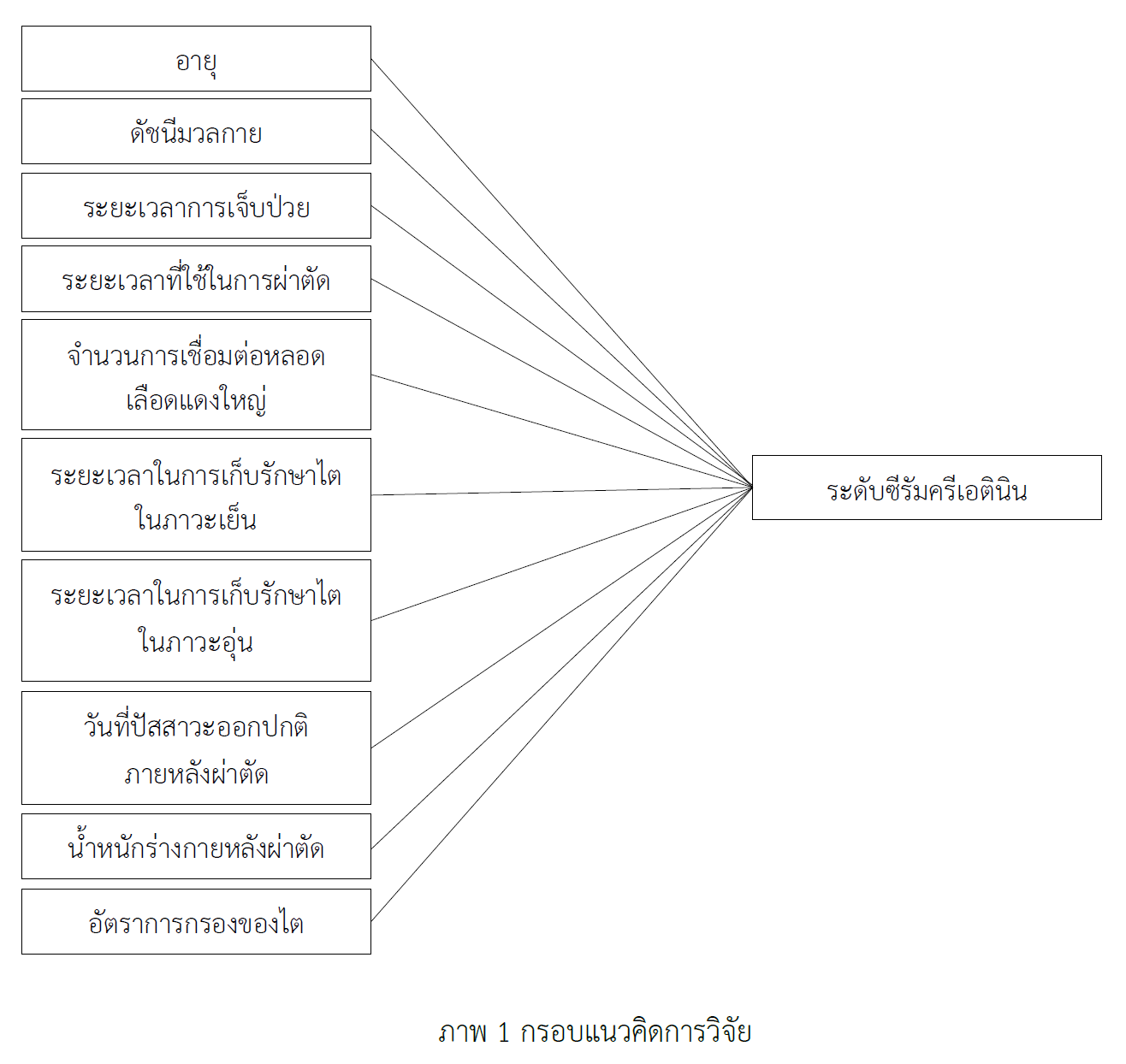
การวิจัยครั้งนี้เป็นการศึกษาแบบย้อนหลัง มีวัตถุประสงค์เพื่อศึกษาความสัมพันธ์ระหว่างอายุ ดัชนีมวลกาย ระยะเวลาการเจ็บป่วย ระยะเวลาที่ใช้ในการผ่าตัด จำนวนการเชื่อมต่อหลอดเลือดแดงใหญ่ ระยะเวลาในการเก็บรักษาไตในภาวะเย็น ระยะเวลาในการเก็บรักษาไตในภาวะอุ่น วันที่ปัสสาวะออกปกติภายหลังผ่าตัด น้ำหนักร่างกายหลังผ่าตัด อัตราการกรองของไต และระดับซีรัมครีเอตินินของผู้รับการปลูกถ่ายไตจากผู้บริจาคสมองตาย เก็บข้อมูลจากเวชระเบียนของผู้เข้ารับการปลูกถ่ายไตจากผู้บริจาคสมองตาย ณ โรงพยาบาลสรรพสิทธิประสงค์ ในช่วงเดือนมกราคม พ.ศ.2560 ถึง เดือนพฤษภาคม พ.ศ.2568 จำนวน 106 คน โดยใช้แบบบันทึกข้อมูล วิเคราะห์ข้อมูลด้วยสถิติพรรณนา และการวิเคราะห์สัมประสิทธิ์สหสัมพันธ์ของเพียร์สัน
ผลการศึกษาพบว่า ปัจจัยที่มีความสัมพันธ์กับระดับซีรัมครีเอตินินของผู้รับการปลูกถ่ายไตจากผู้บริจาคสมองตายอย่างมีนัยสำคัญทางสถิติ ได้แก่ ระยะเวลาในการเก็บรักษาไตในภาวะเย็น (r = -.216, p = .027) วันที่ปัสสาวะออกปกติภายหลังผ่าตัด (r = .382, p = .000) น้ำหนักร่างกายหลังผ่าตัด (r =-.302, p = .002) และอัตราการกรองของไต (r = -.680, p = .000) ในขณะที่อายุ ดัชนีมวลกาย ระยะเวลาการเจ็บป่วย ระยะเวลาที่ใช้ในการผ่าตัด การเชื่อมต่อหลอดเลือดแดงใหญ่ และระยะเวลาในการเก็บรักษาไตในภาวะอุ่นไม่มีความสัมพันธ์กับระดับซีรัมครีเอตินินของผู้รับการปลูกถ่ายไตจากผู้บริจาคสมองตาย
ดังนั้น บุคลากรทางการแพทย์ที่เกี่ยวข้องกับการดูแลรักษาผู้รับการปลูกถ่ายไตจากผู้บริจาคสมองตายควรให้ความสำคัญทั้งในระหว่างขั้นตอนการผ่าตัด โดยควบคุมการเก็บรักษาไตในภาวะเย็นที่เหมาะสม และการดูแลระยะหลังผ่าตัด การดูแลและติดตามให้ปริมาณปัสสาวะอยู่ในเกณฑ์ปกติ การควบคุมน้ำหนักร่างกายหลังผ่าตัดให้เหมาะสม และติดตามอัตราการกรองของไตเป็นระยะเพื่อให้ผู้รับการปลูกถ่ายไตจากผู้บริจาคสมองตายมีคุณภาพชีวิตที่ดีต่อไป
Downloads
เอกสารอ้างอิง
Dube, G. K., Brennan, C., Husain, S. A., Crew, R. J., Chiles, M. C., Cohen, D. J., & Mohan, S. (2019). Outcomes of kidney transplant from deceased donors with acute kidney injury and prolonged cold ischemia time-a retrospective cohort study. Transplant International, 32(6), 646-657. https://doi.org/10.1111/tri.13406
Guinault, D., Del Bello, A., Lavayssiere, L., Nogier, M. B., Cointault, O., Congy, N., . . . Faguer, S. (2019). Outcomes of kidney transplant recipients admitted to the intensive care unit: A retrospective study of 200 patients. BMC Anesthesiology, 19(1), 130. https://doi.org/10.1186/s12871-019-0800-0
Foley, M. E., Vinson, A. J., Skinner, T. A., Kiberd, B. A., & Tennankore, K. K. (2023). The impact of combined warm and cold ischemia time on post-transplant outcomes. Canadian Journal of Kidney Health and Disease, 10, 1-11. https://doi.org/10.1177/20543581231178960
Foroutan, F., Friesen, E. L., Clark, K. E., Motaghi, S., Zyla, R., Lee, Y., . . . Meade, M. O. (2019). Risk factors for 1-year graft loss after kidney transplantation: Systematic review and meta-analysis. Clinical Journal of the American Society of Nephrology, 14(11), 1642-1650. https://doi.org/10.2215/CJN.05560519
Hung, S. C., Kuo, K. L., Peng, C. H., Wu, C. H., Lien, Y. C., Wang, Y. C., & Tarng, D. C. (2014). Volume overload correlates with cardiovascular risk factors in patients with chronic kidney disease. Kidney International, 85(3), 703-709. https://doi.org/10.1038/ki.2013.336
Keddis, M. T., Amer, H., Voskoboev, N., Kremers, W. K., Rule, A. D., & Lieske, J. C. (2016). Creatinine–based and cystatin C–based GFR estimating equations and their non-GFR determinants in kidney transplant recipients. Clinical Journal of the American Society of Nephrology, 11(9), 1640-1649. https://doi.org/10.2215/CJN.11741115
Koh, S. M., Ju, M. K., Huh, K. H., Kim, Y. S., & Kim, M. S. (2020). Serum creatinine level at 1-month posttransplant can independently predict long-term graft survival and functional status. Korean Journal of Transplantation, 34(4), 244-248. https://doi.org/10.4285/kjt.20.0053
Jia, H., Huang, F., Zhang, X., Cheng, J., Chen, J., & Wu, J. (2021). Early perioperative fluid overload is associated with adverse outcomes in deceased donor kidney transplantation. Transplant International, 34(10), 1862-1874. https://doi.org/10.1111/tri.13926
Li, X., Cao, C. X., & Chen, J. (2024). Complications associated with kidney transplantation, causes of graft failure and mortality following kidney transplantation in patients with systemic lupus erythematosus: A meta-analysis. Renal Replacement Therapy, 10(1), 49. https://doi.org/10.1186/s41100-024-00566-8
Liese, J., Bottner, N., Büttner, S., Reinisch, A., Woeste, G., Wortmann, M., . . . Ulrich, F. (2018). Influence of the recipient body mass index on the outcomes after kidney transplantation. Langenbeck's Archives of Surgery, 403(1), 73-82. https://doi.org/10.1007/s00423-017-1584-7
Lum, E., Homkrailas, P., Abdalla, B., Danovitch, G., & Bunnapradist, S. (2023). Cold ischemia time, kidney donor profile index, and kidney transplant outcomes: A cohort study. Kidney Medicine, 5(1), 100570. https://doi.org/10.1016/j.xkme.2022.100570
Malbrain, M. L., Tantakoun, K., Zara, A. T., Ferko, N. C., Kelly, T., & Dabrowski, W. (2024). Urine output is an early and strong predictor of acute kidney injury and associated mortality: A systematic literature review of 50 clinical studies. Annals of Intensive Care, 14(1), 110. https://doi.org/10.1186/s13613-024-01342-x
Neuman, B. (1996). The Neuman systems model in research and practice. Nursing Science Quarterly, 9(2), 67-70. https://doi.org/10.1177/089431849600900207
Ponticelli, C., Reggiani, F., & Moroni, G. (2022). Delayed graft function in kidney transplant: Risk factors, consequences and prevention strategies. Journal of Personalized Medicine, 12(10), 1557. https://doi.org/10.3390/jpm12101557
Prajunphanit, P. (2020). Study on outcomes of deceased-donor kidney transplant patients in Udonthani hospital. Udonthani Hospital Medical Journal, 28(2), 212-219.
Thai Red Cross Society. (2025). Knowledge about organ donation. Retrieved from https://organdonate. redcross.or.th/knowledge
The Official Website of Thai Transplantation Society. (2023). The number of patients awaiting kidney transplantation. Retrieved from https://www.transplantthai.org/?page=donor&pager=1
Yao, Z., Kuang, M., & Li, Z. (2025). Risk factors for delayed graft function in patients with kidney transplantation: A systematic review and meta-analysis. BMJ Open, 15(3), e087128. https://doi.org/10.1136/bmjopen-2024-087128
ดาวน์โหลด
เผยแพร่แล้ว
รูปแบบการอ้างอิง
ฉบับ
ประเภทบทความ
สัญญาอนุญาต
ลิขสิทธิ์ (c) 2025 วารสารพยาบาลตำรวจและวิทยาศาสตร์สุขภาพ

อนุญาตภายใต้เงื่อนไข Creative Commons Attribution-NonCommercial-NoDerivatives 4.0 International License.
ผลงานที่ได้ตีพิมพ์แล้วจะเป็นลิขสิทธิ์ของวารสารพยาบาลตำรวจ