ผลของโปรแกรมเสริมสร้างสมรรถนะแห่งตนของผู้ดูแลต่อการรับรู้สมรรถนะแห่งตนในการดูแลผู้สูงอายุที่ได้รับบาดเจ็บที่ศีรษะระดับเล็กน้อย
คำสำคัญ:
สมรรถนะแห่งตน, การบาดเจ็บที่ศีรษะระดับเล็กน้อย, ผู้สูงอายุบทคัดย่อ
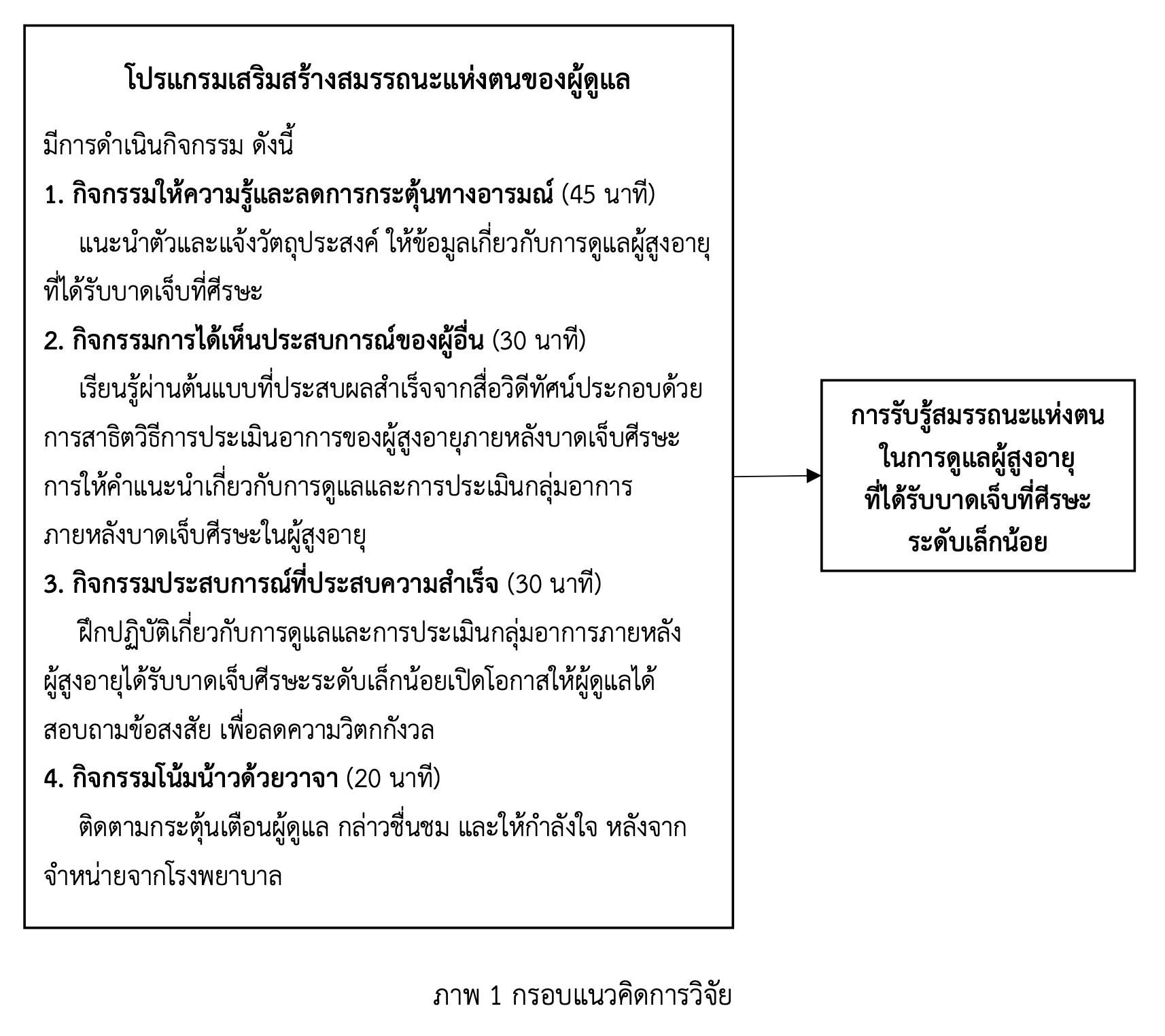
การวิจัยกึ่งทดลองครั้งนี้มีวัตถุประสงค์เพื่อ 1) เปรียบเทียบคะแนนเฉลี่ยการรับรู้สมรรถนะแห่งตนของผู้ดูแลกลุ่มทดลองที่ได้รับโปรแกรมเสริมสร้างสมรรถนะแห่งตนของผู้ดูแลในระยะก่อนและหลังการทดลอง และ 2) เปรียบเทียบคะแนนเฉลี่ยการรับรู้สมรรถนะแห่งตนของผู้ดูแลระหว่างกลุ่มทดลองที่ได้รับโปรแกรมเสริมสร้างสมรรถนะแห่งตนของผู้ดูแลกับกลุ่มควบคุมที่ได้รับการพยาบาลตามปกติในระยะหลังการทดลอง ตัวอย่าง คือ ผู้ดูแลผู้สูงอายุที่ได้รับบาดเจ็บที่ศีรษะระดับเล็กน้อย จำนวน 42 ราย แบ่งเป็นกลุ่มทดลอง 21 ราย และกลุ่มควบคุม 21 ราย โดยกลุ่มควบคุมได้รับการพยาบาลตามมาตรฐาน ส่วนกลุ่มทดลองเข้าร่วมโปรแกรมเสริมสร้างสมรรถนะแห่งตนเป็นระยะเวลา 2 สัปดาห์ เครื่องมือที่ใช้ในการวิจัย ได้แก่ โปรแกรมเสริมสร้างสมรรถนะแห่งตนของผู้ดูแล ประกอบด้วยกิจกรรมการให้ความรู้ การเรียนรู้จากบุคคลอื่น การฝึกปฏิบัติ และการให้กำลังใจ และแบบประเมินการรับรู้สมรรถนะแห่งตนของผู้ดูแลผู้สูงอายุที่ได้รับบาดเจ็บศีรษะระดับเล็กน้อยมีค่าความเที่ยงทั้งฉบับเท่ากับ .86 การวิเคราะห์ข้อมูลด้วยความถี่ ค่าต่ำสุด ค่าสูงสุด ร้อยละ ค่าเฉลี่ย ส่วนเบี่ยงเบนมาตรฐาน Paired t-test และ Independent t-test
ผลการวิจัยพบว่า ผู้ดูแลกลุ่มทดลองที่ได้รับโปรแกรมเสริมสร้างสมรรถนะแห่งตนของผู้ดูแลมีคะแนนเฉลี่ยการรับรู้สมรรถนะแห่งตนของผู้ดูแลในระยะหลังการทดลองสูงกว่าก่อนการทดลอง อย่างมีนัยสำคัญทางสถิติ (M = 140.57, SD = 8.61 และ M = 50.52, SD = 20.31; t = 20.74, p = .000) และคะแนนเฉลี่ยการรับรู้สมรรถนะแห่งตนของผู้ดูแลกลุ่มทดลองสูงกว่ากลุ่มควบคุมที่ได้รับการพยาบาลตามมาตรฐาน อย่างมีนัยสำคัญทางสถิติ (M = 140.57, SD = 8.61 และ M = 85.09, SD = 12.34; t = 16.89, p = .000)
ดังนั้น โปรแกรมเสริมสร้างสมรรถนะแห่งตนของผู้ดูแลมีประสิทธิผลในการเพิ่มการรับรู้สมรรถนะแห่งตนของผู้ดูแลผู้สูงอายุที่ได้รับบาดเจ็บที่ศีรษะระดับเล็กน้อย จึงควรนำโปรแกรมนี้ไปใช้ในหน่วยงานที่ดูแลผู้สูงอายุที่ได้รับบาดเจ็บที่ศีรษะเพื่อเพิ่มประสิทธิภาพในการดูแลและลดความเสี่ยงจากอาการที่อาจเกิดขึ้นหลังการบาดเจ็บ
Downloads
เอกสารอ้างอิง
Albrecht, J. S., Kiptanui, Z., Tsang, Y., Khokhar, B., Liu, X., Simoni-Wastila, L., & Zuckerman, I. H. (2015). Depression among older adults after traumatic brain injury: A national analysis. The American Journal of Geriatric Psychiatry, 23(6), 607-614. https://doi.org/10.1016/j.jagp.2014.07.006
Bandura, A. (1997). Self-efficacy: The exercise of control (11th ed.). W. H. Freeman.
Dehbozorgi, M., Maghsoudi, M. R., Rajai, S., Mohammadi, I., Nejad, A. R., Rafiei, M. A., . . . Bakhtiyari, M. (2024). Depression after traumatic brain injury: A systematic review and Meta-analysis. The American Journal of Emergency Medicine, 86, 21-29. https://doi.org/10.1016/j.ajem.2024.08.039
Department of Older Persons. (2023). General information on the elderly. Retrieved from https://www.dop.go.th/en/know/1
Kalasin Hospital. (2021). Patient injury statistics report, 2016-2020. Accident and Emergency Department, Kalasin Hospital.
Lum, P., Harnirattisai, T., & Tantongtip, D. (2019). The effects of a continuing care program on the perceived self-efficacy of caregivers and post-concussion syndrome in persons with mild traumatic brain injury. Ramathibodi Nursing Journal, 25(1), 58-73. https://he01.tci-thaijo.org/index.php/kcn/article/view/268877/185559
Merchant, R. A., Wojszel, Z. B., & Ryg, J. (2024). The hidden impact of mild-traumatic brain injury in older adults. European Geriatric Medicine, 15(6), 1551-1554. https://doi.org/10.1007/s41999-024-01075-x
Ministry of Public Health. (2024). Falls data in the elderly. Retrieved from https://moph.go.th/
Rooplor, S., Leethongin, M., & Piyawattanapong, S. (2020). Development of a self-efficacy enhancement program for caregivers of elderly with mild traumatic brain injury. In Proceedings of the 21st National Graduate Research Conference (pp. 203-215)
Rooplor, S., Leethong-in, M., & Piyawattanapong, S. (2021). Effects of the self-efficacy enhancing program on the practice behavior of caregivers for the older patients with mild traumatic brain injury after discharge and post-concussion syndrome. Srinagarind Medical Journal, 36(5), 617-624.
Statistical Office Kalasin. (2021). Data from Kalasin Provincial Statistics Office. Retrieved from https://kalasin.nso.go.th/
World Health Organization. (2021). Falls (fact sheet). https://www.who.int/news-room/fact-sheets/detail/falls
Xue, L., Boudreau, R. M., Donohue, J. M., Zgibor, J. C., Marcum, Z. A., Costacou, T., . . . Strotmeyer, E. S. (2021). Persistent polypharmacy and fall injury risk: The health, aging and body composition study. BMC geriatrics, 21(1), 710. https://doi.org/10.1186/s12877-021-02695-9
ดาวน์โหลด
เผยแพร่แล้ว
รูปแบบการอ้างอิง
ฉบับ
ประเภทบทความ
สัญญาอนุญาต
ลิขสิทธิ์ (c) 2025 วารสารพยาบาลตำรวจและวิทยาศาสตร์สุขภาพ

อนุญาตภายใต้เงื่อนไข Creative Commons Attribution-NonCommercial-NoDerivatives 4.0 International License.
ผลงานที่ได้ตีพิมพ์แล้วจะเป็นลิขสิทธิ์ของวารสารพยาบาลตำรวจ