ผลของโปรแกรมดูแลผู้ป่วยโรคหลอดเลือดสมองระยะเปลี่ยนผ่านต่อความพร้อมและภาระในการดูแลของญาติผู้ดูแล
คำสำคัญ:
ความพร้อม, ญาติผู้ดูแล, โปรแกรมดูแลระยะเปลี่ยนผ่าน, ผู้ป่วยโรคหลอดเลือดสมอง, ภาระในการดูแลบทคัดย่อ
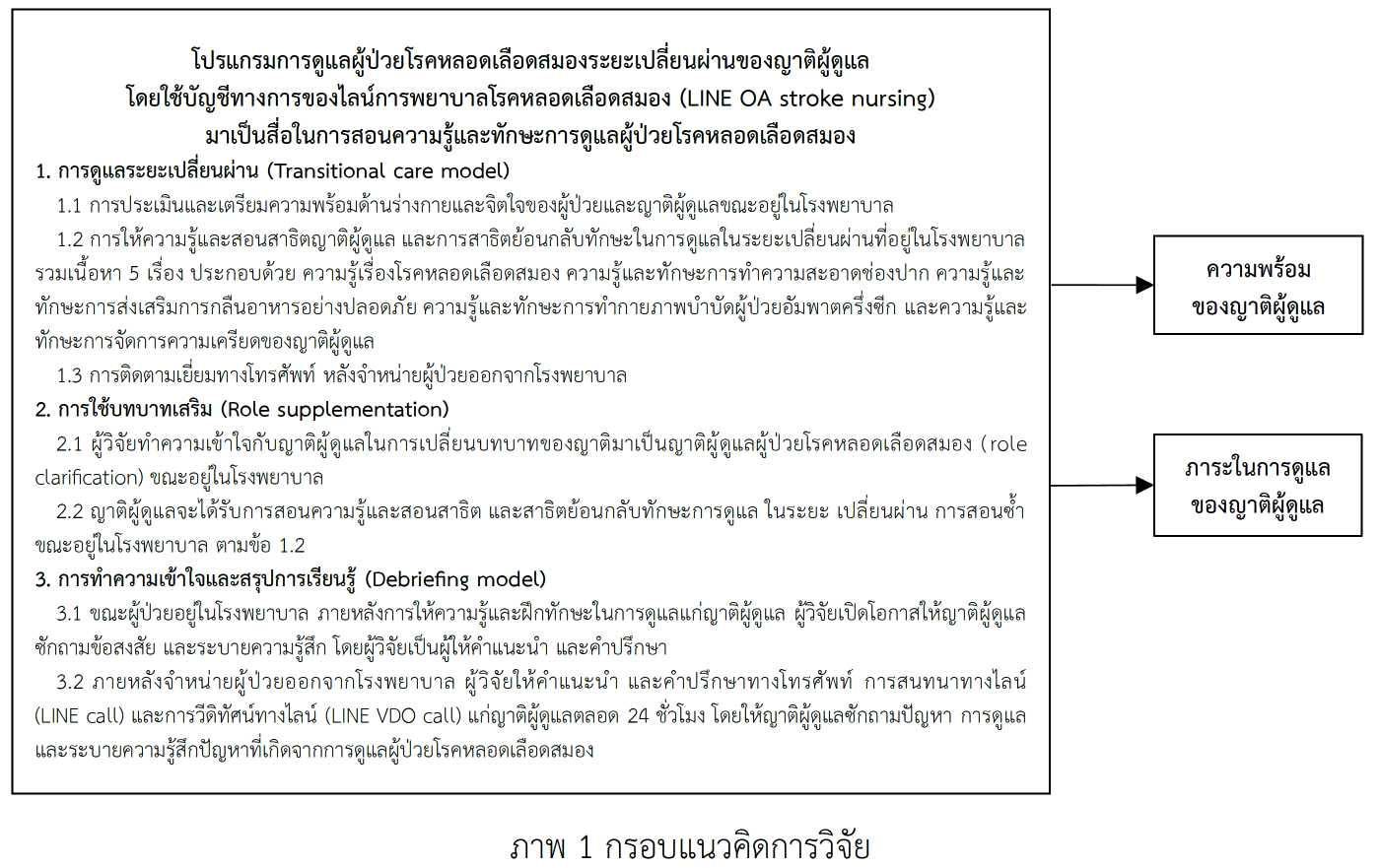
การวิจัยกึ่งทดลองนี้มีวัตถุประสงค์เพื่อศึกษาผลของโปรแกรมดูแลผู้ป่วยโรคหลอดเลือดสมองระยะเปลี่ยนผ่านต่อความพร้อมและภาระในการดูแลของญาติผู้ดูแล กลุ่มตัวอย่างคือญาติผู้ดูแลผู้ป่วยโรคหลอดเลือดสมองที่ได้รับการรักษาในโรงพยาบาลจุฬาลงกรณ์ สภากาชาดไทย ทำการคัดเลือกกลุ่มตัวอย่างแบบเฉพาะเจาะจง กลุ่มควบคุม (n = 28) ได้รับการพยาบาลตามปกติ กลุ่มทดลอง (n = 28) ได้รับการพยาบาลตามปกติร่วมกับโปรแกรมการดูแลผู้ป่วยโรคหลอดเลือดสมองระยะเปลี่ยนผ่านขณะอยู่ในโรงพยาบาลเป็นเวลา 7 วัน และหลังจำหน่ายออกจากโรงพยาบาลติดตามเยี่ยมทางโทรศัพท์เป็นเวลา 6 สัปดาห์ สื่อการสอนญาติผู้ดูแล คือบัญชีทางการของไลน์ประกอบด้วยวีดิทัศน์และอินโฟกราฟฟิก 5 เรื่อง เครื่องมือที่ใช้ในการเก็บรวบรวมข้อมูล ได้แก่ แบบสอบถามความพร้อมในการดูแล และแบบสอบถามภาระในการดูแล วิเคราะห์ข้อมูลโดยใช้สถิติบรรยาย ไคสแควร์ และสถิติที
ผลการวิจัยพบว่า คะแนนเฉลี่ยความพร้อมของญาติผู้ดูแลหลังการทดลอง ในกลุ่มทดลองสูงกว่ากลุ่มควบคุมอย่างมีนัยสำคัญทางสถิติที่ระดับ .05 (t = -14.00, p = .00) คะแนนเฉลี่ยความพร้อมในการดูแลหลังการทดลองในกลุ่มทดลองสูงกว่าก่อนการทดลองอย่างมีนัยสำคัญทางสถิติที่ระดับ .05 (t = -29.86, p = .00) คะแนนเฉลี่ยภาระในการดูแลหลังการทดลองในกลุ่มทดลองต่ำกว่ากลุ่มควบคุมอย่างมีนัยสำคัญทางสถิติที่ระดับ .05 (t = 12.32, p = .00) คะแนนเฉลี่ยภาระในการดูแลหลังการทดลองในกลุ่มทดลองต่ำกว่าก่อนการทดลองอย่างมีนัยสำคัญทางสถิติที่ระดับ .05 (t = 26.38, p = .00) ดังนั้น พยาบาลควรนำโปรแกรมการดูแลผู้ป่วยโรคหลอดเลือดสมองระยะเปลี่ยนผ่านและบัญชีทางการของไลน์ที่พัฒนาขึ้นนี้ไปใช้เพื่อส่งเสริมความพร้อมในการดูแลให้กับญาติผู้ดูแลผู้ป่วยโรคหลอดเลือดสมองต่อไป
Downloads
เอกสารอ้างอิง
Jadboonnak, B. (2019). Development of transitional care program for bedridden elderly patients from hospital to home care. Mahasarakham Hospital Journal, 16(3), 63-71.
Junsiri, P. (2021). Caregiver burden among caregivers of stroke patient in intermediate care service of Kosumpisai hospital. Mahasarakham Hospital Journal, 18(2), 72-80.
King Chulalongkorn Memorial Hospital Stroke unit, Thai Red Cross Society. (2023). Statistics on stroke patients 2021-2023.
Mahoney, F. I., & Barthel, D. W. (1965). Functional evaluation: The Barthel index. Maryland State Medical Journal. 14, 61-65.
Meleis, A. I. (2010). Transitional theory: Middle-range and situation-specific theories in nursing research and practice. New York, NY: Springer.
Nakhornriab, S., Wattanakitkrileart, D., Charoenkitkarn, V., Chotikanuchit, S., & Vanijja, V. (2017). The Effectiveness of mobile application on medication adherence in patients with stroke. Nursing Science Journal of Thailand, 35(3), 58-69.
Polit, D. F., & Beck, C.T. (2021). Nursing research: Generating and assessing evidence for nursing practice (11th ed.). Philadelphia, PA: Wolters Kluwer.
Prasat Neurological Institute. (2015). Clinical nursing practice guideline for stroke (Complete version 2015) (pp. 54-55). Bangkok, Tana Press.
Public health statistics, Ministry of Public Health. (2020). Public health statistics A.D. 2020. Retrieved from https://shorturl.asia/dDUoY
Schumaker, K. L., Stewart, B. J., & Archbold, P. G. (2008). Effect of caregiving demand, mutuality, and preparedness of family caregiver outcome during cancer treatment. Oncology Nursing, 35(1), 49-56.
Seangmanee, S., Arpanantikul, M., & Siripo-ngam, Y. (2013). A case study: Adaptation of a working caregiver to a stroke patient. Ramathibodi Nursing Journal, 18(1), 119-133.
Srisakhot, K., Kuleelung P., Aungvanit, B., Sondos, B., & Sriruksa, S. (2022). Development of integrated discharge-planning programme for stroke patients. Journal of Thailand Nursing and Midwifery Council, 37(3), 20-43.
Stewart, B. J., & Archbold, P. G. (1986). New measures of concepts central to understanding of a caregiving (Unpublished manuscript). School of nursing, Oregon Health & Science University, Portland, Oregon.
Thato, R. (2018). Nursing research: concepts to application (4th ed.). Bangkok: Chulalongkorn University.
Toonsiri, Ch., Sunsern, R., & Lawang, W. (2011). Development of the burden interview for caregivers of patients with chronic illness. Journal of Nursing and Education, 4(1), 62-75.
Wirojratana, V. (2002). Development of the Thai family care inventory (Doctor of Philosophy). School of nursing, Oregon Health & Science University, Portland, Oregon.
Wonginyoo, A., Prasarnnate, R., & Wongcharee, A. (2019). The study of stress and burden of caregivers of stroke patients, Mueang, Udon Thani. Nursing, Health, and Education Journal, 2(4), 40-19.
World Stroke Organization. (2022). Global stroke fact sheet 2022. Retrieved from https://world-stroke-academy.org/media/uploads/2022/02/World-Stroke-Organization-WSO-Global-Stroke-Fact-Sheet-2022.pdf
Zarit, S. H., & Zarit, J. M. (1990). The memory and behavior problems checklist and the burden interview. University Park, PA: Pennsylvania State University, Gerontology Center.
ดาวน์โหลด
เผยแพร่แล้ว
รูปแบบการอ้างอิง
ฉบับ
ประเภทบทความ
สัญญาอนุญาต
ลิขสิทธิ์ (c) 2024 วารสารพยาบาลตำรวจและวิทยาศาสตร์สุขภาพ

อนุญาตภายใต้เงื่อนไข Creative Commons Attribution-NonCommercial-NoDerivatives 4.0 International License.
ผลงานที่ได้ตีพิมพ์แล้วจะเป็นลิขสิทธิ์ของวารสารพยาบาลตำรวจ