การวิเคราะห์องค์ประกอบเชิงสำรวจของแบบประเมินพฤติกรรมการควบคุมระดับน้ำตาลในเลือดของผู้ป่วยโรคเบาหวานชนิดที่ 2 ที่รักษาในโรงพยาบาลกันทรลักษ์ จังหวัดศรีสะเกษ
คำสำคัญ:
พฤติกรรมการควบคุมระดับน้ำตาลในเลือด, โรคเบาหวานชนิดที่ 2, การวิเคราะห์องค์ประกอบเชิงสำรวจบทคัดย่อ
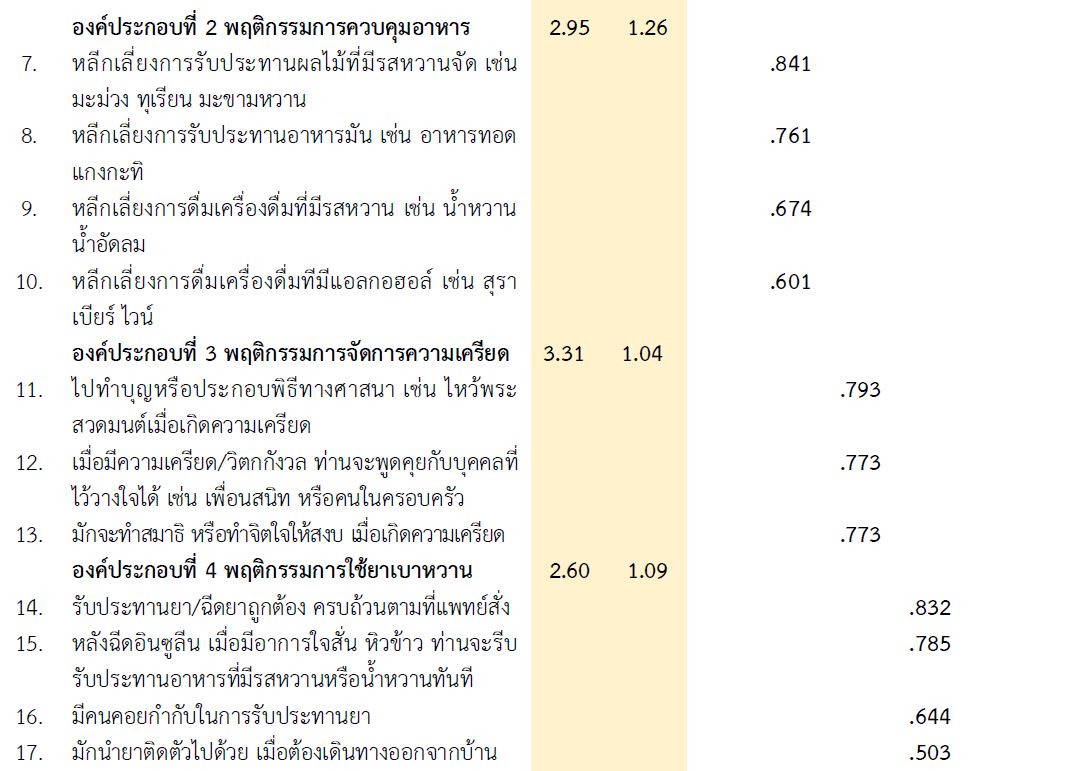
การวิจัยนี้มีวัตถุประสงค์เพื่อวิเคราะห์องค์ประกอบเชิงสำรวจของแบบประเมินพฤติกรรมการควบคุมระดับน้ำตาลในเลือดของผู้ป่วยโรคเบาหวานชนิดที่ 2 ตัวอย่าง คือ ผู้ป่วยโรคเบาหวานชนิดที่ 2 ที่รักษาในโรงพยาบาลกันทรลักษ์ จังหวัดศรีสะเกษ คัดเลือกด้วยวิธีการสุ่มอย่างง่าย จำนวน 210 คน เครื่องมือวิจัยเป็นแบบประเมินพฤติกรรมการควบคุมระดับน้ำตาลของผู้ป่วยโรคเบาหวานชนิดที่ 2 ลักษณะเป็นมาตรประมาณค่าแบบลิเคิร์ท 4 ระดับ มีค่าความตรงเชิงเนื้อหา เท่ากับ .84 - .96 และมีค่าสัมประสิทธิ์แอลฟาของครอนบาค เท่ากับ .90 วิเคราะห์ข้อมูลด้วยการวิเคราะห์องค์ประกอบเชิงสำรวจโดยใช้การหมุนแกนแบบมุมฉากด้วยวิธีแวริแมกซ์
ผลการวิจัย พบว่า พฤติกรรมการควบคุมระดับน้ำตาลในเลือดของผู้ป่วยโรคเบาหวานชนิดที่ 2 มี 5 องค์ประกอบ ดังนี้ 1) พฤติกรรมการออกกำลังกาย 2) พฤติกรรมการจัดการความเครียด 3) พฤติกรรมการควบคุมอาหาร 4) พฤติกรรมการใช้ยาเบาหวาน และ 5) พฤติกรรมการดูแลสุขภาพทั่วไป และมีตัวบ่งชี้วัดทั้งหมด 22 ข้อ มีค่าน้ำหนักองค์ประกอบอยู่ในช่วง .503 - .841 ซึ่งองค์ประกอบทั้งหมดสามารถร่วมกันอธิบายพฤติกรรมการควบคุมระดับน้ำตาลในเลือดของผู้ป่วย ได้ร้อยละ 62.36
Downloads
เอกสารอ้างอิง
Aekplakorn, W., Puckcharern,H., & Satheannoppakao, W. (2021). The 6th survey of Thai public health by physical examination 2019-2020. Retrieved from https://www.rama.mahidol.ac.th/nurturing_talent/sites/default/files/public/img/Researchcamp-bigdata/yr2565/NHES6_Rama_ResearchCamp18May22.pdf
Aekplakorn, W., Chariyalertsak, S., Kessomboon, P., Assanangkornchai, S., Taneepanichskul, S., & Putwatana, P. (2018) Prevalence of diabetes and relationship with socioeconomic status in the Thai population: National health examination survey, 2004–2014. Journal of Diabetes Research, 1654530.
Almomani, M. H., & Al-Tawalbeh, S. (2022). Glycemic control and its relationship with diabetes self-care behaviors among patients with type 2 diabetes in Northern Jordan: A cross-sectional study. Patient Preference and Adherence, 449-465.
Buathongkhamwisat, P., Pinchaleaw, D., & Moolsart, S. (2017). The effectiveness of self-management program on type 2 diabetes patients in Thakor, Maesuai district, Chiang Ria province. Journal of The Police Nurses, 9(1), 105-116.
Buraphunt, R., & Muangsom, N. (2013). Factors affecting uncontrolled type 2 diabetes mellitus of patients in Sangkhom hospital, Udonthani province. KKU Journal for Public Health Research, 6(2), 102-109.
DeVellis, R. F. (2016). Scale development: Theory and applications (4th ed.). Los Angeles, CA: Sage.
Diabetes Association of Thailand. (2017). Clinical practice diabetic guideline 2017. Bangkok: Romyen.
Forjuoh, S. N., Bolin, J. N., Huber Jr, J. C., Vuong, A. M., Adepoju, O. E., Helduser, J. W., . . . Ory, M. G. (2014). Behavioral and technological interventions targeting glycemic control in a racially/ethnically diverse population: A randomized controlled trial. BMC Public Health, 14(1), 1-12.
International Diabetes Federation. (2021). Diabetes Atlas 2021 (10th ed.). The International Diabetes Federation, Annual report.
Lin, S. H., Cheng, P. C., Te Tu, S., Hsu, S. R., Cheng, Y. C., & Liu, Y. H. (2018). Effect of metformin monotherapy on serum lipid profile in statin-naïve individuals with newly diagnosed type 2 diabetes mellitus: A cohort study. PeerJ, 6, e4578.
Saotong, T., Pichayapinyo, P., & Lagampan, S. (2020). Effects of behavior change on glycemic control in type 2 diabetes patients with uncontrolled blood sugar. Journal of Health and Nursing Research, 36(3), 19-32.
Saeedi, P., Petersohn, I., Salpea, P., Malanda, B., Karuranga, S., Unwin, N., . . . IDF Diabetes Atlas Committee. (2019). Global and regional diabetes prevalence estimates for 2019 and projections for 2030 and 2045: Results from the International Diabetes Federation Diabetes Atlas. Diabetes Research and Clinical Practice, 157, 107843.
Sisaket Provincial Public Health Office. (2022). NCD Clinic Plus indicator report 2022. Division of Non-Communicable Diseases, Department of Disease Control, Ministry of Public Health.
Sayuen, C., Phengphol, N., Wannapuek, P., Sonthitham, K., Discharoen, K., Hasiri, N., . . . Chabtakhe, N. (2020). Stress and stress coping of patients with chronic illness in a community, Roi Et province. Journal of Sakon Nakhon Hospital, 23(3), 67-76.
Sharma, K., Akre, S., Chakole, S., & Wanjari, M. B. (2022). Stress-induced diabetes: A Review. Cureus, 14(9), e29142.
Soper, D. S. (2023). A-priori sample size calculator for structural equation models [Software]. Retrieved from https://www.danielsoper.com/statcalc
Sroison, S., Rueanko, A., Ngaoratsame, J., Janwiji, S., Fuongtong, P., & Kaewtankham, K. (2020). Self-care behavior among patients with type 2 diabetes mellitus. Journal of Disease and Health Risk DPC.3, 14(1), 35-47.
Srisatidnarakul, B. (2010). The methodology in nursing research. Bangkok: U&I Inter Media.
Tunsuchart, K., Lerttrakarnnon, P., Srithanaviboonchai, K., Likhitsathian, S., & Skulphan, S. (2020). Type 2 diabetes mellitus related distress in Thailand. International Journal of Environmental Research and Public Health, 17, e2329.
Yom-Tov, E., Feraru, G., Kozdoba, M., Mannor, S., Tennenholtz, M., & Hochberg, I. (2017). Encouraging physical activity in patients with diabetes: intervention using a reinforcement learning system. Journal of Medical Internet Research, 19(10), e338. https://doi.org/10.2196/jmir.7994
World Health Organization. (2016). Global report on diabetes. MEO Design & Communication: Geneva, Switzerland.
ดาวน์โหลด
เผยแพร่แล้ว
รูปแบบการอ้างอิง
ฉบับ
ประเภทบทความ
สัญญาอนุญาต
ลิขสิทธิ์ (c) 2024 วารสารพยาบาลตำรวจและวิทยาศาสตร์สุขภาพ

อนุญาตภายใต้เงื่อนไข Creative Commons Attribution-NonCommercial-NoDerivatives 4.0 International License.
ผลงานที่ได้ตีพิมพ์แล้วจะเป็นลิขสิทธิ์ของวารสารพยาบาลตำรวจ