
ประสบการณ์ชีวิตของมารดาคนอีสานในการส่งเสริมทักษะกระบวนการคิดเชิงบริหารของเด็กก่อนวัยเรียน
คำสำคัญ:
ประสบการณ์ชีวิต, มารดาคนอีสาน, ทักษะกระบวนการคิดเชิงบริหาร, เด็กก่อนวัยเรียน, ปรากฏการณ์วิทยา, ภาคตะวันออกเฉียงเหนือบทคัดย่อ
การศึกษาเชิงปรากฏการณ์วิทยานี้ มีวัตถุประสงค์เพื่อศึกษาประสบการณ์ของมารดาคนอีสานในการส่งเสริมทักษะกระบวนการคิดเชิงบริหารของเด็กก่อนวัยเรียน ผู้ให้ข้อมูลเป็นมารดาคนอีสานที่มีบุตรก่อนวัยเรียนทั้งเพศชายและเพศหญิง อายุระหว่าง 3 - 6 ปี จำนวน 20 คน คัดเลือกแบบเจาะจงตามคุณสมบัติที่กำหนดไว้ เก็บรวบรวมข้อมูลด้วยการสัมภาษณ์เชิงลึกและการบันทึกภาคสนาม วิเคราะห์ข้อมูลด้วยวิธีวิเคราะห์แก่นสาระ และตรวจสอบความน่าเชื่อถือของข้อมูลด้วยการตรวจสอบสามเส้า และการตรวจสอบโดยผู้เชี่ยวชาญและผู้ให้ข้อมูล
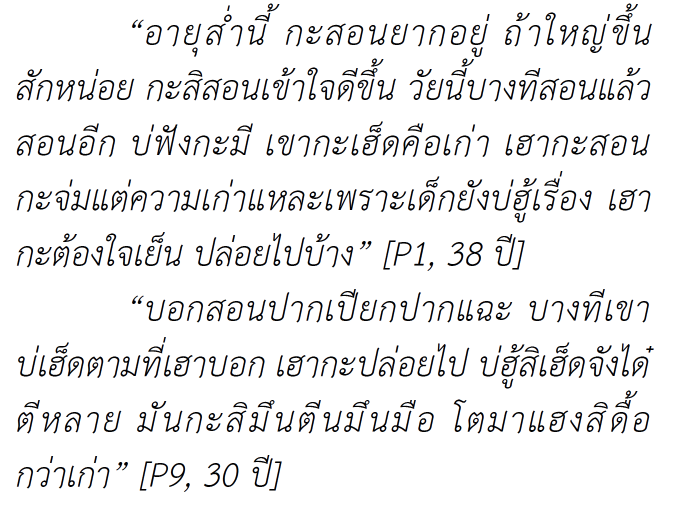
ผลการศึกษาพบว่า มารดาคนอีสานที่มีบุตรก่อนวัยเรียนมีอายุอยู่ระหว่าง 21 - 38 ปี ร้อยละ 60 จบการศึกษาระดับมัธยมศึกษาตอนต้น และร้อยละ 85 มีบุตรมาแล้ว 2 - 3 คน ประสบการณ์ของมารดาคนอีสานในการส่งเสริมทักษะกระบวนการคิดเชิงบริหารของเด็กก่อนวัยเรียน สามารถแบ่งได้เป็น 7 ประเด็น คือ 1) เลี้ยงตามมีตามเกิด ให้เรียนรู้จากสภาพจริง 2) สอนให้คิดอธิบายเหตุผล 3) เป็นแบบอย่างที่ดี 4) บอกสอนชี้แนะเป็นอย่าง ๆ ตามวัย 5) ห้ามปรามว่ากล่าวตักเตือน 6) บอกสอนบ่ฟังความ ต้องถูกตีลงโทษ และ 7) บางเรื่องบอกบ่ฟังกะปล่อยไป
ผลการศึกษาที่ได้ เสนอแนะกลยุทธ์ในการส่งเสริมทักษะกระบวนการคิดเชิงบริหารของเด็กก่อนวัยเรียน โดยให้เด็กได้ใช้เวลาคุณภาพร่วมกับครอบครัวเพื่อเรียนรู้ทักษะชีวิต มารดาเป็นแบบอย่างที่ดี ชี้แนะแนวทางที่ถูกต้อง และรักษาความสมดุลระหว่างการห้ามปรามและการสนับสนุนเด็กให้แสดงออกซึ่งอารมณ์ ความรู้สึก และพฤติกรรม
ที่เหมาะสม
Downloads
เอกสารอ้างอิง
Arsarthong, P., & Palapol, T. (2022). Development models to promote executive functions of early childhood with participation of families and communities in Roi Et province. Thai Red Cross Nursing Journal, 15(2), 266-282.
Brock, L. L., Curby, T. W., & Cannell-Cordier, A. L. (2018). Consistency in children’s classroom experiences and implications for early childhood development. In A. J. Mashburn, J. LoCasale-Crouch, & K. C. Pears (Eds.), Kindergarten transition and readiness. Springer, Cham.
Chukleing, K., Petsate, T., & Khwunma, K. (2019). The development of executive function for preschool children through STEM education learning experience provision on local Thai dessert 4 region cooking activities. Bangkok: Suan Dusit University.
Department of Children and Youth. (2022). Annual report 2021. Department of Children and Youth. Bangkok: S. B. K. printing.
Department of Juvenile Observation and Protection. (2020). Annual statistical report. Bangkok: Department of juvenile observation and protection, Strategy and Planning Division.
Diekelmann, N. L., Allen, D., & Tanner, C. A. (1989). The NLN criteria for appraisal of baccalaureate programs: A critical hermeneutic analysis. New York, NY: National League for Nursing.
Escolano-Pérez, E., Herrero-Nivela, M. L., Blanco-Villaseor, A., & Anguera, M. T. (2017). Systematic observation: Relevance of this approach in preschool executive function assessment and association with later academic skills. Frontiers in Psychology, 8, 2031.
Freud, S. (1994). The social construction of gender. Journal of Adult Development, 1, 37–45.
Heidegger, M. (1962). Being and time. Translate by J. Macquarrie & E. Robinson. Oxford: Blackwell.
Imnamkhao, S., & Siripul, P. (2020). Executive function (EF) in early childhood: A concept analysis. Nursing Journal of the Ministry of Public Health, 30(3), 10-22.
Kansin, S., Mongkolchati, A., & Thinkhamrop, B. (2015). Child rearing practices for children at their first life: Findings from the prospective cohort study of Thai children. Proceedings, International Seminar and Workshop on Public Health Action “Building Healthy Community”. Faculty of Health Sciences, Dian Nuswantoro University.
Lincoln, Y. S., & Guba, E. G. (1985). Naturalistic inquiry. Los Angeles: Sage.
Manubut, T. (2020). Philosophy of Isaan lifestyle values in 4.0 era: Lunar festival and fourteen laws. Sueksitalai Journal, 1(3), 1-14.
Mattera, S., Rojas, N. M., Morris, P. A., & Bierman, K. (2021). Promoting EF with preschool interventions: Lessons learned from 15 years of conducting large-scale studies. Frontiers in Psychology, 12, 640702.
Nghia, P. K. (2018). Becoming a mother: Pregnancy and transformation in English poems written by contemporary mother poets. Thoughts, 1, 90-113.
Phinthong, B., Chaimongkol, N., & Pongjaturawit, Y. (2018). Family factors related to executive function development in preschool children. The Journal of Faculty of Nursing Burapha University, 26(2), 20-29.
Phra Dhampitaka (P.A. Payutto). (2003). Holistic development of Thai children. Bangkok: Buddhist printing house of the Dhammasapa.
Pokam, N., Jantawarit, N., Pakmaluk, W., Phangkam, T., & Suwapong, N. (2022). A development of brain skill, EF (executive functions) with a6 main activities handbook for early childhood in private schools. Journal of Buddhist Philosophy Evolved, 6(1), 204-216.
Rochanavibhata, S. & Marian, V. (2023). Thai and American mothers socialize preschoolers’ emotional development diferently. Scientifc Reports, 13, 12719.
Saripan, S., Phruttikul, S., & Sonboon, C. (2021). Effects of the enhancement kindergarteners’ executive function by using plan-do-review process based on high/scope curriculum. Journal of Education Burapha Universit, 32(3), 56-70.
Seamkhumhom, D., Nookong, A., Rungamornrat, S., & Chutabhakdikul, N. (2019). Factors related to executive functions in preschool-aged children. Thai Journal of Nursing Council, 34(4), 80-94.
Simlee, P., & Samrong, P. (2021). Motherhood in Buddhism. Journal of Modern Learning Development, 6(6), 397-413.
Strategy and Information Division for Provincial Development. (2018). Summary of progress and achievements of projects according to annual government action plan of the province and group of provinces (area) and important government policy projects (agenda) according to the development strategy of Nakhon Phanom province. Nakhon Phanom: Strategy and Information Division for Provincial Development.
Sukadaecha, R. (2020). Child-rearing of Thai families: A systematic integrated literature reviews. Journal of Nursing Science & Health, 43(1), 1-9.
Sulik, M. J., Blair, C., Mills-Koonce, R., Berry, D., Greenberg, M., & Family Life Project Investigators. (2015). Early parenting and the development of externalizing behavior problems: Longitudinal mediation through children's executive function. Child development, 86(5), 1588-1603.
Thisara, P., Chotibang, J., Fongkaew, W., & Jintrawet, U. (2022). Perceptions and experiences of mothers on parenting to promote executive functions in preschool children. Pacific Rim International Journal of Nursing Research, 26(1), 105-120.
Thisara, P., Ponmark, J., Seekhao, P., & Sinlapawitthayathon, B. (2017). Predictive factors of parental behaviors on promoting early childhood development in Phayao province. Journal of Nursing and Health Care, 35(2), 169-176.
Wiriyasoonthorne, K. (2018). The world views reflect from lsaan idioms.Journal of Liberal Arts, Ubon Ratchathani University, 14(2), 249-269.
Xing, X., Wang, M., & Wang, Z. (2018). Parental corporal punishment in relation to children’s executive function and externalizing behavior problems in China. Social Neuroscience, 13(2), 184-189.
ดาวน์โหลด
เผยแพร่แล้ว
รูปแบบการอ้างอิง
ฉบับ
ประเภทบทความ
สัญญาอนุญาต
ลิขสิทธิ์ (c) 2023 วารสารพยาบาลตำรวจ

อนุญาตภายใต้เงื่อนไข Creative Commons Attribution-NonCommercial-NoDerivatives 4.0 International License.
ผลงานที่ได้ตีพิมพ์แล้วจะเป็นลิขสิทธิ์ของวารสารพยาบาลตำรวจ