
ปัจจัยทำนายคุณภาพการเตรียมลำไส้ใหญ่ในผู้ป่วยส่องกล้องตรวจลำไส้ใหญ่ทางทวารหนัก
คำสำคัญ:
การเตรียมลำไส้ใหญ่, ความรอบรู้ด้านสุขภาพ, การจัดการตนเองบทคัดย่อ
การวิจัยนี้เป็นการวิจัยเชิงทำนาย มีวัตถุประสงค์เพื่อศึกษาความสามารถในการทำนายของความรู้ในการเตรียมลำไส้ใหญ่ ความรอบรู้ด้านสุขภาพ การจัดการตนเอง พฤติกรรมการเตรียมลำไส้ใหญ่ และการสื่อสารระหว่างผู้ป่วยและบุคลากรทางการแพทย์ ต่อคุณภาพการเตรียมลำไส้ใหญ่ในผู้ป่วยส่องกล้องตรวจลำไส้ใหญ่ทางทวารหนัก ตัวอย่าง คือ ผู้ป่วยนอกที่เข้ารับการตรวจลำไส้ใหญ่โดยการส่องกล้องทางทวารหนัก โรงพยาบาลบริการทางการแพทย์ตติยภูมิระดับสูง จำนวน 193 คน เก็บรวบรวมข้อมูลโดยใช้แบบประเมินความรู้ในการเตรียมลำไส้ใหญ่ แบบประเมินความรอบรู้ด้านสุขภาพ แบบประเมินการจัดการตนเอง แบบประเมินพฤติกรรมการเตรียมลำไส้ใหญ่ แบบประเมินการสื่อสารระหว่างผู้ป่วยและบุคลากรทางแพทย์ และแบบประเมินคุณภาพการเตรียมลำไส้ใหญ่ ซึ่งมีความเที่ยงจากการวิเคราะห์สัมประสิทธิ์แอลฟาของครอนบาคเท่ากับ .70, .94, .83, .79 และ .94 ตามลำดับ วิเคราะห์ข้อมูลโดยใช้การวิเคราะห์ถดถอยโลจิสติกทวิแบบเชิงชั้น
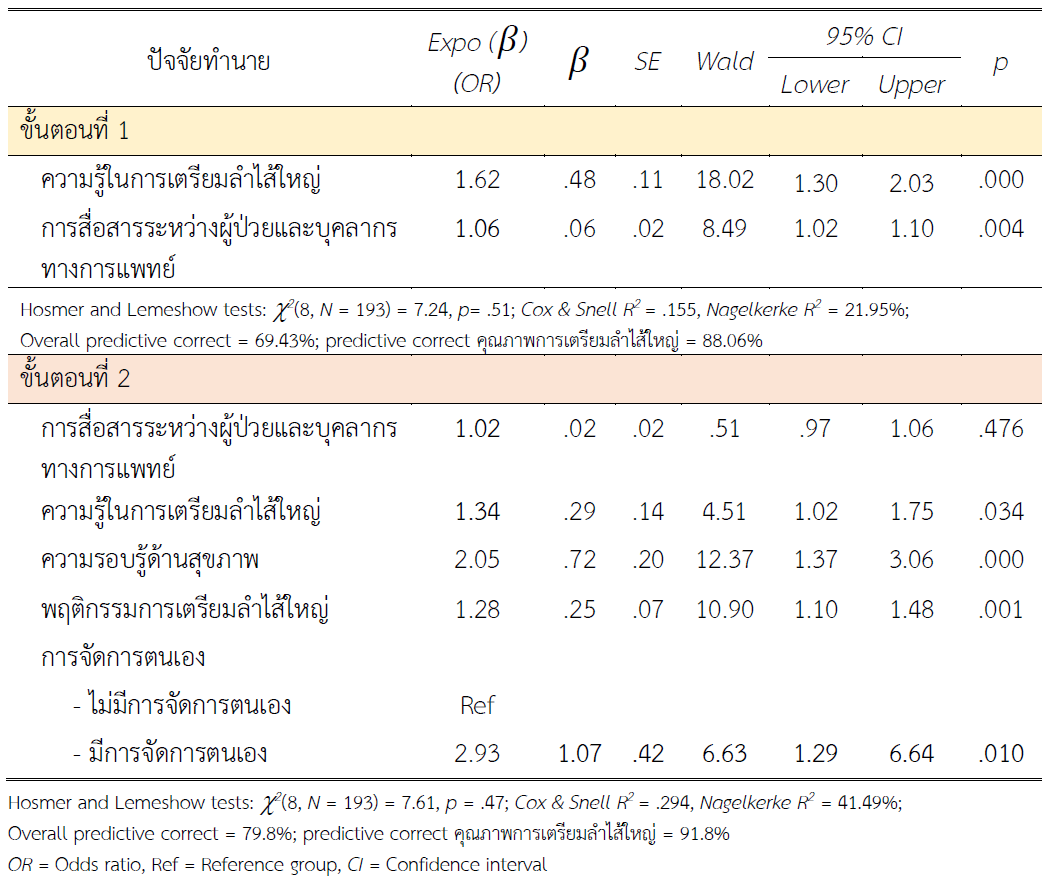
ผลการวิจัยพบว่า ผู้ป่วยที่มีการจัดการตนเอง มีความรอบรู้ด้านสุขภาพระดับดี มีความรู้ในการเตรียมลำไส้ใหญ่ระดับดี และมีพฤติกรรมการเตรียมลำไส้ใหญ่ระดับดี มีโอกาสเตรียมลำไส้ใหญ่สะอาดเพิ่มขึ้น 2.93, 2.05, 1.34 และ 1.28 เท่า ตามลำดับ ส่วนการสื่อสารระหว่างผู้ป่วยและบุคลากรทางแพทย์ไม่สามารถทำนายคุณภาพการเตรียมลำไส้ใหญ่ได้
ดังนั้น บุคลากรทางแพทย์ควรส่งเสริมให้ผู้ป่วยส่องกล้องตรวจลำใหญ่ทางทวารหนักมีการจัดการตนเอง ความรอบรู้ด้านสุขภาพ ความรู้และพฤติกรรมในการเตรียมลำไส้ใหญ่ เพื่อให้ผู้ป่วยเตรียมลำไส้ใหญ่ได้อย่างมีคุณภาพ
Downloads
เอกสารอ้างอิง
Bhanthumkomol, P., Siramolpiwat, S., & Vilaichone, R. K. (2014). Incidence and predictors of inadequate bowel preparation before elective colonoscopy patients. Asian Pacific of Cancer Prevention, 15(24), 10763-10768. https://doi.org/10.7314/ apjcp.2014.15.24.10763.
Budhwani, H., Gakumo, C. A., Yigit, I., Rice, W. S., Fletcher, F. E., Whitfield, S., . . . Turan, J. M. (2022). Patient health literacy and communication with providers among women living with HIV: A mixed methods study. AIDS and Behavior, 26(5), 1422-1430. https://doi.org/10.1007/s10461-021-03496-2
Buttapim, S., Wanitkun, N., Sinthu, S., & Kasemsan, C. (2018). Predictive factors of patients’ quality of life three months after post coronary artery bypass graft surgery. Thai Journal of Cardio-Thoracic Nursing, 29(2), 127-140.
Calderwood, A. H., & Jacobson, B. C. (2010). Comprehensive validation of the Boston bowel preparation scale. Gastrointest Endoscopy, 72(4), 686-692. https://doi.org/10.1016/j.gie.2010.06.068
Constand, M. K., MacDermid, J. C., Dal Bello-Haas, V., & Law, M. (2014). Scoping review of patient-centered care approaches in healthcare. BMC Health Services Research, 14(1), 271. https://doi.org/10.1186/1472-6963-14-271
Choocherd, S., Wanitkun, N., Danaidusadeekul, S., & Yottasurodom, C. (2016). Relationships among health literacy, severity of disease, patient engagement, perception of person-centered care and quality of life in patients after coronary artery bypass graft surgery. Nursing Science Journal of Thailand, 34(2), 94–106.
Donabedian, A. (1988). The quality of care: how can it be assessed? JAMA, 260(12), 1743-1748. https://doi.org/10.1001/jama.1988.03410120089033
Fang, J., Fu, H. Y., Ma, D., Wang, D., Liu, Y. P., Wang, Y. F., . . . Li, Z. S. (2016). Constipation, fiber intake and non-compliance contribute to inadequate colonoscopy bowel preparation: a prospective cohort study. Journal of Digestive Diseases, 17(7), 458-463. https://doi.org/10.1111/1751-2980.12376
Gandhi, K., Tofani, C., Sokach, C., Patel, D., Kastenberg, D., & Daskalakis, C. (2018). Patient characteristics associated with quality of colonoscopy preparation: A systematic review and meta-analysis. Clinical Gastroenterology and Hepatology, 16,357-369. https://doi.org/10.1016/j.cgh.2017.08.016
Gellert, P., & Tille, F. (2015). What do we know so far? The role of health knowledge within theories of health literacy. European Health Psychologist, 17(6), 266-274.
Greene, J., Hibbard, J. H., Sacks, R., Overton, V., & Parrotta, C. D. (2015). When patient activation levels change, health outcomes and costs change, too. Health Affairs, 34, 431-437. https://doi.org/ 10.1377/hlthaff.2014.0452
Hassan, C., East, J., Radaelli, F., Spada, C., Benamouzig, R., Bisschops, R., . . . Ferlitsch, M. (2019). Bowel preparation for colonoscopy: European Society of Gastrointestinal Endoscopy (ESGE) guideline-update 2019. Endoscopy, 51(8), 775-794. https://doi.org/10.1055/a-0959-0505
Hibbard, J. H., & Greene, J. (2013). What the evidence shows about patient activation: Better health outcomes and care experiences; fewer data on costs. Health Affairs, 32(2), 207-214. https://doi.org/10.1377/hlthaff.2012.1061
Hibbard, J. H., Stockard, J., Mahoney, E. R., & Tusler, M. (2004). Development of the patient activation measure: Conceptualizing and measuring activation in patients and consumers. Health Services Research, 39(4p1), 1005-1026. https://doi.org/10.1111/j.1475-6773.2004.00269.x
Hong, H., & Oh, H. J. (2020). The effects of patient-centered communication: Exploring the mediating role of trust in healthcare providers. Health Communication, 35(4), 502-511. https://doi.org/10.1080/10410236.2019.1570427
Hosmer Jr, D. W., Lemeshow, S., & Sturdivant, R. X. (2013). Applied logistic regression (Vol. 398). John Wiley & Sons.
Jacobson, B. C., & Calderwood, A. H. (2020). Measuring bowel preparation adequacy in colonoscopy-based research: Review of key considerations. Gastrointestinal Endoscopy, 91(2), 248-256. https://doi.org/10.1016/j.gie.2019.09.031
King-Marshall, E. C., Mueller, N., Dailey, A., Barnett, T. E., George, T. J., Sultan, S., & Curbow, B. (2016). It is just another test they want to do: Patient and caregiver understanding of the colonoscopy procedure. Patient Education and Counseling, 99(4), 651-658. https://doi.org/10.1016/j.pec.2015.10.021
Kunnackal, J. G., Thuluvath, A. J., Carrier, H., Ahuja, N. K., Gupta, E., & Stein, E. (2019). Poor health literacy and medication burden are significant predictors for inadequate bowel preparation in an urban tertiary care setting. Journal of Clinical Gastroenterology, 53(9), e382-e386. https://doi.org/10.1097/mcg.0000000000001177
Martel, M., Ménard, C., Restellini, S., Kherad, O., Almadi, M., Bouchard, M., & Barkun, A. N. (2018). Which patient-related factors determine optimal bowel preparation? Current Treatment Options in Gastroenterology, 16(4), 406-416. https://doi.org/10.1007/s11938-018-0208-9
McCormack, B., Dewing, J., Breslin, L., Coyne-Nevin, A., Kennedy, K., Manning, M., . . . Slater, P. (2010). Developing person-centred practice: Nursing outcomes arising from changes to the care environment in residential settings for older people. International Journal of Older People Nursing, 5(2), 93-107. https://doi.org/10.1111/j.1748-3743.2010.00216.x
National Cancer Institute. (2023). Screening guidelines Colorectal cancer using the FIT Test method and colonoscopy data recording in the ODS system. Retrieved from https://shorturl. asia/wvIjM
Plichta, S. B., Kelvin, E. A., & Munro, B. H. (2013). Munro's statistical methods for health care research (6th ed.). Wolters Kluwer Health/Lippincott Williams & Wilkins.
Ray, P., Le Manach, Y., Riou, B., & Houle, T. T. (2010). Statistical evaluation of a biomarker. Anesthesiology, 112(4), 1023–1040. https://doi.org/10.1097/ALN.0b013e3181d47604
Sachdev, R., Mo, K., Wang, K. Y., Zhang, B., Musharbash, F. N., Vadhera, A., . . . Neuman, B. J. (2023). Preoperative patient activation predicts minimum clinically important difference for PROMIS pain and physical function in patients undergoing elective spine surgery. The spine journal: official journal of the North American Spine Society, 23(1), 85–91. https://doi.org/10.1016/j.spinee.2022.08.007
Salt, E., Crofford, L. J., Studts, J. L., Lightfoot, R., & Hall, L. A. (2013). Development of a quality of patient-health care provider communication scale from the perspective of patients with rheumatoid arthritis. Chronic Illness, 9(2), 103–115. https://doi.org/10.1177/1742395312455440
Schub, T. B., & March, P. P. (2018). Colonoscopy. In. Ipswich, Massachusetts: EBSCO Publishing.
Serper, M., Gawron, A. J., Smith, S. G., Pandit, A. A., Dahlke, A. R., Bojarski, E. A., . . . Wolf, M. S. (2014). Patient factors that affect quality of colonoscopy preparation. Clinical Gastroenterology and Hepatology: The Official Clinical Practice Journal of the American Gastroenterological Association, 12(3), 451–457. https://doi.org/10.1016/j.cgh.2013.07.036
Shafer, L. A., Walker, J. R., Waldman, C., Yang, C., Michaud, V., Bernstein, C. N., . . . Singh, H. (2018). Factors associated with anxiety about colonoscopy: The preparation, the procedure, and the anticipated findings. Digestive diseases and sciences, 63(3), 610–618. https://doi.org/10.1007/s10620-018-4912-z
Smith, S. G., von Wagner, C., McGregor, L. M., Curtis, L. M., Wilson, E. A., Serper, M., & Wolf, M. S. (2012). The influence of health literacy on comprehension of a colonoscopy preparation information leaflet. Diseases of the colon and rectum, 55(10), 1074–1080. https://doi.org/10.1097/DCR.0b013e31826359ac
Sorensen, K., Van den Broucke, S., Fullam, J., Doyle, G., Pelikan, J., Slonska, Z., . . . (HLS-EU) Consortium Health Literacy Project European. (2012). Health literacy and public health: A systematic review and integration of definitions and models. BMC Public Health, 12, 1-3. https://doi.org/10.1186/1471-2458-12-80
Stevens, J. (2002). Applied multivariate statistics for the social sciences (4th ed.). Mahwah, N.J.: Lawrence Erlbaum Associates.
Trongsakul, S., Lambert, R., Clark, A., Wongpakaran, N., & Cross, J. (2015). Development of the Thai version of Mini-Cog, a brief cognitive screening test. Geriatrics & Gerontology International, 15(5), 594–600. https://doi.org/10.1111/ggi.12318
Underhill, M. L., & Kiviniemi, M. T. (2012). The association of perceived provider-patient communication and relationship quality with colorectal cancer screening. Health Education & Behavior: The Official Publication of the Society for Public Health Education, 39(5), 555-563. https://doi.org/10.1177/1090198111421800
Wanitkun, N., Pattaramongkolrit, S., Vichathai, C., Bhechrung, B., Kloyahem, S., Batterham, R., Osbon, R. (2014). Thai health literacy. Health System Research Institute. Retrieved from http://kb.hsri.or.th/dspace/handle/11228/3987
Yadlapati, R., Johnston, E. R., Gregory, D. L., Ciolino, J. D., Cooper, A., & Keswani, R. N. (2015). Predictors of inadequate inpatient colonoscopy preparation and its association with hospital length of stay and costs. Digestive Diseases and Sciences, 60(11), 3482-3490. https://doi.org/10.1007/s10620-015-3761-2
ดาวน์โหลด
เผยแพร่แล้ว
รูปแบบการอ้างอิง
ฉบับ
ประเภทบทความ
สัญญาอนุญาต
ลิขสิทธิ์ (c) 2023 วารสารพยาบาลตำรวจ

อนุญาตภายใต้เงื่อนไข Creative Commons Attribution-NonCommercial-NoDerivatives 4.0 International License.
ผลงานที่ได้ตีพิมพ์แล้วจะเป็นลิขสิทธิ์ของวารสารพยาบาลตำรวจ