
ปัจจัยทำนายการเกิดอาการผิดปกติของระบบประสาทส่วนปลายจากเคมีบำบัดในผู้ป่วยมะเร็งลำไส้ใหญ่และไส้ตรงที่ได้รับการรักษาด้วยยาเคมีบำบัด
คำสำคัญ:
กิจกรรมทางกาย, ความเครียด, ความรอบรู้ด้านสุขภาพ, มะเร็งลำไส้ใหญ่และไส้ตรง, อาการผิดปกติของระบบประสาทส่วนปลายจากเคมีบำบัดบทคัดย่อ
การศึกษาวิจัยนี้เป็นการศึกษาหาความสัมพันธ์เชิงทำนาย เพื่อศึกษาความสามารถในการทำนายของอายุ ความเครียด กิจกรรมทางกาย และความรอบรู้ด้านสุขภาพ ต่อการเกิดอาการผิดปกติของระบบประสาทส่วนปลายจากเคมีบำบัด (CIPN) ในผู้ป่วยมะเร็งลำไส้ใหญ่และไส้ตรงที่อยู่ระหว่างรับการรักษาด้วยยาเคมีบำบัด ตัวอย่างประกอบด้วยผู้ป่วยมะเร็งลำไส้ใหญ่และไส้ตรง จำนวน 102 รายที่มารับบริการที่หน่วยให้ยาเคมีบำบัดในโรงพยาบาลตติยภูมิ 2 แห่ง ในเขตกรุงเทพมหานคร เครื่องมือวิจัยประกอบด้วย แบบประเมิน CIPN (EORTC QLQ CIPN 20) แบบประเมินความเครียด (Stress test-5) และแบบสอบถามกิจกรรมทางกาย (IPAQ) มีค่าความเชื่อมั่นด้วยวิธี Cronbach's alpha เท่ากับ .86, .83 และ .93 และแบบสอบถามความรอบรู้ด้านสุขภาพ ซึ่งผ่านการทดสอบซ้ำ (Test-retest Reliability) ด้วยวิธีสัมประสิทธิ์ภายในชั้น (Intraclass Correlation Coefficient: ICC) เท่ากับ .85 วิเคราะห์ข้อมูลโดยใช้สถิติเชิงพรรณนา และการวิเคราะห์การถดถอยโลจิสติคแบบขั้นตอนเดียว (Enter Method)
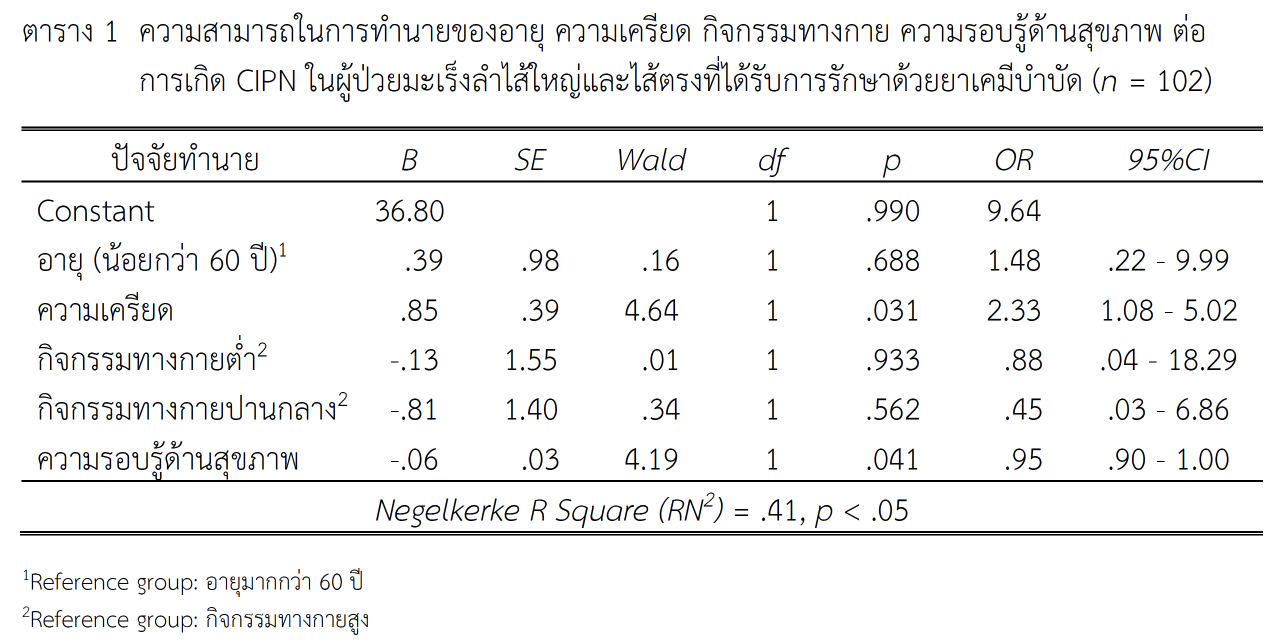
ผลการวิจัยพบว่าผู้ป่วยมะเร็งลำไส้ใหญ่และไส้ตรงที่ได้รับการรักษาด้วยยาเคมีบำบัด มีอาการผิดปกติของระบบประสาทส่วนปลายจากยาเคมีบำบัดในระดับน้อย (Mdn = 7.02, IQR = 9.72) ร้อยละ 90.2 มีความเครียดระดับน้อย ร้อยละ 81.37 มีกิจกรรมทางกายระดับปานกลาง ร้อยละ 55.88 และความรอบรู้ด้านสุขภาพสูงร้อยละ 81.37 ซึ่งอายุ ความเครียด กิจกรรมทางกาย และความรอบรู้ด้านสุขภาพ สามารถร่วมกันทำนายอาการผิดปกติของระบบประสาทส่วนปลายจากเคมีบำบัดในผู้ป่วยมะเร็งลำไส้ใหญ่และไส้ตรงที่ได้รับการรักษาด้วยยาเคมีบำบัดได้ร้อยละ 41 (Negelkerke R2= .41, p < .05) และมีเพียงความเครียด (OR = 2.33, 95%CI = 1.08 - 5.02, p = .031) และความรอบรู้ด้านสุขภาพ (OR = .95, 95%CI = .90 - 1.00, p = .041) เท่านั้นที่สามารถทำนายอาการผิดปกติของระบบประสาทส่วนปลายจากเคมีบำบัดในผู้ป่วยมะเร็งลำไส้ใหญ่และไส้ตรงที่ได้รับการรักษาด้วยยาเคมีบำบัดได้อย่างมีนัยสำคัญทางสถิติ
ผลการศึกษาครั้งนี้จึงเสนอแนะให้ พยาบาลและทีมสุขภาพควรประเมินความเครียด ความรอบรู้ด้านสุขภาพ และอาการผิดปกติของระบบประสาทส่วนปลายจากเคมีบำบัด รวมทั้งจัดการลดความเครียดและส่งเสริมความรอบรู้ด้านสุขภาพเพื่อลดโอกาสเกิดอาการผิดปกติของระบบประสาทส่วนปลายจากเคมีบำบัดในผู้ป่วยมะเร็งลำไส้ใหญ่และไส้ตรงที่ได้รับการรักษาด้วยยาเคมีบำบัด
Downloads
เอกสารอ้างอิง
Alejandro, L., Behrendt, C. E., Chen, K., Openshaw, H., & Shibata, S. (2013). Predicting acute and persistent neuropathy associated with oxaliplatin. American journal of clinical oncology, 36(4), 331-337.
Altaf, R., Brixen, A. L., Kristensen, B., & Nielsen, S. E. (2014). Incidence of cold-induced peripheral neuropathy and dose modification of adjuvant oxaliplatin-based chemotherapy for patients with colorectal cancer. Oncology, 87(3), 167-172.
Dekker, E., Tanis, J. P., Vleugels, A. J., Kasi, M. P., & Wallace, B. M. (2019). Colorectal cancer. Lancet, 394(1), 1467-1480.
Fernandez, S., Franklin, J., Amlani, N., DeMilleVille, C., Lawson, D., & Smith, J. (2015). Physical activity and cancer: A cross-sectional study on the barriers and facilitators to exercise during cancer treatment. Canadian Oncology Nursing Journal /Revue canadienne de soins infirmiers en oncologie, 25(1), 37-42.
Han, J. W., & Sangsook, H. A. N. (2015). Type of chemotherapy-induced peripheral neuropathy, influencing factors, and functional status. Iranian Journal of Public Health, 44(12), 1701.
Hsu, S. Y., Huang, W. S., Lee, S. H., Chu, T. P., Lin, Y. C., Lu, C.H., . . . Jane, S. W. (2019). Incidence, severity, longitudinal trends and predictors of acute and chronic. Oxaliplatin-Induced peripheral neuropathy in Taiwanese patients with colorectal cancer. European Journal of Cancer Care, 28(2), 12976-12987.
International Physical Activity Questionnaire (IPAQ). (2005). IPAQ scoring protocol. Retrieved from https://sites.google.com/site/theipaq/scoring-protocol
Jiwpanya, S., Saneha, C., Puwarawuttipanit, W., & Danchaivijitr, P. (2021). Factors predicting chemotherapy induced peripheral neuropathy in breast cancer patients receiving neurotoxic chemotherapy. Chula Medical Journal, 65(2), 155-163.
Kanda, K., Fujimoto, K., & Kyota, A. (2017). Emotional responses to persistent chemotherapy-induced peripheral neuropathy experienced by patients with colorectal cancer in Japan. Asia-Pacific Journal of Oncology Nursing, 4(3), 233-240.
Kleckner, I., Jusko, T., Culakova, E., Kleckner, A., Asare, M., Inglis, J. E., . . . Mustian, K. M. (2020). Inflammatory and clinical risk factors for CIPN: A nationwide longitudinal study in 143 cancer patients during chemotherapy. Journal of Clinical Oncology, 38(15), 12099-13004.
Lenz, E. R., Pugh, L. C., Milligan, R. A., Gift, A., & Suppe, F. (1997). The middle-range theory of unpleasant symptoms: An update. Advances in Nursing Science, 19(3), 14-27.
Miaskowski, C., Paul, S. M., Mastick, J., Abrams, G., Topp, K., Smoot, B., . . . Levine, J. D. (2018). Associations between perceived stress and chemotherapy-induced peripheral neuropathy and otoxicity in adult cancer survivors. Journal of Pain and Symptom Management, 56(1), 88-97.
Mols, F., Beijers, A. J., Vreugdenhil, G., Verhulst, A., Schep, G., & Husson, O. (2015). Chemotherapy-induced peripheral neuropathy, physical activity and health-related quality of life among colorectal cancer survivors from the PROFILES registry. Journal of Cancer Survivorship, 9(3), 512-522.
Nagaraja, A. S., Sadaoui, N. C., Dorniak, P. L., Lutgendorf, S. K., & Sood, A. K. (2016). SnapShot: Stress and disease. Cell Metabolism, 23(2), 388-388.
Napaporn, W., Suchada, P., Jare, W., Budsara, P., Sanchon, K., Roy, B., & Richard, O. (2014). Health literacy. Health Systems Research Institute.
Oken, M. M., Creech, R. H., Tormey, D. C., Horton, J., Davis, T. E., McFadden, E. T., & Carbone, P. P. (1982). Toxicity and response criteria of the Eastern Cooperative Oncology Group. American journal of clinical oncology, 5(6), 649-656.
Ottaiano, A., Nappi, A., Tafuto, S., Nasti, G., De Divitiis, C., Romano, C., . . . Iaffaioli, V. R. (2016). Diabetes and body mass index are associated with neuropathy and prognosis in colon cancer patients treated with capecitabine and oxaliplatin adjuvant chemotherapy. Oncology, 90(1), 36-42.
Papadakos, J. K., Hasan, S. M., Barnsley, J., Berta, W., Fazelzad, R., Papadakos, C. J., . . . Howell, D. (2018). Health literacy and cancer self-management behaviors: A scoping review. Cancer, 124(21), 4202-4210.
Postma, T. J., Aaronson, N. K., Heimans, J. J., Muller, M. J., Hildebrand, J. G., Delattre, J. Y., . . . EORTC Quality of Life Group. (2005). The development of an EORTC quality of life questionnaire to assess chemotherapy-induced peripheral neuropathy: The QLQ-CIPN20. European journal of cancer, 41(8), 1135-1139.
Prasertsri, N., Teeyapan, W., Leavngsomnopa, Y., Wamalun, C. (2015). Nurse’s role in caring of chemotherapy-induced peripheral neuropathy patients. Nursing Journal of The Ministry of Public Health, 25(3), 1-13.
Pulvers, J. N., & Marx, G. (2017). Factors associated with the development and severity of oxaliplatin-induced peripheral neuropathy: A systematic review. Asia-Pacific Journal of Clinical Oncology, 13(6), 345-355.
Rohrl, K., Guren, M. G., Smastuen, M. C., & Rustoen, T. (2019). Symptoms during chemotherapy in colorectal cancer patients. Supportive Care in Cancer, 27(8), 3007-3017.
Silpakit, O. (2008). Srithanya stress scale. Journal of Mental Health of Thailand, 16(3), 177-185.
Soveri, L. M., Lamminmaki, A., Hanninen, U. A., Karhunen, M., Bono, P., & Osterlund, P. (2019). Long-term neuropathy and quality of life in colorectal cancer patients treated with oxaliplatin containing adjuvant chemotherapy. Acta Oncologica, 58(4), 398-406.
Trongakul, S., Lambert, R., Clark, A., Wongparan, N., & Cross, J. (2015). Development of the Thai version of mini-cog, a brief cognitive screening test. Geriatrics and Gerontology International, 15(5), 594-600.
United Nations Economic Commission for Europe. (2019). 2018 Active ageing index. Retrieved from https://www.unece.org/populations/publications/active-ageing-index-analytical-report
World Health Organization. (2020). Global cancer observatory. Retrieved from https://gco.iarc.fr
Yoon, Y. J., & Park, J. S. (2019). Factors influencing peripheral neuropathy of cancer patients undergoing chemotherapy. Asian Oncology Nursing, 19(2), 71-80.
Zajaczkowska, R., Kocot, K. M., Leppert, W., Wrzosek, A., Mika, J., & Wordliczek, J. (2019). Mechanisms of chemotherapy-induced peripheral neuropathy. International journal of molecular sciences, 20(6), 1451-1480.
ดาวน์โหลด
เผยแพร่แล้ว
รูปแบบการอ้างอิง
ฉบับ
ประเภทบทความ
สัญญาอนุญาต
ลิขสิทธิ์ (c) 2022 วารสารพยาบาลตำรวจ

อนุญาตภายใต้เงื่อนไข Creative Commons Attribution-NonCommercial-NoDerivatives 4.0 International License.
ผลงานที่ได้ตีพิมพ์แล้วจะเป็นลิขสิทธิ์ของวารสารพยาบาลตำรวจ