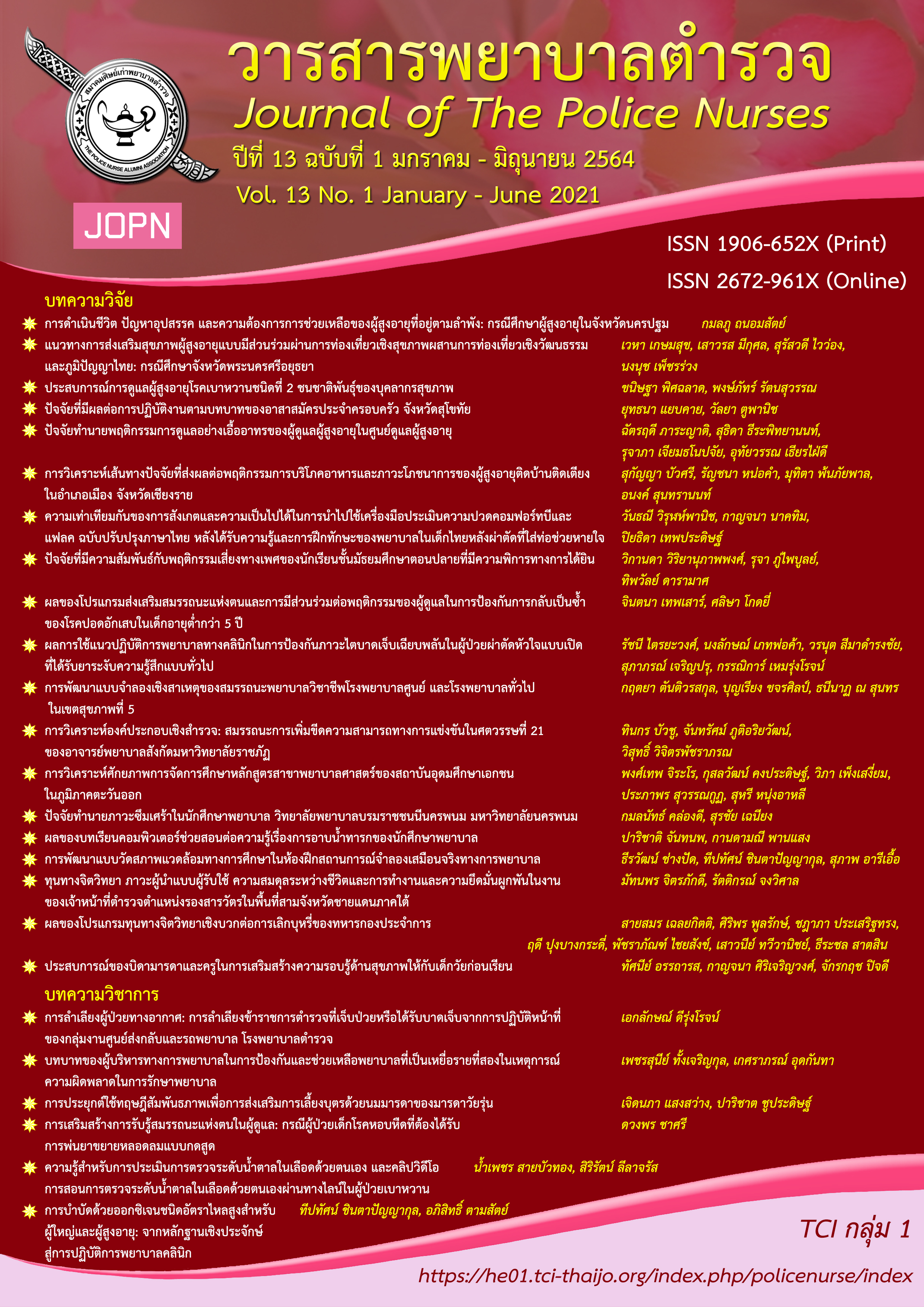
ปัจจัยทำนายภาวะซึมเศร้าในนักศึกษาพยาบาล วิทยาลัยพยาบาลบรมราชชนนีนครพนม มหาวิทยาลัยนครพนม
คำสำคัญ:
ภาวะซึมเศร้า, ความเครียด, การสนับสนุนทางสังคม, ความแข็งแกร่งในชีวิต, นักศึกษาพยาบาลบทคัดย่อ
การศึกษานี้เป็นการวิจัยเชิงทำนาย มีวัตถุประสงค์เพื่อศึกษาปัจจัยทำนายภาวะซึมเศร้าในนักศึกษาพยาบาล ตัวอย่าง คือ นักศึกษาพยาบาล วิทยาลัยพยาบาลบรมราชชนนีนครพนม จำนวน 311 คน ได้มาจากการสุ่มอย่างง่าย เก็บรวบรวมข้อมูลโดยใช้แบบสอบถามสุขภาพผู้ป่วย ฉบับภาษาไทย แบบประเมินความเครียดของสวนปรุง แบบสอบถามความรู้สึกหลากหลายมิติเกี่ยวกับความช่วยเหลือทางสังคม (ฉบับปรับปรุง) และแบบประเมินความแข็งแกร่งในชีวิต ทดสอบความเชื่อมั่นโดยใช้ค่าสัมประสิทธิ์แอลฟาของครอนบาค ได้เท่ากับ .92, .93, .84 และ .92 ตามลำดับ วิเคราะห์ข้อมูลด้วยสถิติบรรยาย และการวิเคราะห์การถดถอยพหุคูณแบบขั้นตอน
ผลการศึกษาพบว่า ความเครียด ความแข็งแกร่งในชีวิต อายุ และการสนับสนุนทางสังคมเป็นปัจจัยทำนายที่สามารถร่วมกันทำนายภาวะซึมเศร้าในนักศึกษาพยาบาลได้ร้อยละ 63 อย่างมีนัยสำคัญทางสถิติ (R2 = .63, R2Change = .62, F (4,310) = 128.09, p = .00) ความเครียดมีความสัมพันธ์ทางบวกกับภาวะซึมเศร้าในนักศึกษาพยาบาล (r = .75, p = .00) อายุ ความแข็งแกร่งในชีวิต และการสนับสนุนทางสังคม มีความสัมพันธ์ทางลบกับภาวะซึมเศร้า (r = -.14, p = .02, r = -.52, p = .00, และ r = -.39, p = .00 ตามลำดับ)
ดังนั้น อาจารย์พยาบาลและผู้เกี่ยวข้องควรพัฒนาแนวทางการป้องกันภาวะซึมเศร้าให้กับนักศึกษาพยาบาล โดยมุ่งเน้นการจัดการความเครียด การส่งเสริมให้ได้รับการสนับสนุนทางสังคม และการเสริมสร้างความแข็งแกร่ง
ในชีวิต
Downloads
เอกสารอ้างอิง
Allen, W. (2016). Examining the relationships between stress, depression, anxiety, and resilience in undergraduate nursing students (Master of science, clinical mental health counseling). University of North Georgia, USA.
Aradilla-Herrero, A., Tomás-Sábado, J., & Gómez-Benito, J. (2014). Associations between emotional intelligence, depression and suicide risk in nursing students. Nurse Education Today, 34(4), 520-525.
Chen, C. J., Chen, Y. C., Sung, H. C., Hsieh, T. C., Lee, M. S., & Chang, C. Y. (2015). The prevalence and related factors of depressive symptoms among junior college nursing students: A cross-sectional study. Journal of Psychiatric and Mental Health Nursing, 22(8), 590-598.
Cheung, T., Wong, S. Y., Wong, K. Y., Law, L. Y., Ng, K., Tong, M. T., . . . Yip, P. S. F. (2016). Depression, anxiety, and symptoms of stress among baccalaureate nursing students in Hong Kong: A cross-sectional study. International Journal of Environmental Research and Public Health, 13, 779.
Cohen, J. (1988). Statistical power analysis for the behavioral sciences (2nd ed.). New Jersey, NJ: Lawrence Erlbaum.
Dawood, E., Mitsu, R., Ghadeer, H. A., & Alrabodh, F. (2017). Assessment of depression and its contributing factors among undergraduate nursing students. International Journal of Nursing, 4(2), 69-79.
Facioli, A. M., Barros, A. F., Melo, M. C., Ogliari, I. C. M., & Custódio, R. J. M. (2018). Depression among nursing students and its association with academic life. Revista Brasileira de Enfermagem, 73(1), e20180173.
Grotberg, E. H. (1995). A guide to promoting resilience in children: strengthening the human spirit. Retrieved from https://bibalex.org/baifa/attachment/documents/115519.pdf
Grotberg, E. H. (1997). The international resilience project: Findings from the research and the effectiveness of interventions. Retrieved from https://files.eric.ed.gov/fulltext/ED419584.pdf
House, J. S. (1981). Work stress and social support. Reading, MA: Addison-Wesley.
Kaewmart, N. (2013). Nursing students with depression. The Journal of Faculty of Nursing Burapha University, 21(3), 14-23.
Kajai, C., & Namwong, A. (2019). Facebook addition, depression, and suicide risk among Z generation nursing students. Journal of Public Health Nursing, 33(2), 33-47.
Lotrakul, M., Sumrithe, s., & Saipanish, R. (2008). Reliability and validity of the Thai version of the PHQ-9. BMC Psychiatry, 8(46).
Mahatnirunkul, S., Pumpaisalchai, W., & Tapanya, P. (1997). Suanprung stress test. Chiangmai: Suanprung hospital.
Muenthaisong, S., Amornrojanavaravutti, W., & Ladla, A. (2018). Factors predicting mental health in nursing students. Journal of Nursing Science and Health, 41(2), 99-107.
Njim, T., Mbanga, C., Mouemba, D., Makebe, H., Toukam. L., Kika, B., & Mulango. (2020). Determinats of depression among nursing students in Camoeroon: A cross-sectional analysis. BMC Nursing, 29, 26.
Nintachan, P., Sangon, S., & Thaweekoon, T. (2012). A resilience-enhancing program. Bangkok: Judthong.
Pulido-Criollo, F. P., Cueto-Escobedo, J., & Guillén- Ruiz, G. (2018). Stress in nursing university students and mental health. Health and Academic Achievement, Blandina Bernal-Morales, Intech Open. https://doi.org/10.5772/intechopen.72993
Ratanasiripong, P. (2012). Mental health of Muslim nursing students in Thailand. International Scholarly Research Network Nurse, 2012(463471).
Rathnayake, A., & Ekanayaka, J. (2016). Depression, anxiety and stress among undergraduate nursing students in a public university in Sri Lanka. International Journal of Caring Sciences, 9(3), 1020-1031.
Ross, R., Wolf, L., Chiang-Hanisko, L., Tanaka, T., Takeo, K., Boonyanurak, P., . . . Seanyakul, P. (2014). Depression and its predictors among nursing students in four countries: USA, Thailand, Taiwan and Japan. Journal of The Royal Thai Army Nurses, 15(3), 195-201.
Samarksavee, N., & Sangon, S. (2015). Factors associated with depression in nursing students. The Journal of Psychiatric Nursing and Mental Health, 29(3), 11-27.
Tafet, G. E., & Nemeroff, C. B. (2016). The link between stress and depression: Psychoneuroendocrino-logical, genetic, and environmental interactions. Journal of Neuropsychiatry and Clinical Neuroscience, 28, 77-88.
Wongpakaran, N., & Wongpakaran, T. (2012). A revised Thai multi-dimensional scale of perceived social support. The Spanish Journal of Psychology, 15(3), 1503-1509.
World Health Organization. (2017). Depression and other common mental disorders: Global health estimates. Geneva, Switzerland: Author.
Xu, Y., Chi, X., Chen, S., Qi, J., Zhang, P., & Yang, Y. (2014). Prevalence and correlates of depression among college nursing students in China. Nurse Education Today, 34(6), e7-12.
Zimet, G. D., Dahlem, N. W., Zimet, S. G, & Faley, G. K. (1988). The multidimensional scale of perceived social support. Journal of Personality Assessment, 52(1), 34-41.
ดาวน์โหลด
เผยแพร่แล้ว
รูปแบบการอ้างอิง
ฉบับ
ประเภทบทความ
สัญญาอนุญาต
ผลงานที่ได้ตีพิมพ์แล้วจะเป็นลิขสิทธิ์ของวารสารพยาบาลตำรวจ