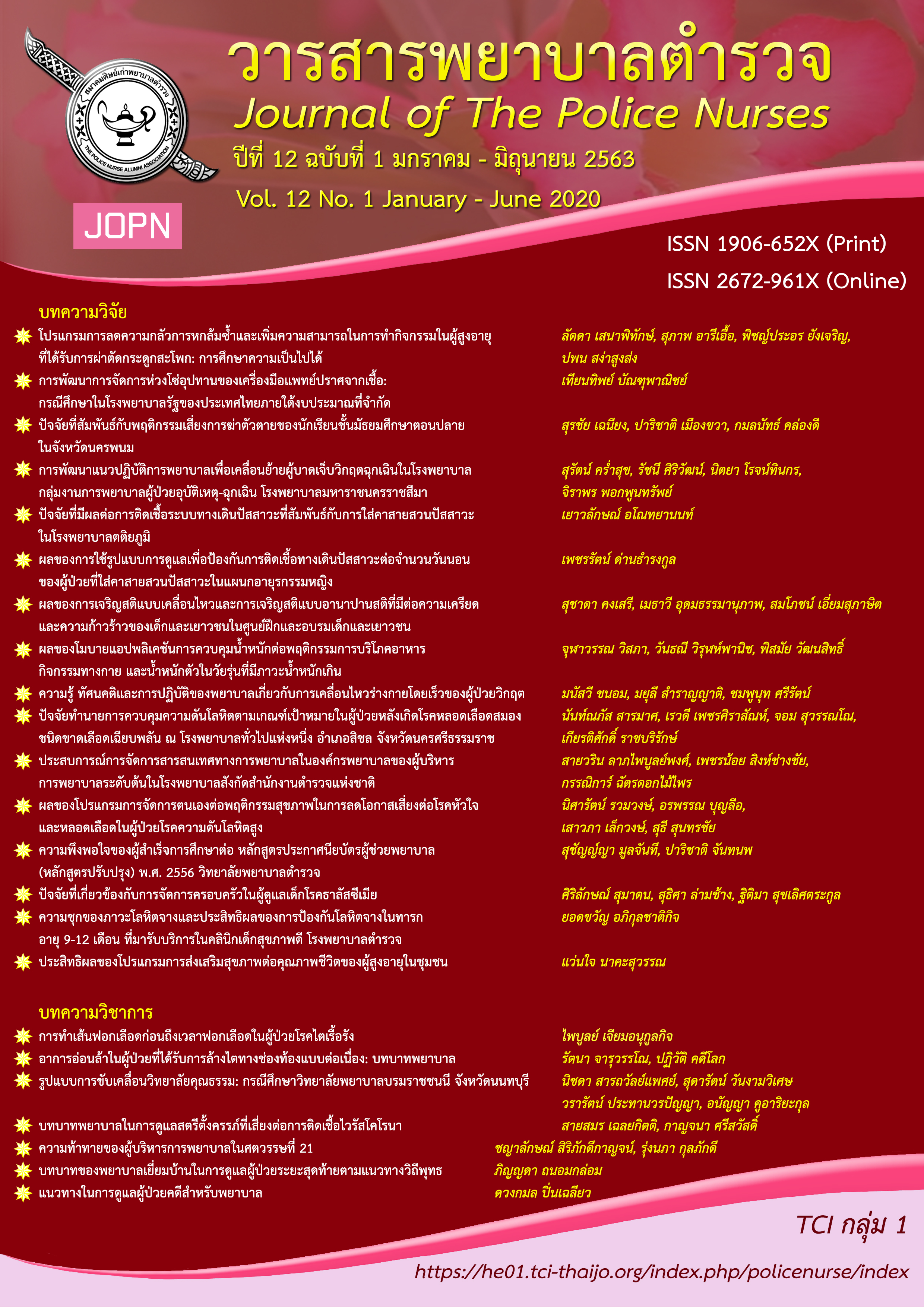
ประสิทธิผลของโปรแกรมการส่งเสริมสุขภาพต่อคุณภาพชีวิตของผู้สูงอายุในชุมชน
คำสำคัญ:
โปรแกรมส่งเสริมสุขภาพ, คุณภาพชีวิต, ผู้สูงอายุบทคัดย่อ
การวิจัยครั้งนี้เป็นการวิจัยกึ่งทดลอง วัตถุประสงค์เพื่อเปรียบเทียบคุณภาพชีวิตของผู้สูงอายุก่อนและหลังได้รับโปรแกรมการส่งเสริมสุขภาพผู้สูงอายุ ตัวอย่างเป็นผู้สูงอายุ ชมรมผู้สูงอายุ โรงพยาบาลส่งเสริมสุขภาพ ตำบลทานสัมฤทธิ์ จังหวัดนนทบุรี ได้รับคัดเลือกอย่างเจาะจง จำนวน 40 คน เครื่องมือที่ใช้ในการวิจัย คือ โปรแกรมส่งเสริมสุขภาพผู้สูงอายุตามแนวคิดทฤษฎีการรับรู้ความสามารถตนเองร่วมกับแรงสนับสนุนทางสังคม แบบวัดคุณภาพชีวิตผู้สูงอายุที่พัฒนามาจากเครื่องชี้วัดคุณภาพชีวิตขององค์การอนามัยโลกของ สุวัฒน์ มหัตนิรันดร์กุล และคณะ (Mahatnirunkul et al., 1997) วิเคราะห์ข้อมูลโดยใช้ ร้อยละ ค่าเฉลี่ย ส่วนเบี่ยงเบนมาตรฐาน และ Wilcoxon Signed Ranks Test
ผลการวิจัย พบว่า คุณภาพชีวิตผู้สูงอายุตัวอย่างวิจัยโดยรวมหลังได้รับโปรแกรมการส่งเสริมสุขภาพมีสูงขึ้นอย่างมีนัยสำคัญทางสถิติที่ระดับ .05(Z = -2.339, p=.019)
Downloads
เอกสารอ้างอิง
Achat, H., Kawachi, I., Levine, S., Berkey, C., Coakley, E., & Colditz, G. (1998). Social networks, stress and health-related quality of life. Quality of life research, 7(8), 735-750.
Bandura, A. (1977). Self-efficacy: Toward a unifying theory of behavioral change. Psychological Review, 84, 191-215.
Cheang, K. M., & Cheok, C. (2015). A 17-month review of the care mode service structure, and design of THRIVE, a community mental health initiative in Northern Singapore. East Asian Archives of Psychiatry, 25(4),168.
Chuawanlee, W. (1999). Effects of external rewards and self-efficacy on students' intrinsic motivation. Faculty of Education, Srinakharinwirot University. Foundation of Thai Gerontology Research and Development. Thai elderly population report 2008. Bangkok: TQP Co.
Cobb, S. (1976). Social support as a moderator of life stress. Psychosomatic Medicine, 38(5), 300–314. https://doi.org/10.1097/00006842-197609000-00003.
Foundation of Thai Gerontology Research and Development. (2009). Thai elderly population report 2009. Bangkok: TQP Co.
Guse, L. W. & Masesar, M. A. (1999). Quality of life and successful aging in long-term care: Perceptions of residents. Issues in Mental Health Nursing, 20, 527-539.
Jaenoobrum, S. (1998). Vision for the elderly and Non – formal education for Thai elderly. Bangkok: Nischin Advertising Group.
Lee, T. W., Ko, I. S., & Lee, K. J. (2006). Health promotion behaviors and quality of life among community-dwelling elderly in Korea: A cross-sectional survey. International journal of nursing studies, 43(3), 293-300.
Lemeshow, S., Hosmer, D. W., Klar, J., Lwanga, S. K., & World Health Organization. (1990). Adequacy of sample size in health studies. Chichester: Wiley.
Nanthamongkolchai, S. (2015). Quality of life among elderly people with chronic diseases in Ubon Ratchathani province. Journal of Public Health Special Issue, 18-29.
Qunnapiruk, L., Ronnarithivichai, C., & Ucharattana, P. (2005). Quality of life among elderly: The meta-analysis. Journal of Gerontology and Geriatric Medicine, 69(1), 2-12.
Saesiew, N. Vanindananda, N., & Choochom, O. (2012). The psychosocial adjustments and situational conditions as correlates of the quality of life in midlife adulthood. Journal of Psycho-Behavioral Science: Thai Behavioral System Journal of Behavioral Science for Development 1(1), 1-13.
Sarnsang, C. (2018). Quality of life and health-promoting behavior of the elderly in Thungkhowpuang Sub-district, Chiang Dao District, Chiangmai Province (Master of public health). Faculty of Graduate Studies, Chiangmai Rajabhat University, Chiangmai.
Sullivan, L. W. (1992). Health promotion and disease prevention. Medical Education, 26, 175-177.
Tantalanukul, S., Rattanasak, S., Sengpanich, C., Srisung., W., & Tungkawanich, T. (2016). The effect of simulation-based learning on the ability development ofprimary medical care practicum of nursing students at Boromarajonani College of Nursing Uttaradit. Boromarajonani College of Nursing, Uttaradit Journal, 8(1), 49-58.
The National Committee on the Elderly he National Committee on the Elderly. (2009). The 2nd National Plan on the Elderly: NPE (2002 – 2021).
ดาวน์โหลด
เผยแพร่แล้ว
รูปแบบการอ้างอิง
ฉบับ
ประเภทบทความ
สัญญาอนุญาต
ผลงานที่ได้ตีพิมพ์แล้วจะเป็นลิขสิทธิ์ของวารสารพยาบาลตำรวจ