EFFECTIVENESS OF MODIFIED BOONMEE LONG-STICK EXERCISE PROGRAM FOR OLDER PEOPLE ON PHYSICAL FITNESS AND QUALITY OF LIFE
Keywords:
quality of life, physical fitness, Boonmee long-stick exerciseAbstract
This quasi-experimental study examined the effectiveness of a modified Boonmee long-stick exercise program on physical fitness and quality of life among older adults. Participants were 64 older adults with below-standard physical fitness who attended the Healthy Aging Clinic at King Chulalongkorn Memorial Hospital. They were recruited through purposive sampling and allocated to an experimental group (n = 32) and a control group (n = 32). The experimental group performed the modified Boonmee long-stick exercise for 45 minutes per session, at least five times per week, over 12 weeks. In contrast, the control group maintained their usual physical activity. Research instruments comprised the modified Boonmee long-stick exercise program, a personal data record form, physical fitness tests, and the Thai version of the WHO Quality of Life–BREF (WHOQOL-BREF-THAI). Data were analyzed using frequencies, percentages, means, and standard deviations, and differences in means were compared using a t-test.
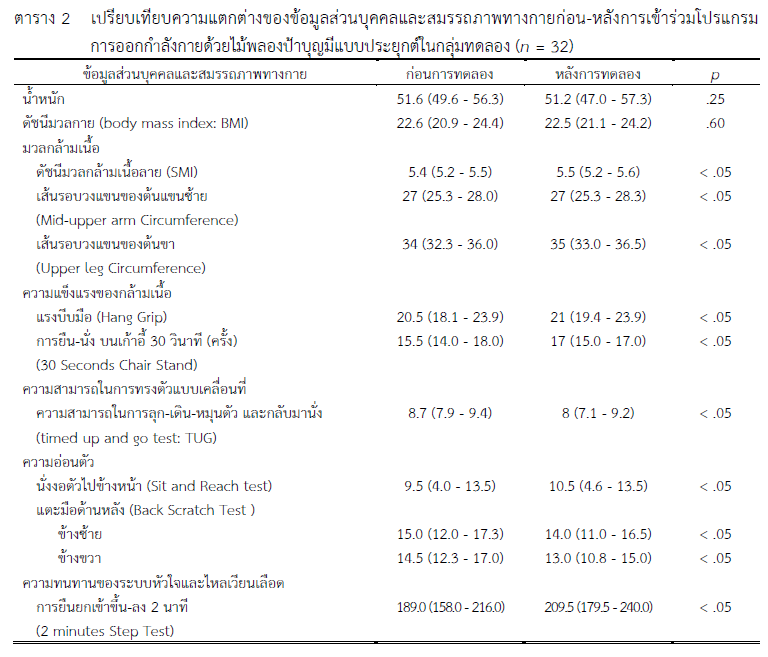
Results showed that the experimental group showed significantly greater increases in skeletal muscle index and upper-leg circumference than the control group (p < .05). In contrast, body weight, body mass index, and mid-upper-arm circumference did not differ significantly. For physical fitness, the experimental group demonstrated significantly higher muscle strength, flexibility, and cardiorespiratory endurance than the control group (p < .05). For quality of life, the experimental group reported significantly better outcomes in the physical, psychological, and social domains than the control group (p < .05). In contrast, the environmental domain showed no significant difference.
The modified Boonmee long-stick exercise program can be applied as a practical exercise modality to enhance physical fitness and quality of life in older adults.
Downloads
References
Bales, C. W., & Porter Starr, K. N. (2018). Obesity interventions for older adults: Diet as a determinant of physical function. Advances in Nutrition, 9(2), 151–159. https://doi.org/10.1093/advances/nmx016
Batsis, J. A., Gill, L. E., Masutani, R. K., Adachi-Mejia, A. M., Blunt, H. B., Bagley, P. J., . . . Bartels, S. J. (2017). Weight loss interventions in older adults with obesity: A systematic review of randomized controlled trials since 2005. Journal of the American Geriatrics Society, 65(2), 257–268. https://doi.org/10.1111/jgs.14514
Beaudart, C., Dawson, A., Shaw, S. C., Harvey, N. C., Kanis, J. A., Biver, E., . . . Reginster, J. Y. (2017). Nutrition and physical activity in the prevention and treatment of sarcopenia: systematic review. Osteoporosis International, 28, 1817–1833. https://doi.org/10.1007/s00198-017-3980-9
Burns, N., & Grove, S. K. (2005). The practice of nursing research: Conduct, critique and utilization (5th ed.), Elsevier Saunders, Missouri.
Buskard, A. N. L., & Petrella, R. J. (2023). Resistance training and weight loss in older adults: A scoping review. Sports Medicine - Open, 9(1), 67. https://doi.org/10.1186/s40798-023-00613-4
Chen, L. K., Liu, L. K., Woo, J., Assantachai, P., Auyeung, T. W., Bahyah, K. S., . . . Arai, H. (2014). Sarcopenia in Asia: consensus report of the Asian Working Group for Sarcopenia. Journal of the American Medical Directors Association, 15(2), 95-101. https://doi.org/10.1016/j.jamda.2013.11.025
Chitaphanakul, S. (2001). Principles of geriatric medicine (3rd ed.). Bangkok: Chulalongkorn University Press.
Choi, Y., Kim, D., & Kim, S. K. (2024). Effects of physical activity on body composition, muscle strength, and physical function in old age: Bibliometric and meta‑analyses. Healthcare, 12(2), 197. https://doi.org/10.3390/healthcare12020197
Cruz‑Jentoft, A. J., Bahat, G., Bauer, J., Boirie, Y., Bruyère, O., Cederholm, T., . . . Zamboni, M. (2019). Sarcopenia: Revised European consensus on definition and diagnosis. Age and Ageing, 48(1), 16–31. https://doi.org/10.1093/ageing/afy169
Feng, Z., Li, Q., Zhou, L., Chen, Z., & Yin, W. (2021). The relationship between depressive symptoms and activity of daily living disability among the elderly: Results from the China health and retirement longitudinal study (CHARLS). Public Health, 198, 75-81. https://doi.org/10.1016/j.puhe.2021.06.023
Izquierdo, M., Merchant, R. A., Morley, J. E., Anker, S. D., Aprahamian, I., Arai, H., . . . Singh, M. F. (2021). International exercise recommendations in older adults (ICFSR): expert consensus guidelines. The Journal of Nutrition, Health & Aging, 25(7), 824-853. https://doi.org/10.1007/s12603-021-1665-8
Janmookda, V., & Dajpratham, P. (2008). The effect of the modified Boonmee long stick exercise on balance, flexibility and strength in the elderly. Journal of Thai Rehabilitation Medicine, 18(2), 59-64.
Khemthong, A., & Saengon, C. (2022). Promoting aerobic exercise for the elderly. Udonthani Hospital Medical Journal, 30(1), 177-186.
Khodadad Kashi, S., Mirzazadeh, Z. S., & Saatchian, V. (2023). A systematic review and meta-analysis of resistance training on quality of life, depression, muscle strength, and functional exercise capacity in older adults aged 60 years or more. Biological Research for Nursing, 25(1), 88-106. https://doi.org/10.1177/10998004221120945
Lang, T., Streeper, T., Cawthon, P., Baldwin, K., Taaffe, D. R., & Harris, T. B. (2010). Sarcopenia: etiology, clinical consequences, intervention, and assessment. Osteoporosis International, 21(4), 543-559. https://doi.org/10.1007/s00198-009-1059-y
Limpawattana, P., & Manjavong, M. (2020). Clinical practice for sarcopenia. KKU Journal of Medicine, 6(2), 7-16.
Liu, H., Ma, Y., Lin, L., Sun, Z., Li, Z., & Jiang, X. (2023). Association between activities of daily living and depressive symptoms among older adults in China: Evidence from CHARLS. Frontiers in Public Health, 11, 1249208. https://doi.org/10.3389/fpubh.2023.1249208
Mahatnirankul, S., et al. (1997). A comparison of the World Health Organization's 100-indicator quality of life scale and its 26 indicators. Suanprung Hospital: Chiang Mai Province.
Mahatnirankul, S., Sinlapakit, P., & Pumpisanchai, V. (1998). Quality of life of Thai people in economic crisis. Funding from the Department of Mental Health, SuanPrung Hospital, Chiang Mai.
Núñez‑Lisboa, M. N., & Dewolf, A. H. (2025). The role of physical activity in mitigating age‑related changes in the neuromuscular control of gait. npj Aging, 11, 49. https://doi.org/10.1038/s41514-025-00239-8
Pavasini, R., Guralnik, J., Brown, J. C., Di Bari, M., Cesari, M., Landi, F., . . . Ferrucci, L. (2016). Short Physical Performance Battery and all-cause mortality: systematic review and meta-analysis. BMC Medicine, 14(1), 215. https://doi.org/10.1186/s12916-016-0763-7
Phoolphoklang, S. (2019). The effect of Ram Mai Plong exercise on the physical fitness and back pain of the elderly. Journal of Public Health Nursing, 33(3), 95-113.
Public Health Outcomes Framework. (2025). Falls figures: Around a third of people aged 65 and older fall each year, rising to around half of people aged 80 and older.
Radaelli, R., Taaffe, D. R., Newton, R. U., Galvão, D. A., & Lopez, P. (2021). Exercise effects on muscle quality in older adults: A systematic review and meta‑analysis. Scientific Reports, 11(1), 21085. https://doi.org/10.1038/s41598-021-00600-3
Riebe, D., Ehrman, J. K., Liguori, G., & Magal, M. (2018). ACSM’s guidelines for exercise testing and prescription. American College of Sports Medicine.
Salari, N., Darvishi, N., Ahmadipanah, M., Shohaimi, S., & Mohammadi, M. (2022). Global prevalence of falls in older adults: A comprehensive systematic review and meta-analysis. Journal of Orthopaedic Surgery and Research, 17(1), 334. https://doi.org/10.1186/s13018-022-03222-1
Shoukat, F., Rehman, S. S. U., & Ahmed, A. (2024). Effects of physical exercise intervention on improving physical functioning and quality of life among geriatric population: A systematic review of randomized controlled trials. Journal of the Pakistan Medical Association, 74(8), 1481–1487. https://doi.org/10.47391/JPMA.8289
Sittironnarit, G., Emprasertsuk, W., & Wannasewok, K. (2020). Quality of life and subjective burden of primary dementia caregivers in Bangkok, Thailand. Asian Journal of Psychiatry, 48, 101913. https://doi.org/10.1016/j.ajp.2019.101913
Sports Science Division, Department of Physical Education, Ministry of Tourism and Sports. (2013). Physical fitness tests and standards for senior citizens aged 60-89 years. Retrieved from https://prt.parliament.go.th/server/api/core/bitstreams/8ad507ed-1e97-42c3-9553-4f5cc161196e/content
Taechasubamorn, P., Lertsinthai, P., & Yaidee, S. (2016). Comparison of the effectiveness of modified Boonmee long stick exercise and home-based exercise program on physical function in women with knee osteoarthritis in a community based program. Naresuan University, Phitsanulok.
Visser, M., Sääksjärvi, K., Burchell, G. L., & Schaap, L. A. (2025). The association between muscle mass and change in physical functioning in older adults: A systematic review and meta-analysis of prospective studies. European Geriatric Medicine, 16(5), 1731-1748. https://doi.org/10.1007/s41999-025-01230-y
Downloads
Published
How to Cite
Issue
Section
License
Copyright (c) 2026 JOURNAL OF THE POLICE NURSES AND HEALTH SCIENCE

This work is licensed under a Creative Commons Attribution-NonCommercial-NoDerivatives 4.0 International License.
ผลงานที่ได้ตีพิมพ์แล้วจะเป็นลิขสิทธิ์ของวารสารพยาบาลตำรวจ