
PREDICTING FACTORS OF PREVENTION BEHAVIORS OF CENTRAL OBESITY AMONG WORKING-AGE FACTORY WORKERS, RATCHABURI PROVINCE
Keywords:
central obesity-preventive behaviors, health literacy, health belief model, food accessibility, social supportAbstract
This study employed a correlational research design to determine the predictive power of health literacy, health beliefs regarding central obesity, food accessibility, and social support for central obesity prevention for central obesity-preventive behaviors among working-age industrial factory workers in Ratchaburi province, using the PRECEDE model as the conceptual framework. A sample of 210 participants was selected through multi-stage random sampling. Data were collected using validated questionnaires assessing health literacy, health beliefs regarding central obesity, food accessibility, social support for central obesity prevention, and preventive behaviors, with Cronbach’s alpha coefficients of .885, .871, .751, .873, and .786, respectively. Data were analyzed using descriptive statistics and stepwise multiple regression analysis.
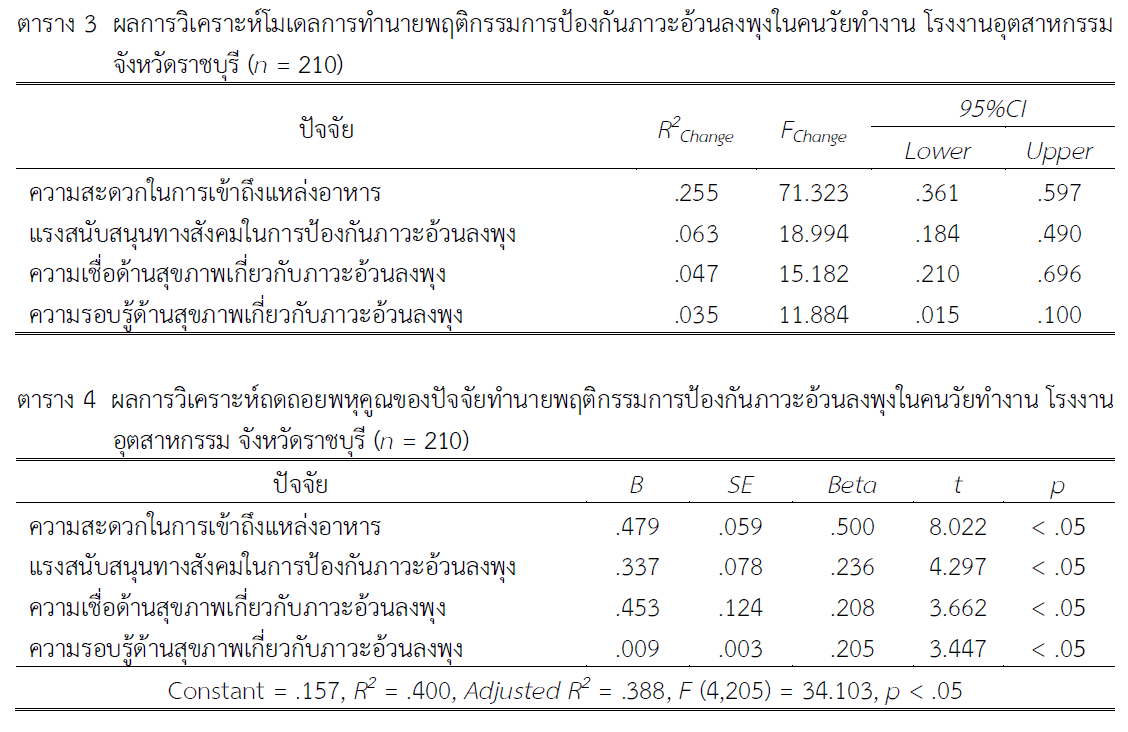
The findings indicated that participants demonstrated a high level of central obesity-preventive behaviors (M = 47.47, SD = 4.83). Food accessibility, social support for central obesity prevention, health beliefs regarding central obesity, and health literacy collectively explained 38.8% of the variance in preventive behaviors (Adjusted R² = .388, p < .05). Among these factors, food accessibility emerged as the strongest predictor (Beta = .500, p < .05).
The results suggest important implications for community nurse practitioners in developing targeted intervention programs among industrial workers. These programs should emphasize improving food accessibility alongside strengthening health literacy, health beliefs, and social support to promote sustainable, central obesity-preventive behaviors.
Downloads
References
Chobthamsakul, S. (2019). Relationship between health literacy and obesity prevention behaviors among undergraduate students in in Bangkok metropolitan region. Journal of Interdisciplinary Research, 8(1), 116-123.
Choosorn, P., & Sanchaisuriya, P. (2020). Prevalence and factors associated with abdominal obesity among working-age group (15-59 years old) in Kut Chap District, Udon Thani Province. KKU Journal of Public Health Research, 13(2), 26-35.
Department of Health. (2023). Guidelines for health promotion and disease prevention in the working-age group, fiscal year 2023. Nonthaburi: Ministry of Public Health.
Division of Non Communicable Diseases. (2023). Report on Non-Communicable Diseases (NCDs) situation: Diabetes, hypertension, and related risk factors 2023. Nonthaburi: Department of Disease Control, Ministry of Public Health.
Green, L. W., & Kreuter, M. W. (2005). Health promotion planning: An educational and ecological approach (4th ed.). Mayfield Publisher.
Health Education Division, Department of Health Service Support. (2018). Health literacy and health behavior assessment for preventing key infectious and non-communicable diseases among working-age population in health behavior change villages. Nonthaburi: Ministry of Public Health.
Namsanor, P. (2011). Factors relating to health promoting behavior of workers in food industrial and processed food products factories, Pathumthani province (Master’s thesis). Chulalongkorn University, Bangkok, Pathum Wan.
Nuansithong, N., Phattharasirisomboon, P., Thongsawang, K., Phuchongchai, T., Sukbua, K., & Proykoksoong, B. (2024). Factors associated with metabolic syndrome's occurrence among working-age group in Mueang district, Chaiyaphum province. Regional Health Promotion Center 9 Journal, 18(2), 406-418.
Panchathongkarm, S. (2023). Health literacy prevents diabetes and hypertension: Working age in health promotion establishments, Health Region 4. Journal of Health and Environmental Education, 8(2), 1-8.
Pineda, E., Stockton, J., Scholes, S., Lassale, C., & Mindell, J. S. (2024). Food environment and obesity: a systematic review and meta-analysis. BMJ Nutrition, Prevention & Health, 7(1), 204-211. https://doi.org/10.1136/bmjnph-2023-000663
Prasittipatt, T., Rudtanasudjatum, K., Methaphat, C., & Thetkathuek, A. (2018). Factors influencing the abdominal obesity of employees in large-sized manufactories in the Eastern region. Journal of Public Health, 27(5), 792-799.
Rawinit, P., & Sattatham, A. (2016). Factor associated with the metabolic syndrome in Chamab Sub-district, Wang Noi District, Ayutthaya Province. Journal of the Association of Private Higher Education Institutions of Thailand, 5(2), 33-47.
Reisi, M., Mostafavi, F., Javadzade, H., Mahaki, B., & Sharifirad, G. (2016). Communicative and critical health literacy and self-care behaviors in patients with type 2 diabetes. Journal of Education and Health Promotion, 5, 32.
Saeloo, J., & Wiriyasirikul, N. (2020). The relationship between health literacy and obesity prevention behaviors of school age children with overweight and obesity in schools under Primary Educational Service Area Office Mueang District, Nakhon Si Thammarat Province. Journal of MCU Nakhondhat, 7(11), 3-15.
Sakulaue, S. (2022). Factors relating to food consumption behaviors of village health volunteer, Muang District, Samut Songkhram Province. Journal of Research for Health Promotion and Quality of Life, 2(3), 59-70.
Supruang, J., Wiriyarattanakul, B., & Sangwan, P. (2021). Factors predicting health promotion behaviors among working-age clients with metabolic syndrome. Journal of Buddhist Social Sciences and Anthropology, 6(8), 386-399.
Sunthonnon, T. (2023). Factors related to health care behaviors of village health volunteers, Raman District, Yala Province. The Journal of Research and Academics, 6(4), 325-340.
Supruang, J., Viriyaratanakul, B., & Sungwan, P. (2021). Predicting factors of health promoting behaviors among working-age adult with metabolic syndrome. Journal of Social Science and Buddhistic Anthropology, 6(8), 387-399.
Tohlaya, K., Juntarat, R., Sriaiam, N., Prasomruk, P., & Prapatpong, P. (2021). Factors associated with self-protection behavior from metabolic syndrome in working-age group (15-59 years old) in Nampleek Sub-district, Mueang Amnat Charoen District, Amnat Charoen Province. Thai Health Science Journal and Community Public Health, 4(1), 130-140.
Truong, X. T., & Lee, D. H. (2025). Hepatic insulin resistance and steatosis in metabolic dysfunction‑associated steatotic liver disease: New insights into mechanisms and clinical implications. Diabetes & Metabolism Journal, 49(5), 964–986. https://doi.org/10.4093/dmj.2025.0644
World Obesity Federation. (2023). World obesity atlas 2023: The economic impact of overweight & obesity in 2020 and 2060.
World Health Organization. (2021). Obesity and overweight. Retrieved from https://www.who.int/news-room/fact-sheets/detail/obesity-and-overweight
Downloads
Published
How to Cite
Issue
Section
License
Copyright (c) 2026 JOURNAL OF THE POLICE NURSES AND HEALTH SCIENCE

This work is licensed under a Creative Commons Attribution-NonCommercial-NoDerivatives 4.0 International License.
ผลงานที่ได้ตีพิมพ์แล้วจะเป็นลิขสิทธิ์ของวารสารพยาบาลตำรวจ