FACTORS PREDICTING WORK HAPPINESS AMONG PROFESSIONAL NURSES IN A PRIVATE HOSPITAL GROUP
Keywords:
work happiness, hardiness, teamwork, ethical climate, professional autonomyAbstract
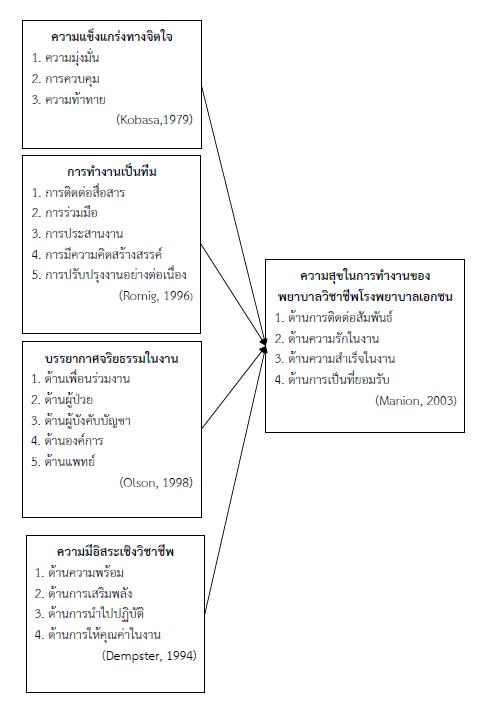
The purposes of this predictive study were to 1) examine the level of work happiness among professional nurses in a private hospital group 2) examine the relationships among hardiness, teamwork, ethical climate, professional autonomy, and work happiness among professional nurses in a private hospital group and 3) determine the predictive power of hardiness, teamwork, ethical climate, and professional autonomy on work happiness among professional nurses in a private hospital group. The sample consisted of 192 professional nurses selected through multistage sampling. The research instrument was a questionnaire of hardiness, teamwork, ethical climate, professional autonomy, and work happiness. Content validity was established by a panel of experts, with content validity index (CVI) values ranging from .90 to 1.00, and Cronbach’s alpha coefficients ranging from .90 to .96. Data were collected via an electronic system and analyzed using descriptive statistics, Pearson’s product-moment correlation coefficient, and stepwise multiple regression analysis. The statistical significance level was set at .05.
The research findings revealed that professional nurses perceived their overall work happiness at a high level (M = 4.25, SD = .41). All study variables were positively and significantly correlated with work happiness (r = .769 - .844, p < .05) Professional autonomy, teamwork, hardiness, and ethical climate significantly predicted work happiness among professional nurses (Beta = .354, .240, .227, and .193, respectively; p < .05). Together, these variables explained 83.4% of the variance in work happiness (R² = .834).
The findings of this study indicate that work happiness among professional nurses is influenced by both individual and organizational factors, particularly professional autonomy and teamwork, which were identified as key contributors to nurses’ work happiness. Therefore, nurse administrators should prioritize promoting professional autonomy in clinical decision-making, enhancing teamwork competencies, strengthening psychological hardiness, and fostering a positive ethical climate within healthcare organizations. These initiatives may help enhance work happiness among professional nurses, leading to greater retention in the profession, improved quality of nursing care, and the achievement of effective and sustainable healthcare outcomes in the long term.
Downloads
References
Asegid, A., Belachew, T., & Yimam, E. (2014). Factors influencing job satisfaction and anticipated turnover among nurses in Sidama Zone Public Health Facilities, South Ethiopia. Nursing Research and Practice, 2014, 909768. http://dx.doi.org/10.1155/2014/909768
Azeem, S. M. (2010). Personality hardiness, job involvement and job burnout among teachers. International Journal of Vocational and Technical Education, 2(3), 36-40.
Baker, D. P., Day, R., & Salas, E. (2006). Teamwork as an essential component of high-reliability organizations. Health Services Research, 41(4p2), 1576–1598. http://dx.doi.org/10.1111/j.1475-6773.2006.00566.x
Burns, N., & Grove, S. K. (2005). The practice of nursing research: Conduct, critique, and utilization (5th ed.). St. Louis, MO: Elsevier Saunders.
Dempster, J. S. (1994). Autonomy: A professional issue of concern for nurse practitioners. Nurse Practitioner Forum, 5(4), 227–232.
Epstein, E. G., & Delgado, S. (2010). Understanding and addressing moral distress. The Online Journal of Issues in Nursing, 15(3), Manuscript1. https://doi.org/10.3912/OJIN.Vol15No03Man01
Hart, S. E. (2005). Hospital ethical climates and registered nurses' turnover intentions. Journal of Nursing Scholarship, 37(2), 173-177.
Jantarasri, D. (2012). Relationships between self-esteem, empowerment, teamwork, and happiness in working of professional nurses at regional hospitals in the eastern region (Master’s thesis). Burapha University, Chon Buri. https://doi.org/10.1177/0149206315575554
Kalisch, B. J., Lee, H., & Salas, E. (2010). The development and testing of the nursing teamwork survey. Nursing Research, 59(1), 42-50.
Ketsamun, P. (2016). A meta-analysis of antecedent variables of work happiness as perceived by professional nurses (Master’s thesis). Chulalongkorn University, Bangkok, Pathumwan.
Kobasa, S. C. (1979). Stressful life events, personality, and health: An inquiry into hardiness. Journal of Personality and Social Psychology, 37(1), 1–11.
Kramer, M., & Schmalenberg, C. E. (2003). Magnet hospital nurses describe clinical autonomy. Journal of Nursing Administration, 33(10), 534-542.
Krobmukh, K. (2025). Happiness in life among professional nurses in an affiliated private hospital in Nonthaburi Province. Thai Journal of Nursing, 75(1), 59–68.
Manion, J. (2003). Joy at work: Creating a positive workplace. Journal of Nursing Administration, 33(12), 652–659.
Mrayyan, M. T. (2006). Comparison of nurses’ autonomy and job satisfaction in Jordanian hospitals. Journal of Nursing Management, 14(4), 252-262. https://doi.org/10.1111/j.1365-2934.2006.00591.x
Nantsupawat, A., Nantsupawat, R., Kulnaviktikul, W., McHugh, M. D., & Aiken, L. H. (2011). Impact of nurse work environment and staffing on hospital nurse and quality of care in Thailand. Journal of Nursing Scholarship, 43(4), 426–432.
Nilkitsaranont, P. (2020). Business/industry trends 2020-2022: Private hospital business. Retrieved from https://www.krungsri.com/th/research/industry/industry-outlook/services/private-hospitals/io/io-private-hospitals
Olson, L. L. (1998). Hospital nurses' perceptions of the ethical climate of their work setting. Image: The Journal of Nursing Scholarship, 30(4), 345–349.
Ongkhana, K. (2006). The relationship between personal factors, self-esteem, work environment and happiness at work of staff nurses, private hospitals, Bangkok Metropolis (Master of nursing science program). Faculty of Nursing, Chulalongkorn University, Bangkok, Pathumwan.
Phakdeechanuan, K., Kellett, U., Henderson, S., Corones-Watkins, K., Saito, A., & Thiangchanya, P. (2024). Addressing registered nurse retention and attrition in Thailand hospitals: An integrative review. Asia-Pacific Journal of Public Health, 37(1), 1–13. https://doi.org/10.1177/10105395241282972
Polit, D. F., & Beck, C. T. (2006). Essentials of nursing research: Methods, appraisal, and utilization (6th ed.). Philadelphia, PA: Lippincott Williams & Wilkins.
Polit, D. F., & Beck, C. T. (2010). Generalization in quantitative and qualitative research: Myths and strategies. International Journal of Nursing Studies, 47(11), 1451–1458. https://doi.org/10.1016/j.ijnurstu.2010.06.004
Romig, D. A. (1996). Breakthrough teamwork: Key to success in a changing world. Alexandria, VA: American Society for Training and Development.
Sathaporwajnana, A. (2008). The relationship between family support, ethical work climate and happiness at work of professional nurses, hospitals under the Ministry of Public Health, Bangkok Metropolis (Master of nursing science program). Faculty of Nursing, Chulalongkorn University, Bangkok, Pathumwan.
Sawatdipanich, N. (2012). Translation of research instruments for cross-cultural research: Techniques and issues for consideration. The Journal of Thailand Nursing and Midwifery Council, 26(1), 19–29.
Siripanichana, C., Suksawat, J., & Mekkhajorn, N. (2024). Factors affecting happiness at work of personnel in the Office of the Permanent Secretary for Justice, Ministry of Justice. Ratchaphruek Journal, 22(1), 34–49.
Laschinger, H. K., & Finegan, J. (2005). Empowering nurses for work engagement and health in hospital settings. JONA: The Journal of Nursing Administration, 35(10), 439–449.
Sperber, A. D. (2004). Translation and validation of study instruments for cross-cultural research. Gastroenterology, 126(1), 124–128. https://doi.org/10.1053/j.gastro.2003.10.016
Srisatidnarakul, B. (2012). Sample size in research: Sampling and statistics used for data analysis. Bangkok: Chulalongkorn University Printing House.
Tontun, W. (2016). Factors influencing happiness at work of professional nurses in nursing department of an affiliated private hospital in Bangkok Metropolis. Christian University Journal, 22(4), 565–573.
Ulrich, B., Buerhaus, P. I., Donelan, K., Norman, L., & Dittus, R. (2007). Magnet status and the quality of nurse work environments. Nursing Economics, 25(6), 321-329.
Victor, B., & Cullen, J. B. (1988). The organizational bases of ethical work climates. Administrative Science Quarterly, 33(1), 101–125. https://doi.org/10.2307/2392857
Weston, M. J. (2010). Strategies for enhancing autonomy and control over nursing practice. The Online Journal of Issues in Nursing, 15(1), Manuscript 2. https://doi.org/10.3912/OJIN.Vol15No01Man02
Downloads
Published
How to Cite
Issue
Section
License
Copyright (c) 2026 JOURNAL OF THE POLICE NURSES AND HEALTH SCIENCE

This work is licensed under a Creative Commons Attribution-NonCommercial-NoDerivatives 4.0 International License.
ผลงานที่ได้ตีพิมพ์แล้วจะเป็นลิขสิทธิ์ของวารสารพยาบาลตำรวจ