SELECTED FACTORS RELATED TO CAREGIVER BURDEN AMONG PRIMARY CAREGIVERS OF OLDER ADULTS WITH MULTIMORBIDITY
Keywords:
caregiver burden, family caregiver, older adults, multimorbidityAbstract
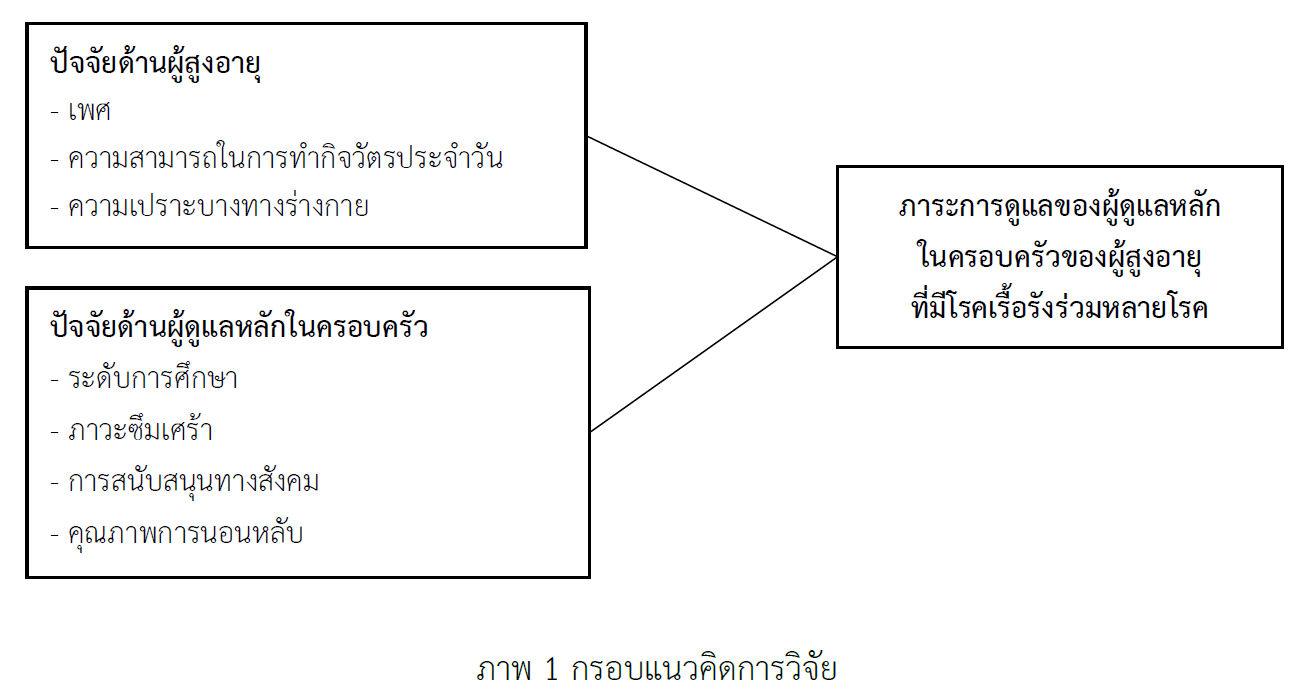
This cross-sectional study aimed to examine caregiver burden and factors associated with caregiver burden among family caregivers of older adults with multimorbidity. The sample consisted of 101 caregiver–older adult dyads attending outpatient internal medicine clinics at three tertiary government hospitals in Bangkok, obtained using convenience sampling. The research instruments included a personal information questionnaire. They validated standardized instruments, including the Activities of Daily Living (ADL) Scale, Frailty Scale, Zarit Burden Interview (ZBI), Pittsburgh Sleep Quality Index (PSQI), Social Support Questionnaire, and the Center for Epidemiologic Studies Depression Scale (CES-D). The internal consistency of these instruments, measured by Cronbach’s alpha coefficients, was .90, .74, .92, .76, .91, and .90, respectively. Data were analyzed using descriptive statistics and correlation analyses, including Eta, Spearman’s rank correlation, and Pearson’s product–moment correlation.
The findings revealed that caregivers experienced a caregiving burden ranging from no burden to a mild burden (M = 21.24, SD = 13.82). Analysis of the relationships between selected factors and caregiver burden revealed that caregiver depression (r = .414, p < .05), Poor caregiver sleep quality (r = .371, p < .05), and physical frailty of the older adults (r = .350, p <.05) were moderately and positively correlated with caregiver burden. Conversely, the older adults’ ability to perform activities of daily living was moderately and negatively correlated with caregiver burden (r = −.435, p < .05), while social support for caregivers showed a weak negative correlation (r = −.210, p < .05). However, no significant correlations were found between caregiver burden and either the gender of the older adults (η = .07, p > .05) or the educational level of the caregivers (rs = −.096, p > .05).
Therefore, reducing caregiver burden among family caregivers of older adults with multimorbidity requires integrated strategies. At the caregiver level, interventions should prioritize the assessment and management of depression, the promotion of sleep quality, and the strengthening of social support. At the older-adult level, they should focus on preventing and reducing physical frailty and preserving functional ability in activities of daily living. These findings provide evidence to inform the planning and design of nursing interventions and the development of targeted strategies to reduce caregiver burden effectively.
Downloads
References
Anuruang, S. (2017). Multimorbidity in older adults: Situations, challenges, and care management. Journal of Nursing Science Chulalongkorn University, 29(2), 1– 13. https://doi.org/10.58837/CHULA.CUNS.29.2.1
Buaiam, P., Chareonthaitrakul, S., Siri, S., & Sathitvipawee, P. (2018). Prevalence and factors associated with multimorbidity among the elderly in Si Prachan district, Suphan Buri province. The 16th National Health Conference, Faculty of Public Health, Mahidol University, Bangkok, Thailand. Retrieved from https://ph.mahidol.ac.th/Present_Petcharat2018
Chaiwongnakkapun, C., Hongsri, P., & Gadudom, P. (2020). Relationship among perceived burden of caring elderly with chronic illness, family relationship, ability to perform activities of daily living (ADL), and cognitive function of elderly with chronic illness in the North of Thailand. Journal of Nurses Association of Thailand Northern Region, 26(2), 24–39.
Department of Disease Control. (2024). Statistics on chronic diseases and health trends among the elderly. Ministry of Public Health. Retrieved from https://ddc.moph.go.th/dncd/publishinfodetail.php?publish=15282&deptcode=dn
Department of Health, Ministry of Public Health. (2024). Report on the health situation of the Thai elderly: Challenges of multimorbidity and long-term care. Nonthaburi, Thailand: Bureau of Elderly Health.
DeVellis, R. F. (2017). Scale development: Theory and applications (4th ed.). Thousand Oaks, CA: Sage.
Gok Metin, Z., Karadas, C., Balci, C., & Cankurtaran, M. (2019). The perceived caregiver burden among Turkish family caregivers providing care for frail older adults. Journal of Transcultural Nursing: Official Journal of the Transcultural Nursing Society, 30(3), 222–230. https://doi.org/10.1177/1043659618790041
Grove, S. K., Burns, N., & Gray, J. R. (2013). The practice of nursing research: Appraisal, synthesis, and generation of evidence (7th ed.). St. Louis, MO: Elsevier Saunders.
Hanh, P. T., Jullamate, P., & Piphatvanitcha, N. (2017). Factors related to caregiver burden among family caregivers of older adults with stroke in Hai Duong, Vietnam. The Southern College Network Journal of Nursing and Public Health, 4(3), 45–62.
Im-oot, P., Nimitanan, N., Kumson, S., & Hemathorn, J. (2009). Factors influencing home care behaviors of caregivers of stroke patients. Christian University of Thailand Journal, 15(2), 130–141.
Inthai, P., Khruapang, P., Choksomngam, Y., & Yingchankul, N. (2021). Prevalence and factors associated with caregiver burden among caregivers of bedridden elderly in San Patong district, Chiang Mai province. Chiang Mai Medical Journal, 60(3), 383–394.
Jaidee, S., & Sasat, S. (2017). A study of frailty in community- dwelling older adults, Bangkok Metropolis. Journal of the Royal Thai Navy Nurses, 44(3), 117–135.
Jirapramukpitak, T., & Tanchaiswad, W. (1997). Sleep problems among nurses of Songklanagarind Hospital. Journal of the Psychiatric Association of Thailand, 42(3), 123–132.
Jitapunkul, S. (1998). Analysis of the elderly. In S. Jitapunkul (Ed.), Principles of geriatric medicine (pp. 85–86). Bangkok, Thailand: Chulalongkorn University Press.
Akdoğan, H., & Ilhan, N. (2024). Factors associated with caregiver burden in family caregivers of older adults: A cross-sectional study. Florence Nightingale Journal of Nursing, 32(3), 254–260. https://doi.org/10.5152/FNJN.2024.24090
Krishnan, S., Chen, H. T., Caston, S., & Rho, S. (2024). Physical and psychological burden among caregivers of Latinx older adults with stroke and multimorbidity. Ethnicity & Disease, 33(4), 156–162. https://doi.org/10.18865/ed.33.4.156
Ofori-Asenso, R., Chin, K. L., Curtis, A. J., Zomer, E., Zoungas, S., & Liew, D. (2019). Recent patterns of multimorbidity among older adults in high-income countries. Population Health Management, 22(2), 127–137. https://doi.org/10.1089/pop.2018.0069
Polit, D. F., & Beck, C. T. (2017). Nursing research: Generating and assessing evidence for nursing practice (10th ed.). Philadelphia, PA: Wolters Kluwer.
Putri, Y. S. E., Putra, I. G. N. E., Falahaini, A., & Wardani, I. Y. (2022). Factors associated with caregiver burden in caregivers of older patients with dementia in Indonesia. International Journal of Environmental Research and Public Health, 19(19), 12437. https://doi.org/10.3390/ijerph191912437
Ringer, T. J., Hazzan, A. A., Kennedy, C. C., Karampatos, S., Patterson, C., Marr, S., & Papaioannou, A. (2016). Care recipients' physical frailty is independently associated with subjective burden in informal caregivers in the community setting: A cross- sectional study. BMC Geriatrics, 16(1), 186. https://doi.org/10.1186/s12877-016-0355-6
Sanchez Barcenas, R. A., López Hernandez, D., Brito-Aranda, L., Garcia Mantilla, B. B., Thompson Bonilla, M. D. R., Pavon Delgado, E., . . . Orozco-Valencia, A. (2024). Factores asociados a la sobrecarga del cuidador en cuidadores primarios de personas adultas mayores con diabetes tipo 2. Atencion Primaria, 56(10), 102948. https://doi.org/10.1016/j.aprim.2024.102948
Schulz, R., & Beach, S. R. (1999). Caregiving as a risk factor for mortality: The caregiver health effects study. JAMA, 282(23), 2215–2219.
https://doi.org/10.1001/jama.282.23.2215
Shieh, S. C., Tung, H. S., & Liang, S. Y. (2012). Social support as influencing primary family caregiver burden in Taiwanese patients with colorectal cancer. Journal of Nursing Scholarship: An Official Publication of Sigma Theta Tau International Honor Society of Nursing, 44(3), 223–231. https://doi.org/10.1111/j.1547-5069.2012.01453.x
Srichanuam, P., Nukaew, O., & Kongsuwan, W. (2023). Factors predicting caregiver burden among caregivers of older adults with dementia presenting with behavioral and psychological symptoms. Proceedings of the National and International Conference of North-Eastern University 2023 (NEUNIC 2023) (pp. 319–331). Khon Kaen, Thailand: North-Eastern University.
Sriwong, W., Mahavisessin, W., Srinonprasert, V., Siriussawakul, A., Aekplakorn, W., Limpawattana, P., . . . Wongviriyawong, T. (2022). Validity and reliability of the Thai version of the simple frailty questionnaire (T-FRAIL) with modifications to improve its diagnostic properties in the preoperative setting. BMC Geriatrics, 22(1), 161. https://doi.org/10.1186/s12877-022-02863-5
Thongaram, U. (2019). Influences of caregivers’ preparedness, caregivers’ burden, and caregivers’reward on adaptation of caregivers caring for patients with stroke (Master's thesis in adult nursing). Faculty of Nursing, Burapha University, Chon Buri. Retrieved from https://digital_collect.lib.buu.ac.th/dcms/files/57910178.pdf
Toonsiri, C., Sunsern, R., & Lawang, W. (2011). Development of the burden interview for caregiversof patients with chronic illness. Journal of Nursing and Education, 4(1), 62–75.
Tuttle, D., Griffiths, J., & Kaunnil, A. (2022). Predictors of caregiver burden in caregivers of older people with physical disabilities in a rural community. PLoS ONE, 17(11), e0277177. https://doi.org/10.1371/journal.pone.0277177
Vorapongsathorn, T., Pandee, W., & Triamchaisri, S. (1990). The validity of the Thai version of the Center for Epidemiologic Studies-Depression Scale (CES-D). Journal of Clinical Psychology, 21(1), 26–45.
World Health Organization. (2024). Ageing and health. Retrieved from https://www.who.int/news-room/fact-sheets/detail/ageing-and-health
Yigitalp, G., Surucu, H. A., Gumus, F., & Evinc, E. (2017). Predictors of caregiver burden in primary caregivers of chronic patients. International Journal of Caring Sciences, 10(3), 1168–1177.
Zarit, S. H., Reever, K. E., & Bach-Peterson, J. (1980). Relatives of the impaired elderly: Correlates of feelings of burden. The Gerontologist, 20(6), 649–655. https://doi.org/10.1093/geront/20.6.649
Zarit, S. H., Todd, P. A., & Zarit, J. M. (1986). Subjective burden of husbands and wives as caregivers: A longitudinal study. The Gerontologist, 26(3), 260–266. https://doi.org/10.1093/geront/26.3.260
Downloads
Published
How to Cite
Issue
Section
License
Copyright (c) 2026 JOURNAL OF THE POLICE NURSES AND HEALTH SCIENCE

This work is licensed under a Creative Commons Attribution-NonCommercial-NoDerivatives 4.0 International License.
ผลงานที่ได้ตีพิมพ์แล้วจะเป็นลิขสิทธิ์ของวารสารพยาบาลตำรวจ