INTEGRATING HEALTH LITERACY AND DIGITAL HEALTH TO PREVENT REPEAT PREGNANCY IN POSTPARTUM ADOLESCENTS: A NARRATIVE REVIEW
Keywords:
health literacy, digital health, contraception, repeat pregnancy, postpartum adolescentsAbstract
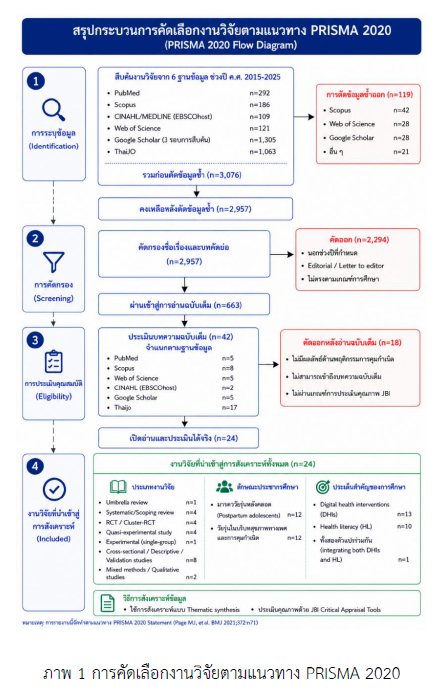
This narrative review aimed to 1) synthesize empirical evidence on the associations between health literacy, digital health, and contraceptive behaviors among postpartum adolescents, and 2) propose nursing guidelines to prevent repeat pregnancy in this population. The review was conducted following PRISMA guidelines, with searches in six databases: PubMed, Scopus, CINAHL, Web of Science, Google Scholar, and ThaiJO, covering publications from 2015 to 2025. A total of 3,076 studies were identified. After eligibility screening and quality appraisal using the Joanna Briggs Institute (JBI) critical appraisal tools, 24 studies met the inclusion criteria, including one umbrella review, four systematic/scoping reviews, four randomized controlled trials (RCTs)/cluster-RCTs, four quasi-experimental studies, one single-group experimental study, eight descriptive/cross-sectional/validation studies, and two mixed-methods/qualitative studies. Among these, 12 studies focused specifically on postpartum adolescents, and 12 studies addressed adolescents in general sexual and contraceptive health contexts. Studies were categorized by primary focus: 10 on health literacy, 13 on digital health, and one examining both variables.
The synthesis revealed that interactive and critical health literacy were consistently associated
with the continuous use of highly effective contraceptive methods, particularly long-acting reversible contraception (LARC). Digital health tools, including decision-support systems, monitoring platforms, and interactive media, supported learning, enhanced self-efficacy, and promoted the continuity of contraceptive service use among postpartum adolescents. However, most evidence was derived from international studies, which may differ contextually from Thai postpartum adolescents, and long-term follow-up beyond 12 months was limited.
Integrating digital health interventions (DHIs) with the promotion of interactive and critical health literacy is a key approach to enable postpartum adolescents to access, appraise, compare options, and make informed contraceptive decisions based on valid empirical evidence. Furthermore, the continuous development of nurses’ digital competencies is essential to support postpartum adolescents in making appropriate contraceptive choices and sustainably preventing repeat pregnancy.
Downloads
References
Ajzen, I. (1991). The theory of planned behavior. Organizational Behavior and Human Decision Processes, 50(2), 179–211.
Babalola, S., Loehr, C., Oyenubi, O., Akiode, A., & Mobley, A. (2019). Efficacy of a digital health tool on contraceptive ideation and use in Nigeria: Results of a cluster-randomized control trial. Global Health: Science and Practice, 7(2), 273-288. https://doi.org/10.9745/GHSP-D-19-00066
Borji-Navan, S., Maleki, N., & Keramat, A. (2024). Efficacy of digital health interventions used for adolescents’ sexual health: An umbrella review. Health Science Reports, 7(12), e70212. https://doi.org/10.1002/hsr2.70212
Chernick, L. S., Bugaighis, M., Daylor, V., Hochster, D., Rosen, E., Schnall, R., . . . Bell, D. L. (2024). A digital sexual health intervention for urban adolescent and young adult male emergency department patients: User-centered design approach. JMIR Formative Research, 8(1), e55815. https://doi.org/10.2196/55815
Cherie, N., Wordofa, M. A., & Debelew, G. T. (2024). Effectiveness of an interactive mobile health intervention (IMHI) to enhance the adoption of modern contraceptive methods during the early postpartum period among women in Northeast Ethiopia: A cluster randomized controlled trial. PLOS ONE, 19(11), e0310124. https://doi.org/10.1371/journal.pone.0310124
Department of Health, Ministry of Public Health. (2022). Annual report on adolescent pregnancy situation in Thailand 2022. Ministry of Public Health.
Dowling, R., Howell, E. M., Dasco, M. A., & Schwartzman, J. (2025). Digital adolescent sexual and reproductive health in low-and middle-income countries: A scoping review. Youth, 5(1), 15. https://doi.org/10.3390/youth5010015
Ippoliti, N., Sekamana, M., Baringer, L., & Hope, R. (2021). Using human-centered design to develop, launch, and evaluate a national digital health platform to improve reproductive health for Rwandan youth. Global Health: Science and Practice, 9(Suppl. 2), S244–S260. https://doi.org/10.9745/GHSP-D-21-00220
Jonas, K., Duby, Z., Maruping, K., Harries, J., & Mathews, C. (2022). Rumours, myths, and misperceptions as barriers to contraceptive use among adolescent girls and young women in South Africa. Frontiers in Reproductive Health, 4, 960089. https://doi.org/10.3389/frph.2022.960089
Laar, A. S., Harris, M. L., Khan, M. N., & Loxton, D. (2024). Views and experiences of young people on using mHealth platforms for sexual and reproductive health services in rural low-and middle-income countries: A qualitative systematic review. PLOS Digital Health, 3(12), e0000362. https://doi.org/10.1371/journal.pdig.0000362
Longhini, J., Rossettini, G., & Palese, A. (2022). Digital health competencies among health care professionals: Systematic review. Journal of Medical Internet Research, 24(8), e36414. https://doi.org/10.2196/36414
Nutbeam, D. (2008). The evolving concept of health literacy. Social Science & Medicine, 67(12), 2072–2078. https://doi.org/10.1016/j.socscimed.2008.09.050
Rattanaviboon, P., & Puektes, S. (2020). Effect of an empowerment program combined with infographic-based education on contraceptive implant decision-making for repeat pregnancy prevention among adolescents. Thai Red Cross Nursing Journal, 13(2), 241–256.
Rosenstock, I. M. (1974). The health belief model and preventive health behavior. Health Education Monographs, 2(4), 354-386. https://doi.org/10.1177/109019817400200405
Santibenchakul, S., Thanativakul, K., & Jaisamrarn, U. (2022). An educational video on long-acting reversible contraception as a counseling tool for postpartum adolescents. Contraception and Reproductive Medicine, 7(1), 24. https://doi.org/10.1186/s40834-022-00195-8
Sze, Y. Y., Berendes, S., Russel, S., Bellam, L., Smith, C., Cameron, S., & Free, C. J. (2023). A systematic review of randomised controlled trials of the effects of digital health interventions on postpartum contraception use. BMJ Sexual & Reproductive Health, 49(1), 50-59.
https://doi.org/10.1136/bmjsrh-2022-201468
Unger, J. A., Ronen, K., Perrier, T., DeRenzi, B., Slyker, J., Drake, A. L., . . . John-Stewart, G. (2018). Short message service communication improves exclusive breastfeeding and early postpartum contraception in a low- to middle-income country setting: A randomised trial. BJOG: An International Journal of Obstetrics and Gynaecology, 125(12), 1620–1629. https://doi.org/10.1111/1471-0528.15337
Vongxay, V., Thongmixay, S., Stoltenborg, L., Inthapanyo, A., Sychareun, V., Chaleunvong, K., & Essink, D. R. (2022). Validation of the questionnaire on sexual and reproductive health literacy for adolescents age 15 to 19 years in Lao People's Democratic Republic. Health Literacy Research and Practice, 6(1), 37-50. https://doi.org/10.3928/24748307-20220207-01
Wong, J. Y. H., Zhang, W., Wu, Y., Choi, E. P. H., Lo, H. H. M., Wong, W., . . . Fong, D. Y. T. (2021). An interactive web-based sexual health literacy program for safe sex practice for female Chinese university students: Multicenter randomized controlled trial. Journal of Medical Internet Research, 23(3), e22564. https://doi.org/10.2196/22564
World Health Organization. (2020). Classification of digital health interventions v1.0: A shared language to describe the uses of digital technology for health. Geneva, Switzerland: World Health Organization. Retrieved from https://www.who.int/
World Health Organization. (2024). Adolescent pregnancy. Geneva, Switzerland: World Health Organization. Retrieved from https://www.who.int/news-room/fact-sheets/detail/adolescent-pregnancy
Downloads
Published
How to Cite
Issue
Section
License
Copyright (c) 2026 JOURNAL OF THE POLICE NURSES AND HEALTH SCIENCE

This work is licensed under a Creative Commons Attribution-NonCommercial-NoDerivatives 4.0 International License.
ผลงานที่ได้ตีพิมพ์แล้วจะเป็นลิขสิทธิ์ของวารสารพยาบาลตำรวจ