
COMPLICATIONS WITHIN THE FIRST 72 HOURS AFTER OPEN-HEART SURGERY AND ASSOCIATED FACTORS: A TWO-YEAR RETROSPECTIVE COHORT STUDY
Keywords:
open-heart surgery, post-cardiac surgery patients, postoperative cardiac complicationsAbstract
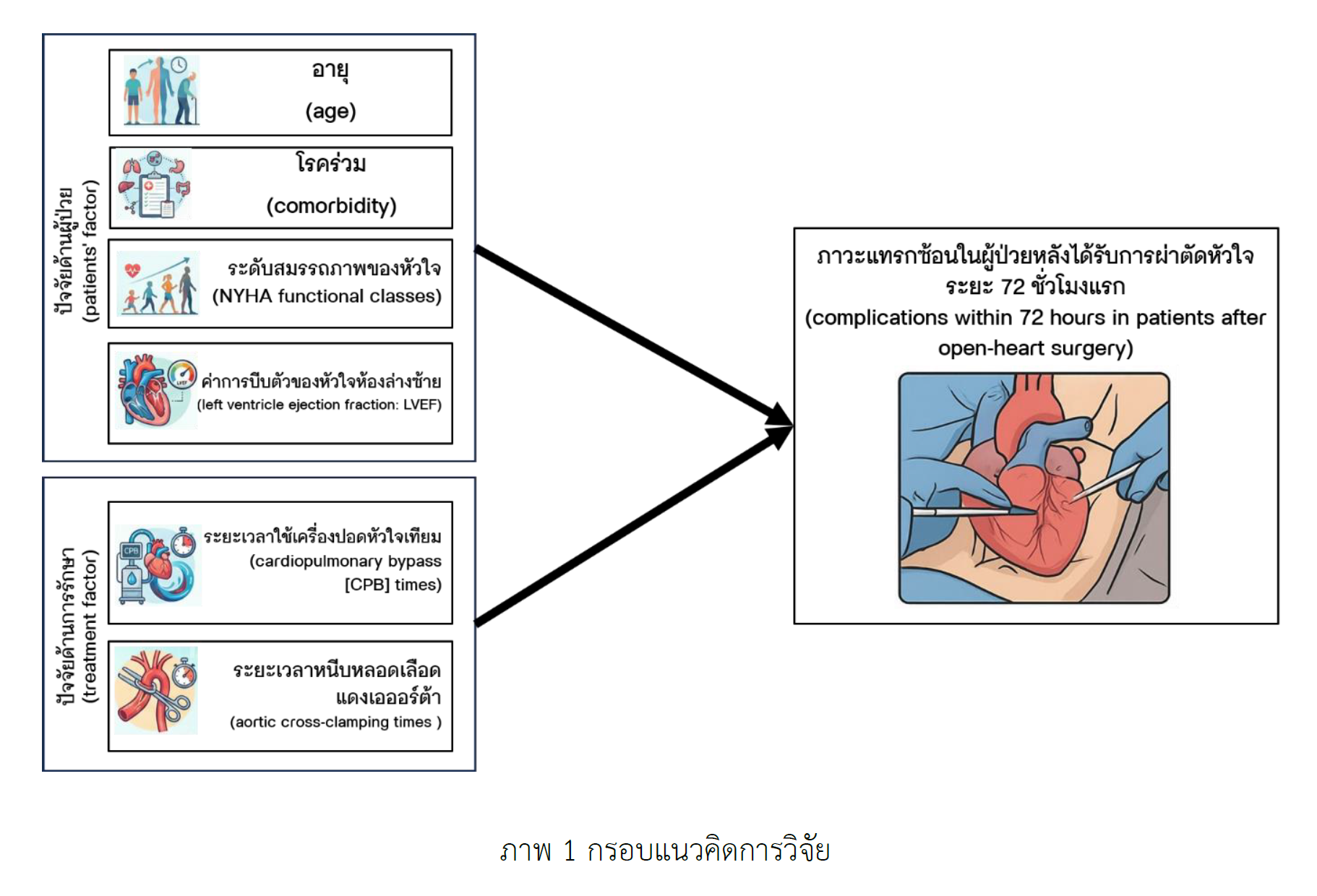
The purpose of this retrospective cohort study was to explore the relationship and factors influencing postoperative complications among patients undergoing open-heart surgery within the first 72 hours. The sample consisted of 345 patients who had undergone open-heart surgery and were admitted to the intensive care unit (ICU) at Ramathibodi Hospital, Mahidol University, between January 1, 2019, and December 31, 2020. Participants were selected using simple random sampling. Data collection instruments included record forms comprising 1) demographic information, 2) comorbidities, and 3) postoperative complications occurring within the first 72 hours after surgery. Data were analyzed using descriptive statistics, Pearson’s product-moment correlation, and hierarchical multiple regression analysis.
The results revealed that the three most common complications among patients undergoing open-heart surgery within the first 72 hours were cardiac arrhythmias (90.72%), myocardial damage (75.94%), and acute kidney injury (50.14%, respectively. Age, comorbidities, New York Heart Association (NYHA) functional classification, cardiopulmonary bypass (CPB) times, and aortic cross-clamp time were moderately positively correlated with complications within the first 72 hours (r = .492, r = .472, r = .375, r = .413, and r = .357, respectively; p < .05). In contrast, left ventricular ejection fraction (LVEF) was moderately negatively correlated with complications (r = -.350, p < .05). Additionally, age, comorbidities, NYHA classification, LVEF, CPB time, and aortic cross-clamp time significantly predicted postoperative complications within the first 72 hours, accounting for 41.3% of the variance (R2 = .413, p < .05).
These findings suggest that critical care nurses providing postoperative care for cardiac surgery patients can develop nursing care plans based on preoperative and intraoperative clinical data to prevent potential early complications following open-heart surgery in the ICU setting.
Downloads
References
Balachandran, S., Lee, A., Denehy, L., Lin, K. Y., Royse, A., Royse, C., & El-Ansary, D. (2016). Risk factors for sternal complications after cardiac operations: A systematic review. The Annals of Thoracic Surgery, 102(6), 2109–2117. https://doi.org/10.1016/j.athoracsur.2016.05.047
Ball, L., Costantino, F., & Pelosi, P. (2016). Postoperative complications of patients undergoing cardiac surgery. Current Opinion in Critical Care, 22(4), 386–392. https://doi.org/10.1097/MCC.0000000000000319
Bjorksten, J., & Tenhu, H. (1990). The crosslinking theory of aging-added evidence. Experimental Gerontology, 25(2), 91–95. https://doi.org/10.1016/0531-5565(90)90039-5
Charlson, M. E., Pompei, P., Ales, K. L., & Mackenzie, C. R. (1987). A new method of classifying prognostic co-morbidity in longitudinal studies: Development and validation. Journal of Chronic Disability, 40(5), 373-383. https://doi.org/10.1016/0021-9681(87)90171-8
Cohen, J. (1992). A power primer. Psychological Bulletin, 112, 155-159. https://doi.org/10.1037/0033-2909.112.1.155
Crawford, T. C., Magruder, J. T., Grimm, J. C., Suarez-Pierre, A., Sciortino, C. M., Mandal, K., . . . Whitman, G. J. (2017). Complications after cardiac operations: All are not created equal. The Annals of Thoracic Surgery, 103(1), 32–40. https://doi.org/10.1016/j.athoracsur.2016.10.022
DeVellis, R. F. (2017). Scale development: Theory and applications (4th ed.). Thousand Oaks, CA: Sage.
Edwards, F. H., Ferraris, V. A., Kurlansky, P. A., Lobdell, K. W., He, X., O'Brien, S. M., . . . Shahian, D. M. (2016). Failure to rescue rates after coronary artery bypass grafting: An analysis from The Society of Thoracic Surgeons Adult Cardiac Surgery database. The Annals of Thoracic Surgery, 102(2), 458–464. https://doi.org/10.1016/j.athoracsur.2016.04.051
Hardin, S. R., & Kaplow, R. (2020). Cardiac surgery essentials for critical care nursing (3rd ed.). Sudbury, MA: Jones and Bartlett Publishers.
Howell, D. C. (2013). Statistical methods for psychology (8th ed.). Belmont, California: Wadsworth Cengage Learning.
Howitt, S. H., Grant, S. W., Campbell, N. G., Malagon, I., & McCollum, C. (2020). Are serum potassium and magnesium levels associated with atrial fibrillation after cardiac surgery? Journal of Cardiothoracic and Vascular Anesthesia, 34(5), 1152–1159. https://doi.org/10.1053/j.jvca.2019.10.045
Jawitz, O. K., Gulack, B. C., Brennan, J. M., Thibault, D. P., Wang, A., O'Brien, S. M., . . . Smith, P. K. (2020). Association of postoperative complications and outcomes following coronary artery bypass grafting. American Heart Journal, 222, 220–228. https://doi.org/10.1016/j.ahj.2020.02.002
Kamiya, H., Tanzeem, N., Akhyari, P., Pedraza, A., Kallenbach, K., Lichtenberg, A., & Karck, M. (2014). Impact of severe postoperative complications after cardiac surgery on mortality in patients aged over 80 years. Annals of Thoracic and Cardiovascular Surgery, 20(5), 383–389. https://doi.org/10.5761/atcs.oa.13-02268
Matos, A. A., Silva, D. B., De Jesus, M. L., Guimarães, A. R., & Cordeiro, A. L. L. (2020). Incidence of complications after cardiac surgery. International Physical Medicine & Rehabilitation Journal, 5(1), 25-28. https://doi.org/10.15406/ipmrj.2020.05.00224
Mazzeffi, M., Zivot, J., Buchman, T., & Halkos, M. (2014). In-hospital mortality after cardiac surgery: Patient characteristics, timing, and association with postoperative length of intensive care unit and hospital stay. The Annals of Thoracic Surgery, 97(4), 1220–1225. https://doi.org/10.1016/j.athoracsur.2013.10.040
Omer, S., Adeseye, A., Jimenez, E., Cornwell, L. D., & Massarweh, N. N. (2022). Low left ventricular ejection fraction, complication rescue, and long-term survival after coronary artery bypass grafting. The Journal of Thoracic and Cardiovascular Surgery, 163(1), 111–119.e2. https://doi.org/10.1016/j.jtcvs.2020.03.040
Patra, C., Chamaiah Gatti, P., & Panigrahi, A. (2019). Morbidity after cardiac surgery under cardiopulmonary bypass and associated factors: A retrospective observational study. Indian Heart Journal, 71(4), 350–355. https://doi.org/10.1016/j.ihj.2019.07.004
Poungsombut, J., Sindhu, S., Thosingha, O., & Laksanabunsong, P. (2012). Factors related to complications in postoperative open heart surgery patients during critical period. The Journal of Faculty of Nursing Burapha University, 20(1), 22–32.
Roberts, A., Duncan, E. C., Hargrave, P., Kingery, D. R., Barnes, J., Horstemeyer, D. L., & Stahl, R. F. (2023). Complications of cardiopulmonary bypass from an anesthesia perspective: A clinical review. HCA Healthcare Journal of Medicine, 4(1), 13–21. https://doi.org/10.36518/2689-0216.1525
Siriratwarangkul, S. (2020). Complications after open heart surgery at Suratthani hospital. Thai Journal of Anesthesiology, 46(1), 7-14.
Soper, D. S. (2021). A-priori sample size calculator for multiple regression [Software]. Retrieved from https://www.danielsoper.com/statcalc
Thourani, V. H., Badhwar, V., Shahian, D. M., O’Brien, S., Kitahara, H., Vemulapalli, S., . . . Jacobs, J. P. (2019). The Society of Thoracic Surgeons Adult Cardiac Surgery Database: 2019 Update on research. The Annals of Thoracic Surgery, 108(2), 334–342. https://doi.org/10.1016/j.athoracsur.2019.05.001
Tiansawad, S. (2019). Instrument development for nursing research. Chiang Mai: Siampimnana.
Udzik, J., Sienkiewicz, S., Biskupski, A., Szylinska, A., Kowalska, Z., & Biskupski, P. (2020). Cardiac complications following cardiac surgery procedures. Journal of Clinical Medicine, 9(10), 3347. https://doi.org/10.3390/jcm9103347
Utriyaprasit, K. (2001). The relationship between recovery symptom and functional outcome in Thai CABG patients. Ohaio: Case Western Reserve University.
Vafeas, C., & Slatyer, S. (2021). Gerontological nursing: A holistic approach to the care of older people. Chatswood, NSW: Elsevier.
Wahba, A., Milojevic, M., Boer, C., De Somer, F. M. J. J., Gudbjartsson, T., van den Goor, J., . . . EACTS/ EACTA/EBCP Committee Reviewers. (2020). 2019 EACTS/EACTA/EBCP guidelines on cardiopulmonary bypass in adult cardiac surgery. European Journal of Cardio-Thoracic Surgery, 57(2), 210–251. https://doi.org/10.1093/ejcts/ezz267
You, S. C., Shim, C. Y., Hong, G. R., Kim, D., Cho, I. J., Lee, S., . . . Chung, N. (2016). Incidence, predictors, and clinical outcomes of postoperative cardiac tamponade in patients undergoing heart valve surgery. PloS One, 11(11), e0165754. https://doi.org/10.1371/journal.pone.0165754
Downloads
Published
How to Cite
Issue
Section
License
Copyright (c) 2025 JOURNAL OF THE POLICE NURSES AND HEALTH SCIENCE

This work is licensed under a Creative Commons Attribution-NonCommercial-NoDerivatives 4.0 International License.
ผลงานที่ได้ตีพิมพ์แล้วจะเป็นลิขสิทธิ์ของวารสารพยาบาลตำรวจ