DEVELOPMENT AND IMPLEMENTATION OF A PRACTICE PROTOCOL FOR BEREAVEMENT CARE FOR FAMILIES OF PEDIATRIC PATIENTS RECEIVING PALLIATIVE CARE
Keywords:
bereavement care, pediatric palliative care, family care guidelines for pediatric patientsAbstract
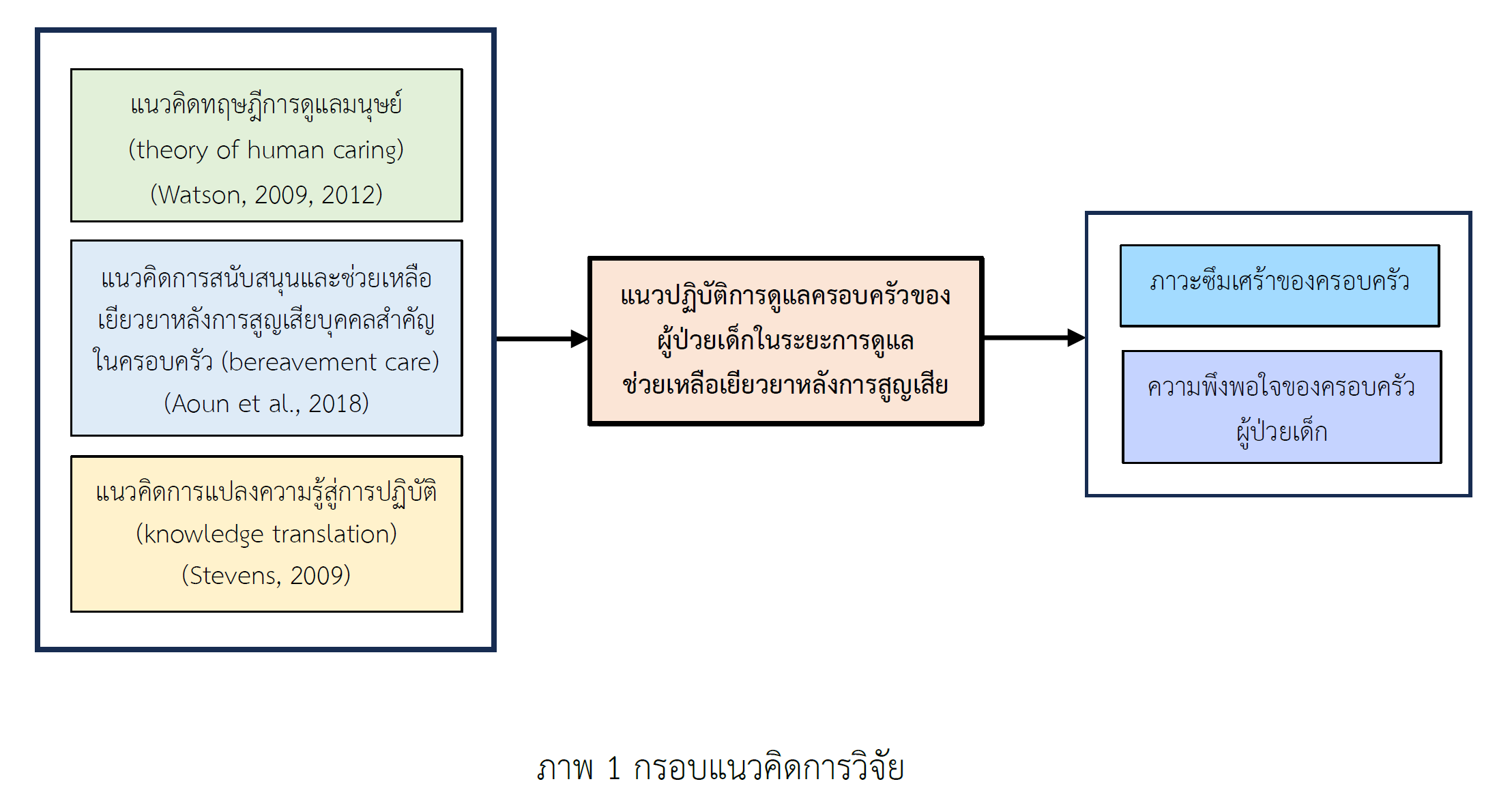
This research and development study aimed to develop and implement a practice guideline for bereavement care for families of pediatric patients who had received palliative care. The sample was selected using purposive sampling, including 43 family members of deceased pediatric patients who had entered the palliative care system at the Pediatric Nursing Department, Faculty of Medicine Ramathibodi Hospital, Mahidol University. The research instruments included the bereavement care practice guideline for families of pediatric patients, the Brief Grief Questionnaire (BGQ), and a satisfaction questionnaire. The reliability of BGQ measured by Cronbach’s alpha was .75. Data were analyzed using descriptive statistics and the Wilcoxon Signed-Rank test.
The findings indicated that: 1) The developed practice guideline for bereavement care of families of pediatric patients receiving palliative care demonstrated a content validity index (CVI) ranging from .87 to 1.00 and was considered both clinically appropriate and feasible, yielding outcomes aligned with its intended objectives; 2) Follow-up assessments of BGQ scores among participating family members showed a significantly decrease over time, with scores at 2 weeks, 6 weeks, and 6 months post-loss demonstrating statistical significance at the .05 level (Mdn2nd weeks = 4.00, Mdn6th weeks = 3.00 and Mdn6th months = 1.00, respectively; p = .000); and 3) Overall satisfaction with the bereavement care received over the 6-month period was reported at the highest level (M = 4.72, SD = .29).
Downloads
References
Aoun, S. M., Breen, L. J., White, I., Rumbold, B., & Kellehear, A. (2018). What sources of bereavement support are perceived helpful by bereaved people and why? Empirical evidence for the compassionate communities approach. Palliative Medicine, 32(8), 1378–1388. https://doi.org/10.1177/0269216318774995
Aoun, S. M., Rumbold, B., Howting, D., Bolleter, A., & Breen, L. J. (2017). Bereavement support for family caregivers: The gap between guidelines and practice in palliative care. PloS One, 12(10), e0184750. https://doi.org/10.1371/journal.pone.0184750
Best, J. W., & Khan, J. V. (2016). Research in education (10th ed.). Englewood Cliffs, NJ: Prentice-Hall.
Breen, L. J., Kawashima, D., Joy, K., Cadell, S., Roth, D., Chow, A., & Macdonald, M. E. (2022). Grief literacy: A call to action for compassionate communities. Death Studies, 46(2), 425–433. https://doi.org/10.1080/07481187.2020.1739780
Hudson, P., Hall, C., Boughey, A., & Roulston, A. (2018). Bereavement support standards and bereavement care pathway for quality palliative care. Palliative & Supportive Care, 16(4), 375-387. https://doi.org/10.1017/S1478951517000451
Ito, M., Nakajima, S., Fujisawa, D., Miyashita, M., Kim, Y., Shear, M. K., . . . Wall, M. M. (2012). Brief measure for screening complicated grief: Reliability and discriminant validity. PloS One, 7(2), e31209. https://doi.org/10.1371/journal.pone.0031209
Kanjanawasee, S. (2016). Research and development for Thai education. Silpakorn Educational Research Journal, 8(2), 1-18.
Kobel, C., Morris, D., Thompson, C., & Williams, K. E. (2019). Bereavement support in palliative care: A national survey of Australian services. Journal of Palliative Medicine, 22(8), 933-938. https://doi.org/10.1089/jpm.2018.0502
Lichtenthal, W. G., & Breitbart, W. (2015). The central role of meaning in adjustment to the loss of a child to cancer: Implications for the development of meaning-centered grief therapy. Current Opinion in Supportive and Palliative Care, 9(1), 46–51. https://doi.org/10.1097/SPC.0000000000000117
Lichtenthal, W. G., Roberts, K. E., Donovan, L. A., Breen, L. J., Aoun, S. M., Connor, S. R., & Rosa, W. E. (2024). Investing in bereavement care as a public health priority. The Lancet Public Health, 9(4), e270–e274. https://doi.org/10.1016/S2468-2667(24)00030-6
Melnyk, B. M., & Fineout-Overholt, E. (2023). Evidence-based practice in nursing & healthcare: A guide to best practice (5th ed.). Philadelphia, PA: Wolters Kluwer/Lippincott Williams & Wilkins.
Polit, D. F., & Hungler, B. (2013). Essentials of nursing research: Methods, appraisal, and utilization (8th ed.). Philadelphia: Lippincott Williams and Wilkins.
Public Health Strategies of the Ministry of Public Health. (2020). Public health statistics A.D.2019. Nonthaburi: Ministry of Public Health.
Shear, K. M., Jackson, C. T., Essock, S. M., Donahue, S. A., & Felton, C. J. (2006). Screening for complicated grief among Project Liberty service recipients 18 months after September 11, 2001. Psychiatric Services, 57(9), 1291-1297. https://doi.org/10.1176/ps.2006.57.9.1291
Stevens, K. R. (2009). Essential competencies for evidence-based practice in nursing. Academic Center for Evidence-Based Practice. University of Texas Health Science Center at San Antonio.
Thamanee, G., Patoomwan, A., & Phengjard, J. (2018). Palliative care needs of children with cancer and their families as perceived by family caregivers. Ramathibodi Nursing Journal, 24(3), 295-312.
Watson, J. (2009). Caring science and human caring theory: Transforming personal and professional practices of nursing and health care. Journal of Health and Human Services Administration, 31(4), 466–482. http://www.jstor.org/stable/25790743
Watson, J. (2012). Human caring science: A theory of nursing (2nd ed.). Burlington: Jones & Bartlett Learning.
Wongwanich, S. (2016). Educational research methodology: Inspiring new perspective. Bangkok: Icon printing.
Yathongchai, S., Boontoch, K., & Wanta, R. (2023). Effects of the bereavement program to prevent complicated grief of bereaved parents who lose a child from illness. Journal of Nursing Science and Health, 46(1), 74–87.
Downloads
Published
How to Cite
Issue
Section
License
Copyright (c) 2025 JOURNAL OF THE POLICE NURSES AND HEALTH SCIENCE

This work is licensed under a Creative Commons Attribution-NonCommercial-NoDerivatives 4.0 International License.
ผลงานที่ได้ตีพิมพ์แล้วจะเป็นลิขสิทธิ์ของวารสารพยาบาลตำรวจ