THE EFFECT OF PENDER’S HEALTH PROMOTION MODEL ON COREGIVERS’ HEARING PROMOTION BEHAVIORS TOWARDS HIGH-RISK INFANTS WITH HEARING IMPAIRMENT AND FOLLOW UP RATE
Keywords:
high-risk infants, missed follow-up appointments, hearing loss, Pender’s health promotion modelAbstract
This quasi-experimental study aimed to 1) compare caregivers’ hearing promotion behaviors for newborns at risk of hearing loss before and after receiving Pender’s Health Promotion Model and 2) examine the follow-up attendance rate among these infants. The sample consisted of 27 caregivers and 27 newborns at risk of hearing loss who were admitted to the Neonatal Intensive Care Unit and the Premature Care Unit at the Queen Sirikit National Institute of Child Health. All infants had failed their initial hearing screening and were scheduled for follow-up assessments. The experimental tool was Pender’s Health Promotion Model applied to caregivers’ hearing promotion behaviors for newborns at risk of hearing loss and their adherence to follow-up appointments. The research instruments used for data collection include: a caregiver demographic questionnaire, a follow-up appointment record form, and a caregiver behavior assessment form for hearing promotion in newborns at risk of hearing loss. The assessment form was validated by experts and had a reliability coefficient of .83. Data was analyzed using descriptive statistics and Friedman’s test.
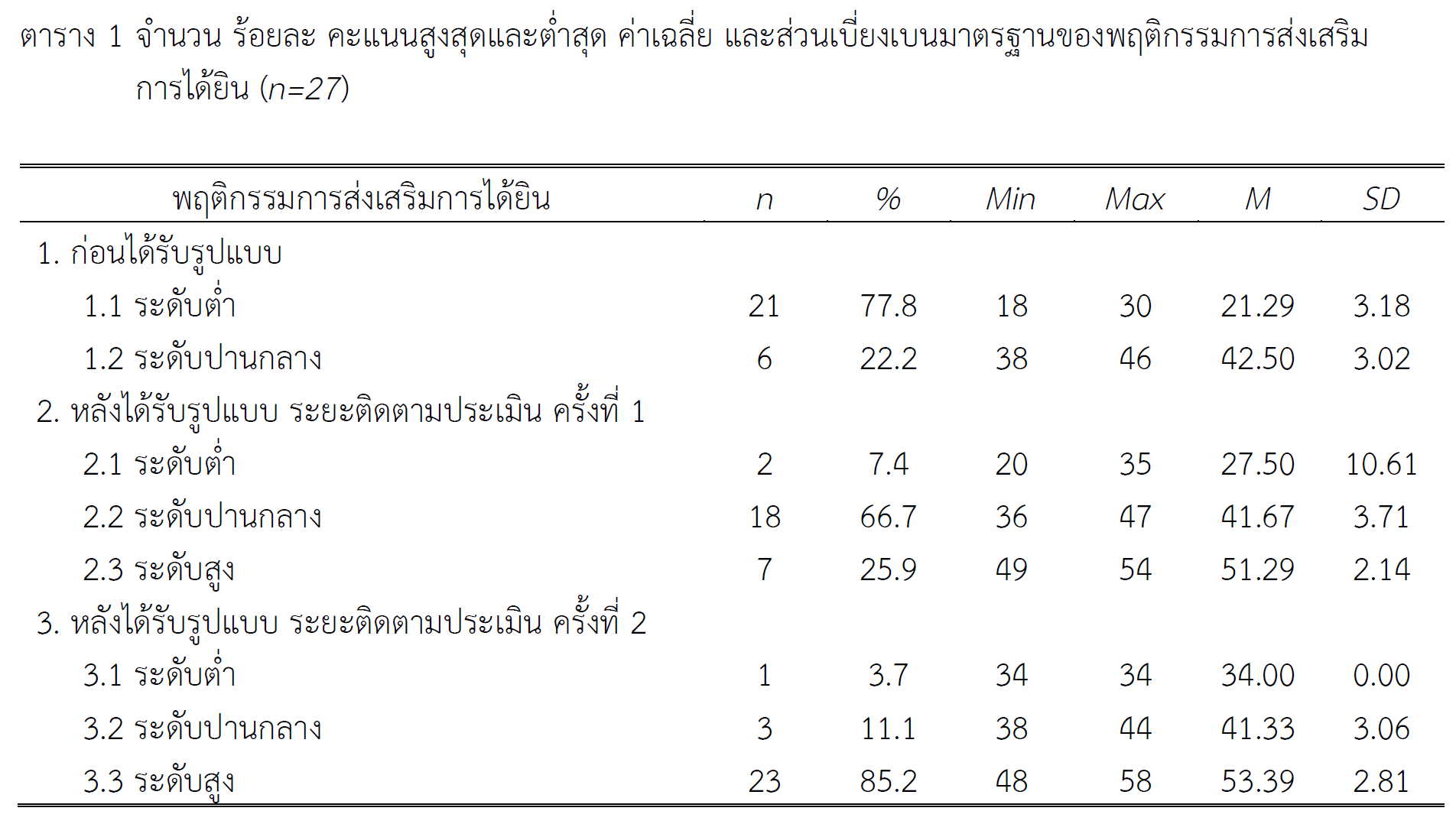
The research results found that: (1) Caregivers' hearing promotion behavior scores significantly increased over time, from a low level before the intervention (M = 21.29, SD = 3.18), to a moderate level at the first follow-up (M = 41.67, SD = 3.71), and to a high level at the second follow-up (M = 53.39, SD = 2.81). (2) The caregivers’ hearing promotion behavior scores for newborns at risk of hearing loss before receiving the intervention, after receiving the intervention at the first follow-up, and after receiving the intervention at the second follow-up were significantly different in at least one pair, with a statistical significance level of p < .05. (3) Follow-up attendance rates for infants at risk of hearing loss were 85.19% at the first follow-up and 88.89% at the second follow-up.
The results should be used to establish policies or guidelines for improving the quality of hearing screening programs, in order to identify children with hearing impairments and provide timely hearing rehabilitation within six months.
Downloads
References
Chouyboonchum, T., Chamchoi, P., Chaikhamrongkul, T., Isarangura, S., & Tiravanitchakul, R. (2022). Universal newborn hearing screening and incidence of hearing loss in Ramathibodi hospital: A 5-year experience (2014 to 2018). Ramathibodi Medical Journal, 45(4), 25-34.
Fortnum, H. M., Davis, A., Summerfield, A. Q., Marshall, D. H., Davis, A. C., Bamford, J. M., . . . Hind, S. (2001). Prevalence of permanent childhood hearing impairment in the United Kingdom and implications for universal neonatal hearing screening: questionnaire-based ascertainment study Commentary: Universal newborn hearing screening: Implications for coordinating and developing services for deaf and hearing-impaired children. BMJ, 323(7312), 536-539.
Hsieh, W. H., & Lin, H. C. (2022). Follow-up on children with suspected bilateral congenital hearing loss identified through universal newborn hearing screening program in Taiwan: A national-based population study. International Journal of Pediatric Otorhinolaryngology, 157, 111141. https://doi.org/10.1016/j.ijporl.2022.111141
Jansong, W. & Chaiyawat, W. (2016). The effect of the nursing intervention based on Pender’s health promotion model on infection prevention behaviors in mothers of 1-5 year-old children with cancer undergoing chemotherapy. Thai Red Cross Nursing Journal, 9(2), 159-172.
Joint Committee on Infant Hearing, American Academy of Pediatrics, & American Speech-Language-Hearing Association. (2000). Year 2000 position statement: Principles and guidelines for early hearing detection and intervention programs. Joint Committee on Infant Hearing, American Academy of Audiology, American Academy of Pediatrics, American Speech-Language-Hearing Association, and Directors of Speech and Hearing Programs in State Health and Welfare Agencies. Pediatrics, 106(4), 798-817.
Kasemsiri, J. (2018). Effect of the developmental promoting program on mother’s behavior to promote development of premature infants (Master of Nursing Science). Faculty of Nursing, Burapha University, Chonburi.
Ministry of Public Health. (2021). Manual for assessing and promoting the development of children at risk. Nonthaburi: War Veterans Organization.
Queen Sirikit National Institute of Child Health. (2022). Statistics of the Otorhinolaryngology Unit. Photocopied documents.
Parangrit, K. (2022). Factors affecting newborn hearing screening follow-up at Otolaryngology Department, Chiang Rai Prachanukroh hospital. Chiang Rai Medical Journal, 14(3), 9-17.
Russ, S. A., Hanna, D., DesGeorges, J., & Forsman, I. (2010). Improving follow-up to newborn hearing screening: A learning-collaborative experience. Pediatrics, 126(Supp1), S59-S69.
Scheepers, L. J., Swanepoel, D. W., & Le Roux, T. (2014). Why parents refuse newborn hearing screening and default on follow-up rescreening - A South African perspective. International Journal of Pediatric Otorhinolaryngology, 78(4), 652-658.
Srichanchai, J., & Thongmee, A. (2022). Nurse’ role in the developmental language disorder (DLD) In early childhood during the COVID-19 outbreak. Journal of MCU Nakhondhat, 9(8), 1-16.
Surawongsin, A. (2007). Hearing test results (OAE and ABR) in high-risk infants (Thesis according to the curriculum to approve the knowledge and experts in the practice of pediatrics).
Thompson, D. C., McPhillips, H., Davis, R. L., Lieu, T. A., Homer, C. J., & Helfand, M. (2001). Universal newborn hearing screening: summary of evidence. JAMA, 286(16), 2000-2010.
Titirungruang, C., Charusripan, P., & Patarapak, S. (2018). Early detection of infant hearing impairment. Chulalongkorn Medical Journal, 62(1), 53-65.
Trumikaborworn, S. (2023). Pender's theory of health promotion. Retrieved from http://www.nurse.ubu.ac.th/sub/knowledgedetail/PD.pdf
Downloads
Published
How to Cite
Issue
Section
License
Copyright (c) 2025 JOURNAL OF THE POLICE NURSES AND HEALTH SCIENCE

This work is licensed under a Creative Commons Attribution-NonCommercial-NoDerivatives 4.0 International License.
ผลงานที่ได้ตีพิมพ์แล้วจะเป็นลิขสิทธิ์ของวารสารพยาบาลตำรวจ