การพัฒนาแบบประเมินปัญหาพฤติกรรมสำหรับเด็กบกพร่องทางสติปัญญาเพื่อใช้ในการดำเนินงานพัฒนาเด็กบกพร่องทางสติปัญญาของบุคลากรสาธารณสุข
คำสำคัญ:
แบบประเมินปัญหาพฤติกรรม, เด็กบกพร่องทางสติปัญญา, บุคลากรสาธารณสุขบทคัดย่อ
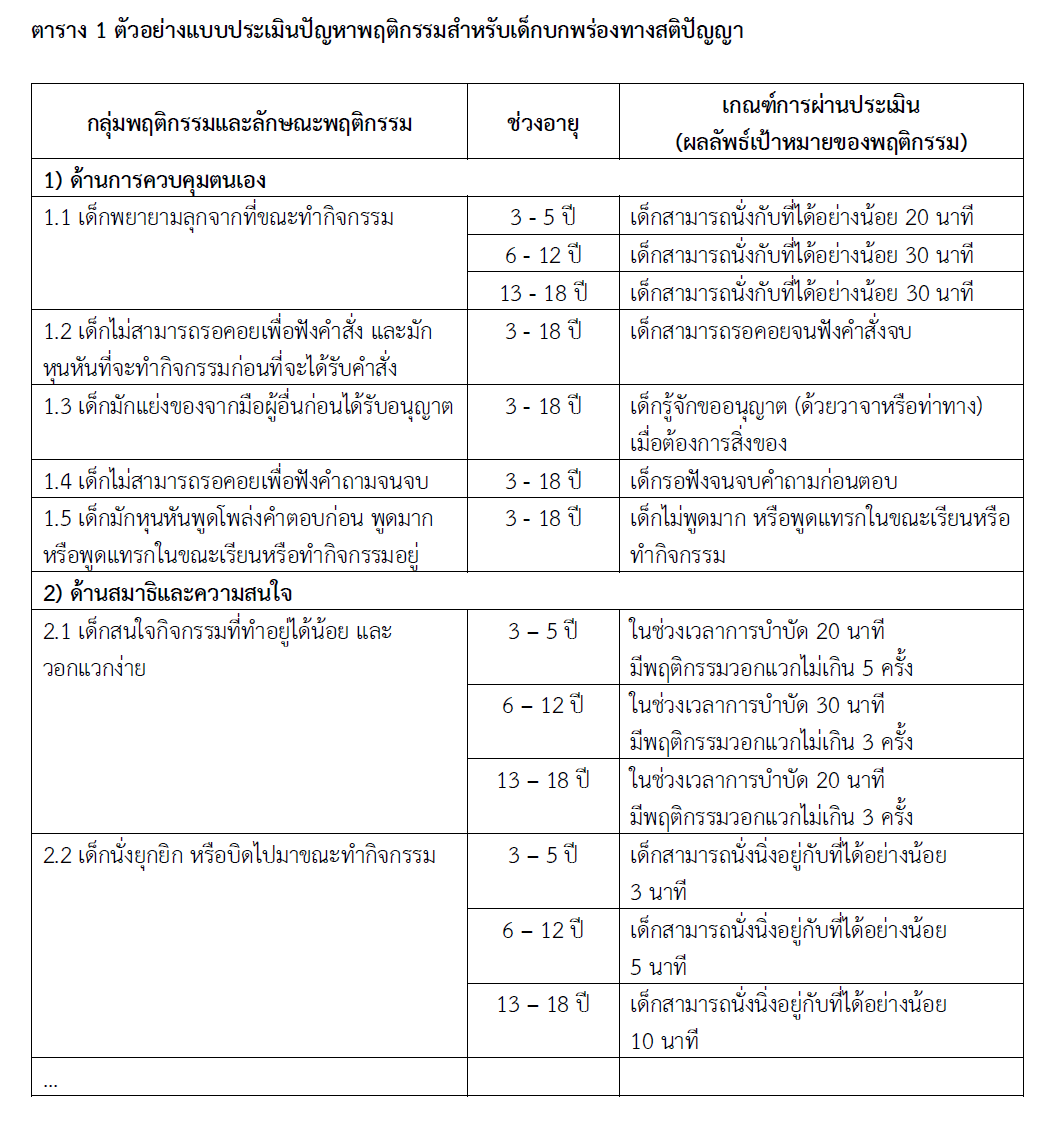
การวิจัยนี้เป็นการวิจัยและพัฒนา ดำเนินการวิจัยใน 2 ระยะ คือ ระยะที่ 1 ร่างแบบประเมิน ตรวจสอบคุณภาพ และทดลองใช้แบบประเมินปัญหาพฤติกรรมสำหรับเด็กบกพร่องทางสติปัญญา และระยะที่ 2 พัฒนาแบบประเมินจากระยะแรก และติดตามประเมินผลการนำไปใช้ ตัวอย่างแบ่งเป็น 2 ระยะ ระยะที่ 1 เป็นเด็กบกพร่องทางสติปัญญา จำนวน 32 คน และระยะที่ 2 เป็นบุคลากรสาธารณสุข จำนวน 60 คน เลือกแบบเฉพาะเจาะจงตามเกณฑ์ เครื่องมือที่ใช้ในการวิจัย คือ แบบประเมินปัญหาพฤติกรรมสำหรับเด็กบกพร่องทางสติปัญญาและแบบประเมินผลการใช้แบบประเมิน การวิเคราะห์ข้อมูลโดยใช้สถิติบรรยาย ได้แก่ ความถี่ ร้อยละ และวิเคราะห์คุณภาพเครื่องมือด้วยดัชนีความสอดคล้องระหว่างข้อคำถามกับวัตถุประสงค์ และความเชื่อมั่นระหว่างผู้สังเกต
ผลการวิจัยพบว่า 1) แบบประเมินปัญหาพฤติกรรมสำหรับเด็กบกพร่องทางสติปัญญา ฉบับทดลองใช้ มีทั้งหมด 7 ด้าน 35 ข้อ มีค่าดัชนีความสอดคล้องระหว่างข้อคำถามกับวัตถุประสงค์ อยู่ระหว่าง .40 - 1.00 และมีค่าความเชื่อมั่นระหว่างผู้สังเกต เท่ากับ .81 และ 2) แบบประเมินปัญหาพฤติกรรมสำหรับเด็กบกพร่องทางสติปัญญา ฉบับสมบูรณ์ มีทั้งหมด 7 ด้าน 30 ข้อ และผลการประเมินจากการนำไปใช้พบว่า แบบประเมินปัญหาพฤติกรรมสำหรับเด็กบกพร่องทางสติปัญญาที่พัฒนาขึ้นมีประโยชน์ในการนำไปใช้ในการประเมินคัดกรอง การวางแผนบำบัดรักษา การนำไปใช้ในงานชุมชนหรือเครือข่าย งานวิชาการหรืองานวิจัย การสอนหรือการถ่ายทอดความรู้ อีกทั้ง ยังสามารถนำไปต่อยอดเป็นแนวทางเชิงนโยบายเพื่อขยายผลการดำเนินการพัฒนาเด็กบกพร่องทางสติปัญญาในระดับชุมชนและประเทศในอนาคต
Downloads
เอกสารอ้างอิง
Aman, M. G., & Singh, N. N. (2016). Aberrant behavior checklist (ABC). In J. L. Matson (Ed.), Handbook of intellectual and developmental disabilities (pp. 109–123). New York, NY: Springer. https://doi.org/10.1007/978-1-4939-3186-2_8
Department of Mental Health. (2024). Five-year operational plan (2023–2027) of the department of mental health. Retrieved from http://www.dmh.go.th/intranet/p2554/download/view.asp?id=2349
Emerson, E. (2015). The evaluation and treatment of challenging behaviour in people with intellectual disabilities. In R. McCulloch & S. Hutchison (Eds.), Challenging behaviour in children and adolescents (pp. 117–131). Routledge. https://doi.org/10.4324/9781315741887
Glidden, L. M., Abbeduto, L., McIntyre, L. L., & Tassé, M. J. (Eds.). (2021). APA handbook of intellectual and developmental disabilities (Vols. 1 & 2). American Psychological Association.
Khaimuk, P. (2024). Policy on mental health development for the fiscal year 2024. Retrieved from http://www.dmh.go.th/intranet/p2554/policy/view.asp?id=3399
Landis, J. R., & Koch, G. G. (1977). The measurement of observer agreement for categorical data. Biometrics, 33(1), 159-174.
O'Neill, R. E., Horner, R. H., Albin, R. W., Sprague, J. R., Storey, K., & Newton, J. S. (2015). Functional assessment and program development for problem behavior: A practical handbook (3rd ed.). Pacific Grove, CA: Brooks/Cole.
Rajanukul Institute. (2024). Vision: Mission of Rajanukul Institute. Retrieved from http://www.rajanukul.go.th/_admin/file-download/12-6865-1550478402.pdf
Reyes-Martín, J., Simó-Pinatella, D., & Font-Roura, J. (2022). Assessment of challenging behavior exhibited by people with intellectual and developmental disabilities: A systematic review. International Journal of Environmental Research and Public Health, 19(14), 8701. https://doi.org/10.3390/ijerph19148701
Zablotsky, B., Ng, A. E., Black, L. I., & Blumberg, S. J. (2023). Diagnosed developmental disabilities in children aged 3–17 years: United States, 2019–2021. NCHS Data Brief, no 473. Hyattsville, MD: National Center for Health Statistics. https://dx.doi.org/10.15620/cdc:129520
ดาวน์โหลด
เผยแพร่แล้ว
รูปแบบการอ้างอิง
ฉบับ
ประเภทบทความ
สัญญาอนุญาต
ลิขสิทธิ์ (c) 2025 วารสารพยาบาลตำรวจและวิทยาศาสตร์สุขภาพ

อนุญาตภายใต้เงื่อนไข Creative Commons Attribution-NonCommercial-NoDerivatives 4.0 International License.
ผลงานที่ได้ตีพิมพ์แล้วจะเป็นลิขสิทธิ์ของวารสารพยาบาลตำรวจ