THE EFFECTIVENESS OF USING NURSING PRACTICE GUIDELINES FOR THE PREVENTION OF POSTPARTUM HEMORRHAGE WITHIN 2 HOURS AFTER DELIVERY IN THE DELIVERY ROOM DEPARTMENT, OMKOI HOSPITAL, CHIANG MAI PROVINCE
Keywords:
nursing practice guidelines, postpartum hemorrhage, nurse satisfaction, nursing practice skillsAbstract
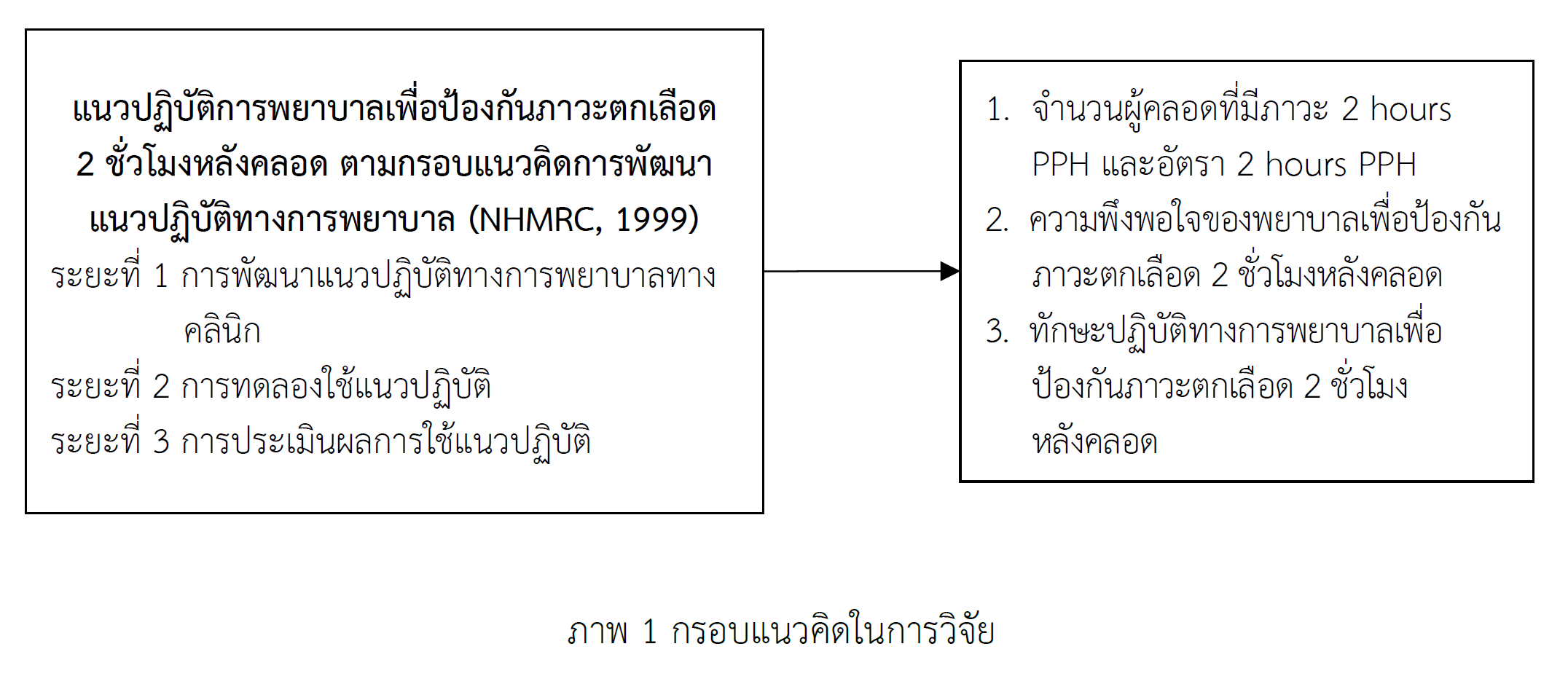
This quasi-experimental research aimed to study the incidence of postpartum hemorrhage (PPH) within 2 hours after delivery, evaluate nurse satisfaction, and compare nursing practical skill scores before and after the implementation of nursing practice guidelines for the prevention of postpartum hemorrhage within that period. The sample consisted of 14 professional nurses rotating through the labor room and 57 term pregnant women who received care between March and April 2024. The research tool was the nursing practice guidelines for the prevention of postpartum hemorrhage within 2 hours after delivery. The instruments used for data collection were the nurse satisfaction questionnaire and the nursing practice skill assessment form for PPH prevention. Data were analyzed using descriptive statistics including frequency, percentage, mean, standard deviation, variance, and compared using Repeated Measures ANOVA.
The results showed that: 1) The incidence of postpartum hemorrhage within 2 hours decreased after the intervention. 2) The mean nurse satisfaction score after the intervention was at a moderate level (M = 18.00). 3) The mean nursing practice skill scores after the intervention in both the first and second months were significantly higher than before the intervention. 4) The mean skill scores in the second month post-intervention were significantly higher than both the pre-intervention and the first month post-intervention scores.
Therefore, the nursing practice guidelines for the prevention of postpartum hemorrhage within 2 hours after delivery can help labor room midwives at Omkoi Hospital provide more effective care and reduce maternal mortality. Future research should explore the long-term sustainability of skill retention and the outcomes of this guideline, and the implementation of these guidelines should be promoted in labor rooms of other hospitals as well.
Downloads
References
Bloom, B. S. (1971). Handbook on formative and summative evaluation of student learning. New York, NY: McGraw–Hill.
Bureau of Health Promotion. (2022). The analysis of maternal death in Thailand in the last 6 months of the fiscal year 2022 (September 2021 – March 2022), the maternal mortality surveillance system. Retrieved from https://hp.anamai.moph.go.th/
Chantaburee, N., Siriphan, S., Tohpaeroh, M., & Maeka, S. (2024). Factors predicting maternal-infant attachment following unplanned cesarean section in Thai-Muslim mothers, Narathiwat province. Journal of The Police Nurses and Health Science, 16(1), 195-206.
Charoensri, P., Sarakarn, W., & Chaiyara, B. (2017). The development of a nursing model for pregnant women to prevent early postpartum hemorrhage. Journal of Nursing and Health Care, 35(3), 48-57.
Cohen, J. (1977). Statistical power for the behavioral sciences (2nd ed.). New York, NY: Academic Press.
Delivery Room, Omkoi Hospital. (2023). Summary of birth report for fiscal year 2020 - 2023, Omkoi Hospital. Chiang Mai: Omkoi Hospital.
Escobar, M. F., Nassar, A. H., Theron, G., Barnea, E. R., Nicholson, W., Ramasauskaite, D., . . . Nasner, D. (2022d). FIGO recommendations on the management of postpartum hemorrhage 2022. International Journal of Gynecology & Obstetrics, 157(S1), 3–50. https://doi.org/10.1002/ijgo.14116
Khamkruea, S., Srisuwan, T., & Kaewboonruang, R. (2018). Development of clinical practice guideline for early postpartum hemorrhage in labor room, Lamphun hospital. Lanna Journal of Health Promotion & Environmental Health, 8(1), 46-57.
Kunsete, P. (2021). Development of a clinical nursing practice guideline to prevent early postpartum hemorrhage for vaginal delivery in a labor room, Songkhla hospital. Journal of Nursing and Public Health Research, 1(2), 83-99.
Lowdermilk, D. L., Cashion, M. C., Alden, K. R., Olshansky, E., & Perry, S. E. (2024). Maternity and women’s health care (13th ed.). St. Louis, MO: Elsevier.
Maternal and Child Health Division, Department of Health. (2024). Maternal and child health division, Department of Health (April 2024 Situation), Ministry of Public Health. Retrieved from https://hp.anamai.moph.go.th/
Maternal and Child Health Section, Chiang Mai Provincial Public Health Office. (2023). Maternal and child health situation in Chiang Mai province. Retrieved from https://www.chiangmaihealth.go.th/document/230714168930015872.pdf
National Health and Medical Research Council (NMRC). (1999). A guide to the developmental, implementation and evaluation of clinical practice guidelines. Retrieved from http://www.nhmrc.gov.au/_files_nhmrc/file/publications/synopses/cp30.pdf
Pairoj, P., & Sirilert, S. (2025). Update management of postpartum hemorrhage. Retrieved from https://w1.med.cmu.ac.th/obgyn/lecturestopics/54198/
Pochana, W., Chaiwongsa, W., & Somchok, P. (2021). Development of the risk factor assessment and nursing practice guideline for prevention of early postpartum hemorrhage by knowledge management, Sawang Dandin Crown Prince Hospital. Research and Development Health System Journal, 14(2), 182-194.
Sanitlou, N., Satphet, W., & Naphaarak, Y. (2019). Sample size calculation using G*Power program. Journal of Suvarnabhumi Institute of Technology (Human and Social Sciences), 5(1), 496-507.
The Joanna Briggs Institute. (2013). New JBI levels of evidence: Level of evidence and grades of recommendation working party October 2013. Retrieved from http://www.Joannabriggs.edu.aupubs/approach.php
The Royal Thai College of the Obstetricians and Gynecologists. (2020). RTCOG, Clinical practice guideline prevention and management of postpartum hemorrhage. Retrieved from https://www.rtcog.or.th/photo/cpg/OB-63-020.pdf
Thiansawat, S. (2020). Instrument development for nursing research. Chiangmai: Siam Print Nana Company.
Ueatrongchit, K., Panpakdee, O., & Siripittayakunkit, A. (2012). Factors contributing to advanced practice nurses’ professional satisfaction. Thai Journal of Nursing Council, 27(2) 5-16.
Wongpon, P., & Somwong, S. (2024). Development of nursing practice guidelines to prevent of 24 hours postpartum hemorrhage by monitoring to prevent uterine atony in Saimoon hospital, Yasothon province. Retrieved from https://yasothon.moph.go.th/ssjyasothon/FrontEnd/report_AcademicWork_Read.php?racd_id=45&racdf_id=51
World Health Organization (WHO). (2023). WHO recommendations on the assessment of postpartum blood loss and use of a treatment bundle for postpartum haemorrhage. Geneva: World Health Organization. Retrieved from https://www.who.int/publications/i/item/9789240085398
Downloads
Published
How to Cite
Issue
Section
License
Copyright (c) 2025 JOURNAL OF THE POLICE NURSES AND HEALTH SCIENCE

This work is licensed under a Creative Commons Attribution-NonCommercial-NoDerivatives 4.0 International License.
ผลงานที่ได้ตีพิมพ์แล้วจะเป็นลิขสิทธิ์ของวารสารพยาบาลตำรวจ