FACTORS PREDICTING PARENTING STRESS IN PARENTS OF CHILDREN WITH AUTISM SPECTRUM DISORDER DURING THE COVID-19 PANDEMIC
Keywords:
parenting stress, children with autism spectrum disorder, COVID-19, behavior problem, online learningAbstract
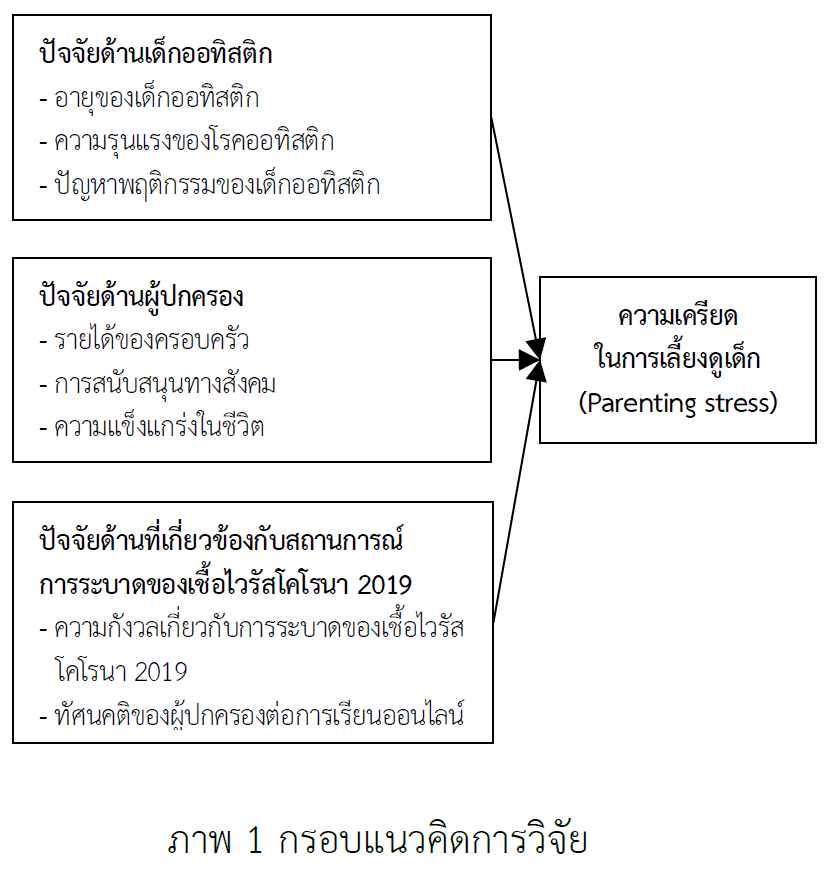
This research aimed to investigate the factors predicting parenting stress in parents of children with autism spectrum disorder (ASD). The sample consisted of 85 parents of children with ASD who sought services at the Child and Adolescent Psychiatric Department under the Department of Mental Health. The instruments for the data collection were a Parental Stress Scale, Home Situation Questionnaire-Autism Spectrum Disorder, Revised-Thai Version of the Multi-dimentional Scale of Perceived Social Support, Resilience Inventory, Worry about COVID-19 Scale, and Distance Education Scale. The reliability indicies of research instruments were tested by Cronbach’s alpha coefficients equal to .78, .97, .91, .93, .93 and .77, respectively. The data were analyzed using descriptive statistics, correlation coefficient, and stepwise multiple regression.
The findings revealed that behavior problems of children with ASD, resilience, and parental attitude about online learning accounted for 38 percent of parenting stress in parents of children with ASD (R2 = .38, R2Change = .04, F (3,79) = 16.03, p < .05). Hence, the findings can be utilized as basic information to develop a guideline preventing parenting stress in the parents of children with ASD.
Downloads
References
American Psychiatric Association. (2013). Diagnostic and statistical manual of mental disorders (DSM-V) (5th ed.). Arlington, VA.
Berry, J. O., & Jones, W. H. (1995). The parental stress scale: Initial psychometric evidence. Journal of Social and Personal Relationships, 12(3), 463-472.
Centers for Disease Control and Prevention. (2020). Data & statistics on autism spectrum disorder. Retrieved from https://www.cdc.gov/ncbddd/autism/data.html
Chawdhury, M., Aman, M. G., Lecavalier, L., Smith, T., Johnson, C., Swiezy, N., . . . Scahill, L. (2016). Factor structure and psychometric properties of the revised Home Situations Questionnaire for autism spectrum disorder: The home situations questionnaire- autism spectrum disorder. Autism, 20(5), 528-537.
Colizzi, M., Sironi, E., Antonini, F., Ciceri, M. L., Bovo, C., & Zoccante, L. (2020). Psychosocial and behavioral impact of COVID-19 in autism spectrum disorder: An online parent survey. Brain Sciences, 10, 341-357.
Di Renzo, M., Di Castelbianco, F. B., Vanadia, E., Petrillo, M., D’Errico, S. Racinaro, L., . . . Rea, M. (2020). Parent-reported behavioural changes in children with autism spectrum disorder during the COVID-19 lockdown in Italy. Continuity in Education, 1(1), 117–125.
Efstratopoulou, M., Delligianidou, S., & Sofologi, M. (2021). Exploring parents’ experience on distance learning for student with ASD. European Journal of Special Education Research, 7(1), 14-23.
Huang, S., Sun, T., Zhu, Y., Song, S., Zhang. J., Huang. L., . . . Jing, J. (2021). Impact of the COVID-19 pandemic on children with ASD and their families: An online survey in China. Psychology Research and Behavior Management, 14, 289-297.
Latzer, I. T., Leitner, Y., & Karnieli-Miller, O. (2021). Core experiences of parents of children with autism during the COVID-19 pandemic lockdown. Autism, 25(4), 1047-1059.
Levante, A., Petrocchi, S., Bianco, F., Castelli, I., Colombi, C., Keller, R., . . . Lecciso, F. (2021). Psychological impact of COVID-19 outbreak on families of children with autism spectrum disorder and typically developing peers: An online survey. Brain Sciences, 11(6), 808.
Manning, J., Billian, J., Matson, J., Allen, C., & Soares, N. (2021). Perceptions of families of individuals with autism spectrum disorder during the COVID-19 crisis. Journal of Autism and Developmental Disorders, 51, 2920–2928.
Marcellus, L. (2004). Are we missing anything? Pursuing research on attrition. Canadian Journal of Nursing Research, 36(3), 82-98.
Martin, K. B., Hammal, Z., Ren, G., Cohn, J. F., Cassell., J., Ogihara, M., . . . Messinger, D. S. (2018). Objective measurement of head movement differences in children with and without autism spectrum disorder. Molecular Autism, 9, 14.
Miranda, A., Mira, A., Berenguer, C., Rosello, B., & Baixauli, I. (2019). Parenting stress in mothers of children with autism without intellectual disability. Mediation of behavioral problems and coping strategies. Frontiers in Psychology, 10, 464.
Mutluer, T., Doenyas, C. & Genc, A. (2020). Behavioral implications of the COVID-19 process for autism spectrum disorder, and individuals' comprehension of and reactions to the pandemic conditions. Frontiers in Psychiatry, 11, 561882.
Nader-Grosbois, N., & Mazzone, S. (2014). Emotional regulation, personality and social adjustment in children with autism disorders. Psychology, 5, 1750-1767.
Nintachan, P., & Sangon, S. (2021). Development of worry about COVID-19 scale (Research report). Bangkok: Ramathibodi School of Nursing, Faculty of Medicine Ramathibodi Hospital, Mahidol University.
Nintachan, P., Sangon, S., & Thaweekoon, T. (2012). A resilience-enhancing program. Bangkok: Judthong.
Öçal, T., Halmatov, M., & Ata, T. (2021). Distance education in COVID-19 pandemic: An evaluation of parent’s, child’s and teacher’s competences. Education and Information Technologies, 26, 6901–6921.
Parenteau, C. I., Bent, S., Hossain, B., Chen, Y., Widjaja, F., Breard, M., . . . Hendren, R. L. (2020). COVID-19 related challenges and advice from parents of children with autism spectrum disorder. SciMedicine Journal, 2(Special Issue “COVID-19”), 73-82.
Pastor-Cerezuela, G., Fernández-Andrés, M. I., Tárraga-Mínguez, R., & Navarro-Peña, J. M. (2015). Parental stress and ASD: Relationship with autism symptom severity, IQ, and resilience. Focus on Autism and Other Developmental Disabilities, 31(4), 1-12.
Payjapoh, C. (2017). Predicting factors of care behaviors among caregivers of newborns up to 5 years old after open heart surgery (Master of nursing science program, pediatric nursing). Faculty of Medicine Ramathibodi Hospital, Mahidol University, Bangkok.
Payjapoh, C., Kongsaktrakul, C., & Vallibhakara, S. A. (2017) Predicting factors of care behaviors among caregivers of newborns up to 5 years old after open heart surgery. Journal of Nursing Science & Health, 40(4), 134-141.
Rajanukul Institute. (2014). Autistic children: Handbook for parents (3rd ed.). Bangkok.
Wang, C. (2021). Mental health and social support of caregivers of children and adolescents with ASD and other developmental disorder during COVID-19 pandemic. Journal of Affective Disorders Report, 6, 100242.
White, L. C., Law, J. K., Daniels, A. M., Toroney, J., Vernoia, B., Xiao, S., . . . SPARK Consortium. (2021). Brief report: Impact of COVID-19 on individuals with ASD and their caregivers: A perspective from the SPARK cohort. Journal of Autism and Developmental Disorders, 51(10), 3766–3773. https://doi.org/10.1007/s10803-020-04816-6
Wongpakaran, N., & Wongpakaran, T. (2012). A revised Thai multi-dimensional scale of perceived social support. The Spanish Journal of Psychology, 15(3), 1503-1509.
Yilmaz, B., Azak, M., & Sahin, N. (2021). Mental health of parents of children with autism spectrum disorder during COVID-19 pandemic: A systematic review. World Journal of Psychiatry, 11(7), 388-402.
Zulkipli, A. E., Mansor, M., & Ismail, Z. (2020). Parental attitude, social support and parental stress among parents of children with autism in Selangor, Malaysia. International Journal of Education, Psychology and Counselling, 5(34), 160-175.
Zimet, G. D., Dahlem, N. W., Zimet, S. G, & Faley, G. K. (1988). The multidimensional scale of perceived social support. Journal of Personality Assessment, 52(1), 34-41.
Downloads
Published
How to Cite
Issue
Section
License
Copyright (c) 2023 JOURNAL OF THE POLICE NURSES

This work is licensed under a Creative Commons Attribution-NonCommercial-NoDerivatives 4.0 International License.
ผลงานที่ได้ตีพิมพ์แล้วจะเป็นลิขสิทธิ์ของวารสารพยาบาลตำรวจ