Journal Information
Publication Ethics
Publication Ethics
The Kuakarun Journal of Nursing adheres to internationally accepted standards of scholarly publishing and upholds a transparent publication process. The journal places the highest priority on publication ethics and is strictly committed to ethical principles throughout all stages of the publication process.
Duties and Responsibilities of Editors
- The editor shall maintain neutrality and impartiality and must not have any conflicts of interest with authors, reviewers, or journal administrators.
- The editor is responsible for overseeing and managing all manuscripts submitted for consideration for publication. Editorial decisions shall be based on the academic quality of the manuscripts, with careful consideration of whether the content aligns with the aims, scope, and editorial policies of the journal.
- The editor shall appoint three qualified peer reviewers for each manuscript. Reviewers must possess appropriate expertise relevant to the manuscript content, including subject matter expertise in nursing, research methodology, and/or statistics. Reviewers shall be selected from diverse institutions and must have no affiliation with the authors or their institutions. The editor must strictly maintain the confidentiality of both authors’ and reviewers’ identities.
- The editor shall manage the peer review process using a double-blinded peer review system, in which neither authors nor reviewers are aware of each other’s identities. All reviewers must be conducted free from conflicts of interest.
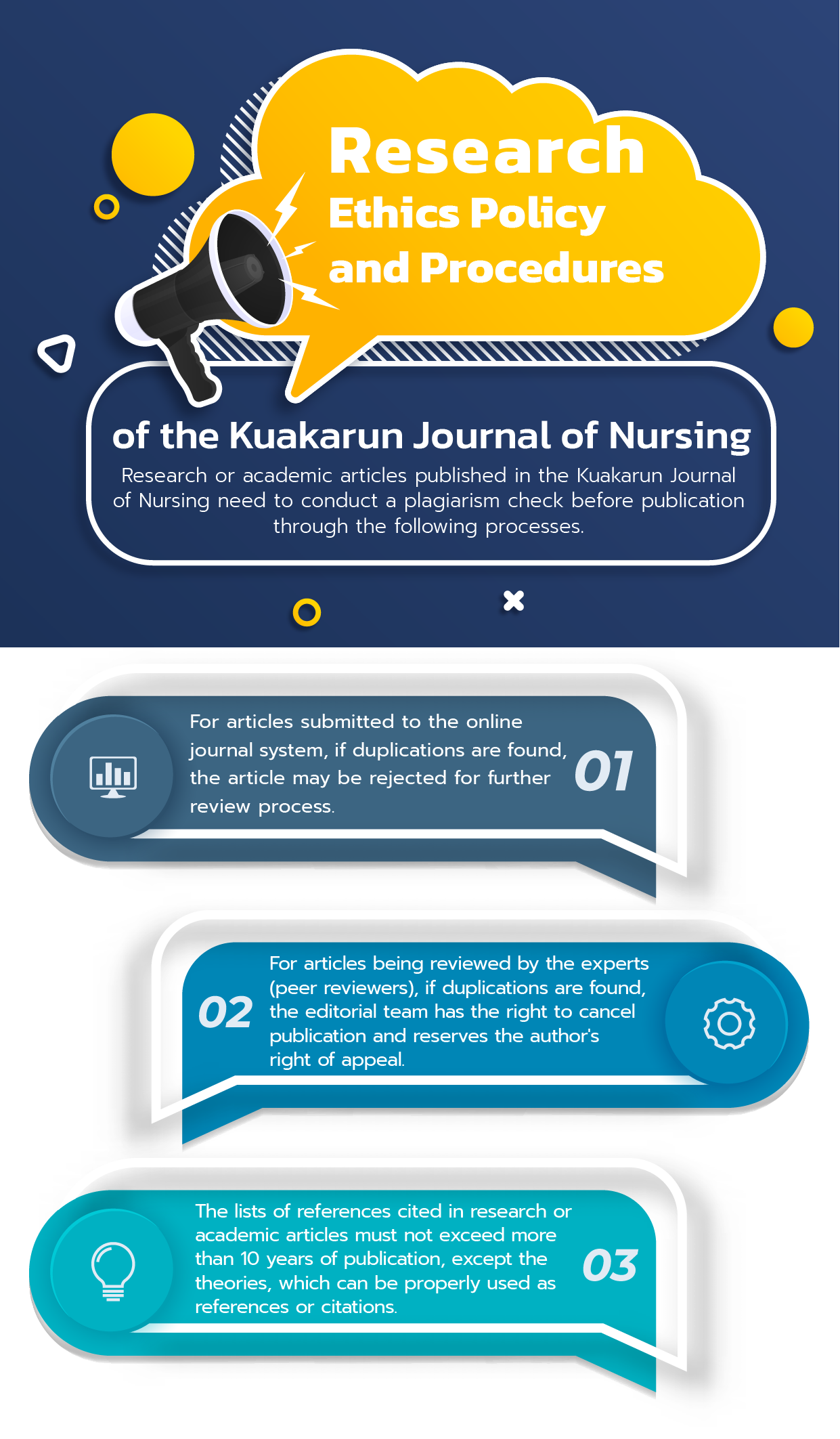
- The editor is required to screen all submitted manuscripts for plagiarism. If plagiarism is detected at any stage of the review process, the editorial process shall be suspended immediately, and the authors shall be contacted to provide an explanation. The editor shall then determine whether the manuscript should be accepted or rejected based on the findings.
- In cases where the authors are affiliated with the Kuakarun Faculty of Nursing, an external editor shall be appointed as the handling editor for the manuscript. In addition, all three reviewers must be external experts unaffiliated with the faculty to prevent bias and conflicts of interest (COI). Reviewers shall be selected based on their specific expertise in the relevant subject matter and/or research methodology.
- The editor shall consolidate the reviewers’ comments and recommendations and communicate them to the authors through the journal’s online submission system and the journal’s official email. Authors are required to revise their manuscripts according to the reviewers’ recommendations within the specified timeframe. If clarification is needed, authors may contact the editor via the online system, email, or telephone using the journal’s official contact information.
- The editor shall not overturn decisions to accept or reject manuscripts made by former editors. However, if substantial and verifiable ethical or academic concerns are identified, the editor may reconsider such decisions.
- The editor must not participate in the editorial decision-making process for manuscripts in which they have a personal, professional, or financial interest, or which involve family members or close colleagues.
- The editor must not engage in practices intended to artificially enhance journal metrics or rankings, such as requesting inappropriate citations to their own work or to the journal, unless such citations are academically justified and relevant.
- The editor is responsible for monitoring the integrity of the published record. If errors, misleading statements, or distortions of facts are identified in published articles, the editor must take prompt action to issue corrections or clarifications. In cases of confirmed research misconduct, the editor must retract the article in a transparent and verifiable manner and ensure that readers and relevant indexing databases are duly informed.
Duties and Responsibilities of Authors
- Authors must submit an original manuscript that has not been previously published or disseminated in any form and is not under consideration by any other journal. In the event that a violation is identified, the Editorial Board reserves the right to suspend the author’s submission and publication privileges for a period of three years.
- Authors must not engage in plagiarism. All sources of information, ideas, or data derived from the work of others must be appropriately cited and referenced in accordance with accepted academic standards.
- Authors are required to present factual findings derived from their study honestly and accurately. Data fabrication, falsification, or misrepresentation of research results is strictly prohibited.
- Authors must provide full names, institutional affiliations, and institutional addresses in both Thai and English for all authors, as well as details of research funding sources (if any), on the abstract page in accordance with the journal’s manuscript preparation guidelines. In addition, the name and email address of the corresponding author must be clearly specified. For manuscripts derived from an academic program or degree requirement, authors must also identify the name of the program, field of study, faculty, and institution.
- Authors must submit documentation confirming approval from a Human Research Ethics Committee or Institutional Review Board (IRB) of their affiliated institution, including any relevant amendment documents, such as changes to the research team (if applicable), to ensure compliance with ethical principles for the protection of research participants.
- Authors must comply with all submission procedures and editorial processes of the journal to ensure the quality and integrity of the published content.
- Authors acknowledge and accept that all decisions made by the Editorial Board are final.
Duties and Responsibilities of Reviewers
- Reviewers play a vital role in assisting the editor in the selection of manuscripts for publication in the Kuakarun Journal of Nursing. Reviewers provide constructive comments and recommendations to enhance the quality of manuscripts and to ensure alignment with the primary objectives and intentions of the authors.
- Reviewers must be aware of their own areas of expertise and possess adequate knowledge and understanding of the content of the manuscripts assigned for review. If a manuscript does not fall within the reviewer’s area of expertise, the reviewer should promptly inform the editor so that an alternative reviewer may be appointed.
- Reviewers must give primary consideration to the scholarly quality of the manuscript and conduct the review in accordance with academic principles, free from bias, and without any conflict of interest with the author(s).
- Reviewers must uphold the public interest and refrain from seeking personal benefit or advantage from the academic work under review.
- Reviewers must immediately notify the editor if any ethical misconduct is identified in the manuscript under review, such as plagiarism or other forms of academic dishonesty.
- Reviewers should complete and submit their reviews within the specified timeframe. If reviewers are unable to provide the review within the designated period, they should promptly inform the editor.
- Reviewers are required to evaluate manuscripts and provide detailed suggestions for revision in accordance with the journal’s review form or through the online journal system. This includes an overall assessment of the manuscript and a clear summary of the review outcome.
- Reviewers must maintain strict confidentiality regarding the manuscripts under review. They must not disclose any information related to the manuscripts, use the content for personal purposes, or contact the author(s) directly without prior authorization from the journal.