The Effects of an Integrated Nursing Model in Home-Based Patients with Methamphetamine Addiction, Mueang District, Ratchaburi Province
Keywords:
Integrated nursing program, Substance abuse, Methamphetamine, Home-based patientsAbstract
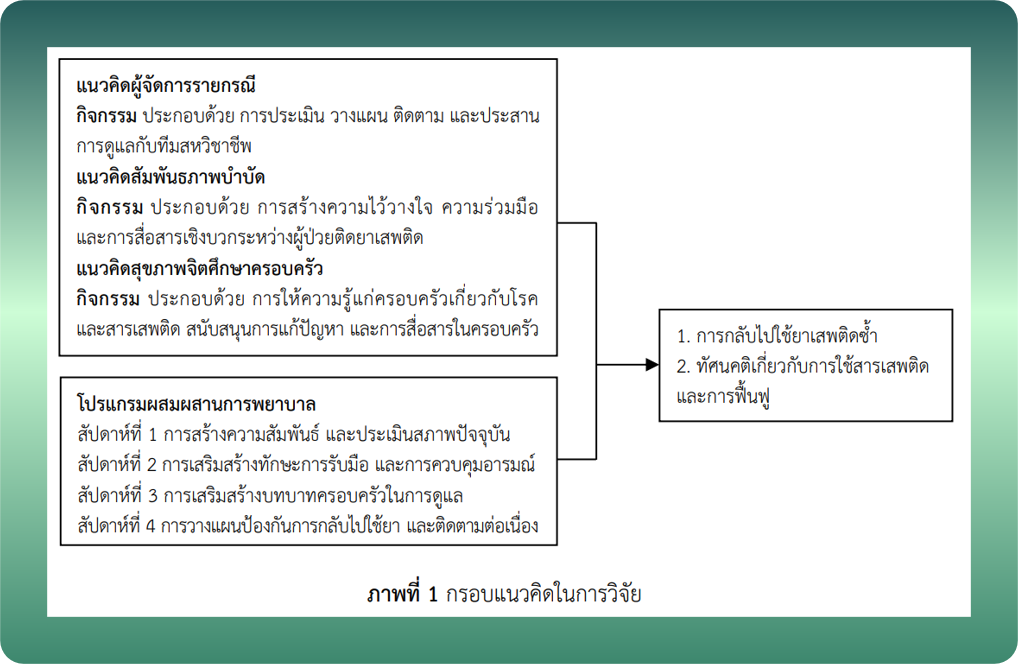
This quasi-experimental study with a posttest-only two-group design aimed to examine the effects of an integrated nursing program on individuals with amphetamine-type stimulant dependence receiving home-based care. The sample consisted of 38 participants who had completed four months of treatment and were referred for home follow-up. Participants were randomly assigned alternately into an experimental group receiving the integrated nursing program and a control group receiving routine nursing care, with 19 participants in each group. The research instruments included: 1) the integrated nursing program, 2) an attitude assessment toward substance use and rehabilitation, and 3) a questionnaire measuring relapse to substance use. These research instruments demonstrated content validity index (CVI) values at .94 and 1.00, and the values of Cronbach’s alpha coeffient were .82 and .94, respectively. Data were analyzed using descriptive statistics, independent t-tests, and chi-square tests.
The results showed that the experimental group had a significantly lower rate of relapse compared with the control group (χ² = 7.238, p-value = .007). The experimental group demonstrated significantly higher mean scores for attitudes toward substance use and rehabilitation than the control group (t-test = 6.018, p-value < .001). The mean attitude score of the experimental group was 4.95 (SD = .07), whereas that of the control group was 4.43 (SD = .37). These findings indicate that the integrated nursing program incorporating therapeutic relationships, family psychoeducation, and a case management approach can reduce drug relapse and enhance accurate understanding of the harmful effects of substance use.
References
Singkhara C. Case study: nursing care for drug-addicted patients with aggressive behavior and personality disorder. Songkhla: Thanyarak Songkhla Hospital; 2022. (in Thai)
Department of Mental Health, Ministry of Public Health. Report on the mental health situation of patients with substance use disorders 2022. Nonthaburi: Office of the Permanent Secretary, Ministry of Public Health; 2022. (in Thai)
Chiawiriyabunya I. Research and development of cannabis and hemp extracts for medical use for national development. Summary report of the academic conference; 2018 Feb 8-9; Government Pharmaceutical Organization. Bangkok: Government Pharmaceutical Organization; 2018. (in Thai)
Ratchaburi Hospital. Database outpatient at the substance abuse clinic, Ratchaburi Hospital, 2022-2024. Ratchaburi: Ratchaburi Hospital; 2025. (in Thai)
Panya S, Thajang S, Chapik N, Kanchanabut S, Mongkolsawad J. The relationship between personal factors, psychosocial factors, and environmental factors among repeated methamphetamine recurrence in Thanyarak hospital. Nursing Journal CMU 2021;48(2):273-82. (in Thai)
Wisedsing W, Uraiwong S, Sotraka P. Factors associated with relapse in patients after drug rehabilitation [Dissertation]. Bangkok: Thammasat University; 2020. (in Thai)
Petchtam K, Payakkakom A, Paek SC. Factors influencing substance use in Chiang Rai, Thailand. Asian Crime and Society Review 2024;11(2):1-10. doi: 10.14456/acsr.2024.8.
Tran MTN, Luong HQ, Minh GL, Dunne MP, Baker P. Psychosocial interventions for amphetamine type stimulant use disorder: an overview of systematic reviews. Frontiers in Psychiatry 2021;12:512076. doi: 10.3389/fpsyt.2021.512076.
Sieangchokyoo P, Piboonarluk W, Suriyachai S, Saengsawang S. The development of a nursing-integrated model for relapse and addiction relapse for schizophrenic patients with methamphetamine use disorder. Journal of Somdet Chaopraya Institute of Psychiatry 2023;17(2):62-77. (in Thai)
Mueser KT, Glynn SM, Cather C, Xie H, Zarate R, Smith LF, et al. A randomized controlled trial of family intervention for co-occurring substance use and severe psychiatric disorders. Schizophrenia Bulletin 2013;39(3):658-72. doi: 10.1093/schbul/sbr203.
Peplau HE. Phases and roles in nursing situations. In: Peplau HE, editor. Interpersonal relations in nursing, a conceptual frame of reference for psychodynamic nursing. New York: Springer Publishing; 1952. p. 17-70.
Glasser W. Choice theory: a new psychology of personal freedom. New York: HarperCollins; 1998.
Krejcie RV, Morgan DW. Determining sample size for research activities. Educational and Psychological Measurement 1970;30(3):607-10. doi: 10.1177/001316447003000308.
Arun J. Statistics in research: appropriate selection. Bangkok: Witthayaphat; 2014. (in Thai)
Ajzen I. The theory of planned behavior. Organizational Behavior and Human Decision Processes 1991;50(2):179-211. doi: 10.1016/0749-5978(91)90020-T.
Rosenstock IM. Historical origins of the health belief model. Health Education Monographs 1974;2(4):328-35. doi: 10.1177/109019817400200403.
Piboonarluk W, Yunibhand J, Pouwkantarakorn W, Unharasamee W. The effect of case management by advanced practice nurse on relapse in persons with schizophrenia. Thai Journal of Nursing and Midwifery Practice 2018;5(2):5-18. (in Thai)
Huaisai T, Chaiyachet M, Natawin K. Effects of therapeutic relationship program on depression and self esteem among drug addicts [Internet]. 2021 [cited 2023 Feb 6]. Available from: https://misn.pbri.ac.th/FONMIS/public/uploads/faculty/1724137211_4c6a025539d11f783cd1.pdf (in Thai)
Chotiwarangkul N. Evaluation of knowledge, attitude towards drug use and drug therapy in drug treatment program at Sawanpracharak hospital, Nakhonsawan. Region 3 Medical and Public Health Journal 2022;19(3):236-57. (in Thai)
Gibson CH. A concept analysis of empowerment. Journal of Advanced Nursing 1991;16(3):354-61. doi: 10.1111/j.1365-2648.1991.tb01660.x.
Beck JS. Cognitive behavior therapy: basics and beyond. 3rd ed. New York: Guilford Press; 2020.
Downloads
Published
How to Cite
Issue
Section
License
Copyright (c) 2025 Kuakarun Journal of Nursing

This work is licensed under a Creative Commons Attribution-NonCommercial-NoDerivatives 4.0 International License.