
Nurse’s Role in Providing Holistic Care for Patients with Post-Stroke Depression
Keywords:
Stroke, Post-stroke depression, Nursing rolesAbstract
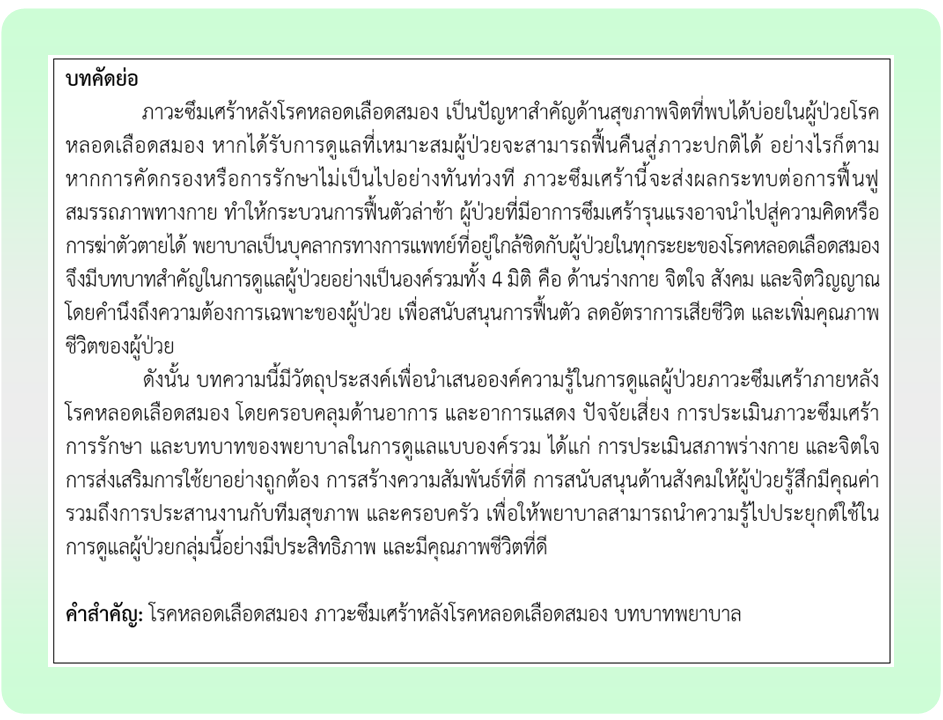
Post-stroke depression (PSD) is a significant mental health issue frequently observed in stroke patients. Providing appropriate care, patients will recover to a normal mental state. Nevertheless, delayed screening or treatment may severely affect physical rehabilitation, slowing the recovery process. In cases of patients with PSD are severe, there may be risks of suicidal thoughts or behaviors. Nurses, as key healthcare providers closely involved with patients throughout each phase of stroke recovery, play a critical role in providing holistic care that spans four dimensions: physical, psychological, social, and spiritual. This individualized approach supports recovery, reduces mortality, and enhances the quality of life.
Therefore, this article aims to present nurses’ knowledge in caring for patients with post-stroke depression. It covers symptoms and signs, risk factors, depression assessment, treatment approaches, as well as the nursing role in providing holistic care for patients experiencing post-stroke depression. Nurses are responsible for assessing both the physical and psychological conditions of patients, promoting appropriate medication use, building therapeutic relationships, and offering social support to help patients feel valued. In addition, coordination with healthcare teams and families is emphasized to ensure that nurses can effectively apply the knowledge gained to provide quality care and improve patients’ quality of life.
References
Schöttke H, Gerke L, Düsing R, Möllmann A. Post-stroke depression and functional impairments-a 3-year prospective study. Comprehensive Psychiatry 2020;99:152171. doi: 10.1016/j.comppsych.2020.152171.
Hatthakit U, Thanoi W. Holistic nursing and complemenatary therapy: an integration of the concepts into nursing education. Thai Journal of Nursing Council 2012;27 Suppl 1:S5-17. (in Thai)
Aniwattanapong D. Post-stroke depression. Journal of the Psychiatric Association of Thailand 2018;63(4):383-418. (in Thai)
Sarkar A, Sarmah D, Datta A, Kaur H, Jagtap P, Raut S, et al. Post-stroke depression: chaos to exposition. Brain Research Bulletin 2021;168:74-88. doi: 10.1016/j.brainresbull.2020.12.012.
Lanctot KL, Lindsay MP, Smith EE, Sahlas DJ, Foley N, Gubitz G, et al. Canadian stroke best practice recommendations: mood, cognition and fatigue following stroke, 6th edition update 2019. International Journal of Stroke 2020;15(6):668-88. doi: 10.1177/1747493019847334.
Krick S, Koob JL, Latarnik S, Volz LJ, Fink GR, Grefkes C, et al. Neuroanatomy of post-stroke depression: the association between symptom clusters and lesion location. Brain Communications 2023;5(5):fcad275. doi: 10.1093/braincomms/fcad275.
Ojagbemi A, Bello T, Elugbadebo F. Suicidal thoughts and contexts in black African stroke survivors. Journal of Geriatric Psychiatry and Neurology 2019;32(2):74-80. doi: 10.1177/0891988718824035.
Castilla-Guerra L, Fernandez Moreno MDC, Esparrago-Llorca G, Colmenero-Camacho MA. Pharmacological management of post-stroke depression. Expert Review of Neurotherapeutics 2020;20(2):157-66. doi: 10.1080/14737175.2020.1707666.
Liu L, Xu M, Marshall IJ, Wolfe CDA, Wang Y, O’Connell MD. Prevalence and natural history of depression after stroke: a systematic review and meta-analysis of observational studies. PLoS Medicine 2023;20(3):e1004200. doi: 10.1371/journal.pmed.1004200.
Seesawang J, Thongtang P. Post-stroke depression among older adult stroke survivors. Boromarajonani College of Nursing, Uttaradit Journal 2016;8(2):73-85. (in Thai)
Butsing N, Zauszniewski JA, Ruksakulpiwat S, Griffin MTQ, Niyomyart A. Association between post-stroke depression and functional outcomes: a systematic review. PLoS One 2024;19(8):e0309158. doi: 10.1371/journal.pone.0309158.
Chongprasertpon R, Ruangritchankul S. Post-stroke depression in older adults. Chonburi Hospital Journal 2023;48(1):41-60. (in Thai)
Medeiros GC, Roy D, Kontos N, Beach SR. Post-stroke depression: a 2020 updated review. General Hospital Psychiatry 2020;66:70-80. doi: 10.1016/j.genhosppsych.2020.06.011.
Shi Y, Yang D, Zeng Y, Wu W. Risk factors for post-stroke depression: a meta-analysis. Frontiers in Aging Neuroscience 2017;9:218. doi: 10.3389/fnagi.2017.00218.
Aiamanan M, Pattanarueangkul P. Post-stroke depression among older adult and management. Thai Journal of Nursing 2021;70(2):55-61. (in Thai)
Sanguanchue A, Tanthanapanyakorn P, Arsa R. The prevalence and associated factors of depression among older people with chronic diseases in Wang Noi district, Phra Nakhon Si Ayutthaya province. Journal of Yala Rajabhat University 2019;14(2):277-87. (in Thai)
Robinson RG, Jorge RE. Post-stroke depression: a review. The American Journal of Psychiatry 2016;173(3):221-31. doi: 10.1176/appi.ajp.2015.15030363.
Jorgensen TSH, Wium-Andersen IK, Wium-Andersen MK, Jorgensen MB, Prescott E, Maartensson S, et al. Incidence of depression after stroke, and associated risk factors and mortality outcomes, in a large cohort of Danish patients. Journal of the American Medical Association Psychiatry 2016;73(10):1032-40. doi: 10.1001/jamapsychiatry.2016.1932.
Wang S, Wang CX, Zhang N, Xiang YT, Yang Y, Shi YZ, et al. The association between post-stroke depression, aphasia, and physical independence in stroke patients at 3-month follow-up. Frontiers in Psychiatry 2018;9:374. doi: 10.3389/fpsyt.2018.00374.
Sangphrachan S, Dallas JC, Hengudomsub P, Pratoomsri W. The meaning of self-esteem as perceived by older adults with depression. Nursing Journal of the Ministry of Public Health 2016;26(2):76-88. (in Thai)
Dajpratham P, Pukrittayakamee P, Atsariyasing W, Wannarit K, Boonhong J, Pongpirul K. The validity and reliability of the PHQ-9 in screening for post-stroke depression. BioMed Central Psychiatry 2020;20(1):291. doi: 10.1186/s12888-020-02699-6.
Wu Y, Levis B, Sun Y, He C, Krishnan A, Neupane D, et al. Accuracy of the Hospital Anxiety and Depression Scale Depression subscale (HADS-D) to screen for major depression: systematic review and individual participant data meta-analysis. British Medical Journal 2021;373:n972. doi: 10.1136/bmj.n972.
Fang Y, Mpofu E, Athanasou J. Reducing depressive or anxiety symptoms in post-stroke patients: pilot trial of a constructive integrative psychosocial intervention. International Journal of Health Sciences 2017;11(4):53-8.
Tess AV, Smetana GW. Medical evaluation of patients undergoing electroconvulsive therapy. The New England Journal of Medicine 2009;360(14):1437-44. doi: 10.1056/NEJMra0707755.
Li X, Zhang C. Comparative efficacy of nine antidepressants in treating Chinese patients with post-stroke depression: a network meta-analysis. Journal of Affective Disorders 2020;266:540-48. doi: 10.1016/j.jad.2020.02.005.
Beach SR, Celano CM, Sugrue AM, Adams C, Ackerman MJ, Noseworthy PA, et al. QT prolongation, torsades de pointes, and psychotropic medications: a 5-year update. Psychosomatics 2018;59(2):105-22. doi: 10.1016/j.psym.2017.10.009.
Steigleder T, Kollmar R, Ostgathe C. Palliative care for stroke patients and their families: barriers for implementation. Frontiers in Neurology 2019;10:164. doi: 10.3389/fneur.2019.00164.
Towfighi A, Ovbiagele B. Health equity and actionable disparities in stroke: 2022 update. Stroke 2023;54(2):374-8. doi: 10.1161/STROKEAHA.122.041892.
Pliankerd P. Depressive disorder: nurse’s role in nursing care. Journal of The Royal Thai Army Nurses 2014;15(1):18-21. (in Thai)
Korjedee P, Nualanan P, Chongchirawongsa P, Thanawangsri S, Kanlayapuek A. Role of nurses in continuing care for stroke patients at home. Hua Hin Medical Journal 2022;2(2):24-42. (in Thai)
Ketvatimart M. The roles of professional nurses in the management of stroke patients. Journal of Health Science Research 2017;11(2):71-80. (in Thai)
Worawichayapong C, Kespichayawattana J. The effect of empowerment program emphasizing family participation on depression of older persons with stroke. Journal of The Police Nurses and Health Science 2014;6(2):16-32. (in Thai)
Downloads
Published
How to Cite
Issue
Section
License
Copyright (c) 2025 Kuakarun Journal of Nursing

This work is licensed under a Creative Commons Attribution-NonCommercial-NoDerivatives 4.0 International License.