
Development of a Participatory Health Management Model Based on Sufficiency Economy Philosophy in Roi-Et Province
Keywords:
Development, Community health, Holistic, Participation, Sufficiency economyAbstract
This participatory action research aimed to develop a community health management model based on the Sufficiency Economy Philosophy in Roi Et Province, Thailand. This study consisted of three phases: 1) the preparation phase, which involved identifying community health issues and randomly selecting 367 participants; 2) the implementation phase, a total of 40 participants including community leaders, village committees, health volunteers, and community residents were enrolled to create and implement a community health management plan; and 3) the evaluation phase, which 80 respondents were randomly selected and data were collected using self-assessment questionnaires. These questionnaires consisted of health management, health literacy, and WHOQOL-BREF with their content validity being .96 and .98, and reliability was .85, .85 and .88, respectively. The quantitative data was analyzed using descriptive and inferential statistics in terms of paired t-tests while the qualitative data was analyzed using content analysis.
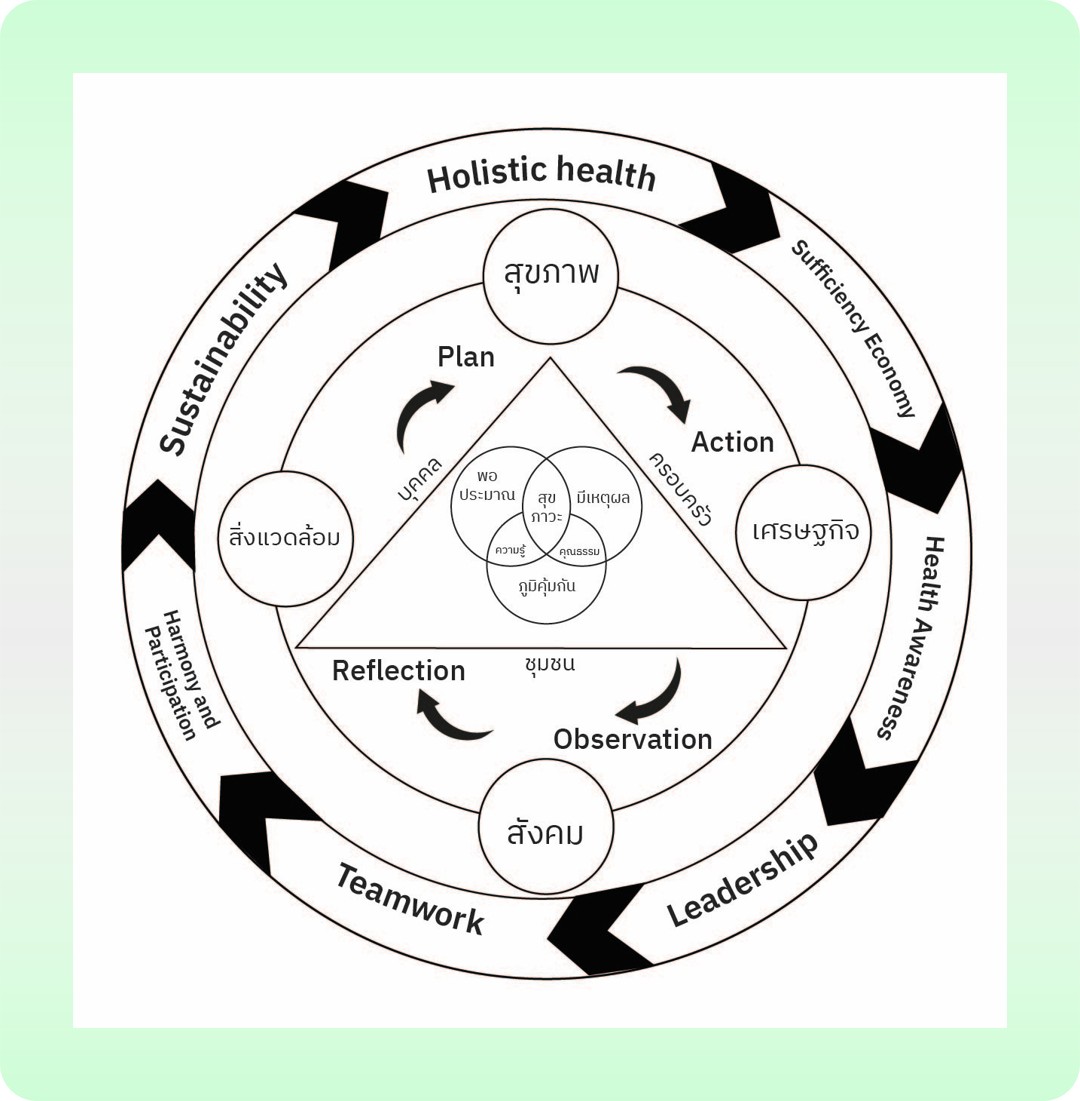
The findings revealed that the community residents reported moderate levels of health knowledge (35.00%), health management (36.25%), and quality of life (38.75%), respectively. The “HEALTHS Model” is composed of seven key elements, including holistic health, sufficiency economy, health awareness, leadership, teamwork, harmony and participation, and sustainability. Following the model’s implementation, participants reported substantial enhancements in health knowledge, management, and quality of life (p-value < .01). This study emphasizes the significance of continuing to promote this participatory health management paradigm, which is founded on the Sufficiency Economy Philosophy, in order to ensure long-term sustainability in community health.
References
Vipavanich S, Sungrugsa N. The model development of health promotion based on the philosophy of sufficiency economy for community well-being. Veridian E-Journal, Silpakorn University 2016;9(2):1207-23. (in Thai)
Department of Disease Control, Ministry of Public Health. Report on the situation of NCDs, diabetes, hypertension, and related risk factors, 2019. Bangkok: Aksorn Graphic and Design; 2020. (in Thai)
Charoendee K, Boribun N, Butrachumsaeng A, Rungrueang S, editors. Annual report 2023. Non-communicable diseases division, Department of Disease Control, Ministry of Public Health. Bangkok: Akson Graphic and Design; 2023. (in Thai)
Baiya T, Nilkong V. Community development for participatory health managemenet according to sufficientcy economy philosophy in Nan province. Department of Health Service Support Journal 2020;16(2):25-36. (in Thai)
Watthanasaen S, Kittivongvisut A, Kankhwao P, Poosakaew T. The model development to enhance well-being followed the philosophy of sufficiency economy for farmer network groups under Khok Nong Na model. BCNNON Health Science Research Journal 2023;17(3):126-39. (in Thai)
Nilkote R, Chantaranamchoo N. Community of practices learning for developing community well-being: participatory action research. The Golden Teak: Humanity and Social Science Journal 2018;24(1):167-80. (in Thai)
Jariyawat S, Worachad W (Payutto), Kaewmat O, Thanawamso W (Promsri). Sufficiency economy philosophy for sustainable development. Journal of Roi Kaensarn Academi 2021;6(5):197-209. (in Thai)
Yeamsoonthorn P, Phuttharakkhito J (Noree), Sirinanto J. Community health development under the sufficiency economy philosophy in Chonburi province. Panya Journal 2022;29(2):38-53. (in Thai)
Singsom R, Songklin P. Community management according to the sufficiency economy concept of Ban Phon-Had community Dong Khrang Noi sub-district Kaset Wisai district Roi-Et province. Journal of Social Science for Local Rajabhat Mahasarakham University 2021;5(3):120-7. (in Thai)
Thongjun S, Takaew R, Bunchua K, Amalitwarin S. Holistic health based on the sufficiency economy philosophy. Journal of Buddhamagga 2023;8(1):1-11. (in Thai)
Boonsang S, Sanlum W, Monthon N, Prukratok N. A community model applying the idea of sufficiency economy for happiness community. NRRU Community Research Journal 2017;11(2):9-20. (in Thai)
Butsriphum S, Angasinha C. Ban Wang Nok Khai : strong community funding based on social capital and sufficient economy. Journal of Philosophical Vision 2022;27(1):10-28. doi: 10.14456/jpv.2022.2. (in Thai)
Kemmis S, McTaggart R. The action research planner. 3rd ed. Victoria: Deakin University; 1988.
Thairath Online. “Dong Krang Noi” Roi Et wins the 2021 Best Change Leader Award, receives 1 million baht [Internet]. 2021 [cited 2023 Sep 26]. Available from: https://www.thairath.co.th/news/local/northeast/2135892 (in Thai)
Mahatnirunkul S, Tuntipivatanaskul W, Pumpisanchai W. Comparison of the WHOQOL-100 and the WHOQOL-BREF (26 items). Journal of Mental Health of Thailand 1998;5:4-15. (in Thai)
Thonginchan J, Yutthana P (Siriwan), Phrakhrusundhondhammanithas (Chalerm Bungmek), Somdeth (Srila-Ngad). Model of community development based on the philosophy of the sufficiency economy: a case study of context of Wat Pong Kham, Doophong sub-district, Santisuk district, Nan province. Mahachula Academic Journal 2022;9(1):361-81. (in Thai)
Phongsakchat P, Malai C, Noysipoom N, Jampated M. Health behaviors enhancing based on local wisdom. Journal of The Royal Thai Army Nurses 2019;20(3):44-53. (in Thai)
Chaiyaparn N, Boonkla S, Konharn K, Chaiyapan N, editors. Handbook for developing health literacy in disease prevention and health threats. Bangkok: RNPP WATER; 2021. (in Thai)
Department of Health, Ministry of Public Health. Driving health literacy and health communication [Internet]. 2017 [cited 2023 Sep 26]. Available from: https://doh.hpc.go.th/data/HL/HL_DOH_drive.pdf (in Thai)
Intarakamhang A. The development and application of ABCDE-health literacy scale for Thai adults [Internet]. 2017 [cited 2023 Sep 26]. Available from: http://bsris.swu.ac.th/upload/243362.pdf (in Thai)
Edwards M, Wood F, Davies M, Edwards A. The development of health literacy in patients with a long-term health condition: the health literacy pathway model. BioMed Central Public Health 2012;12:130. doi: 10.1186/1471-2458-12-130.
World Health Organization. Health literacy and health promotion: definitions, concepts, and examples in the Eastern Mediterranean Region. 7th Global Conference on Health Promotion Promoting Health and Development; 2009 Oct 26-30; Nairobi, Kenya: WHO; 2009.
Pender NJ. Health promotion in nursing practice. 3rd ed. Stamford, Connecticut: Appleton and Lange; 1996.
Arpanantikul M, Phuphaibul R, Khuwatsamrit K. Analysis of integration of sufficient-health indices with the philosophy of sufficiency economy. Thai Journal of Nursing Council 2015;30(1):41-57. (in Thai)
Arpanantikul M. Sufficient health. Thai Journal of Nursing Council 2018;33(2):5-14. (in Thai)
Downloads
Published
How to Cite
Issue
Section
License
Copyright (c) 2025 Kuakarun Journal of Nursing

This work is licensed under a Creative Commons Attribution-NonCommercial-NoDerivatives 4.0 International License.