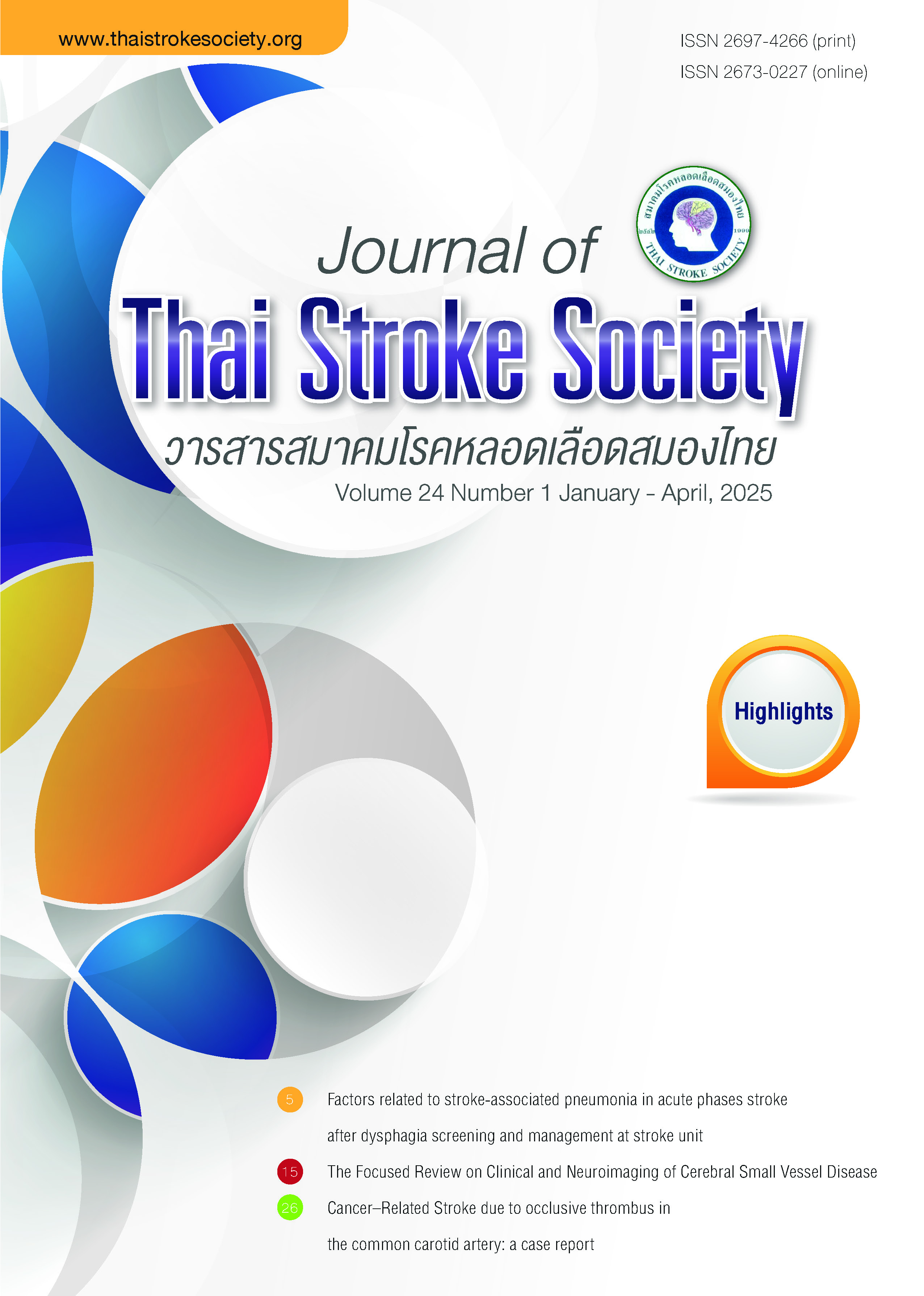
Factors related to stroke-associated pneumonia in acute phases stroke after dysphagia screening and management at stroke unit
Keywords:
Acute stroke, factor-related pneumonia, stroke-associated pneumonia, dysphagia screeningAbstract
Objectives: To investigate potential factors linked to Stroke-Associated Pneumonia (SAP), we considered five variables: failure in the initial dysphagia screening test, manifestation of declining neurological signs, non-compliance with NPO (Nil Per Os) guidelines before the test, the duration from stroke onset to dysphagia screening, and the duration from admission date to dysphagia screening.
Methods: We conducted a retrospective analysis of the medical records of acute stroke patients admitted to the stroke unit between January 1, 2020, and December 31, 2022. Dysphagia screening tests were administered, and we compared two groups: those who presented with SAP and those without.
Results: We reviewed 358 medical records and randomly selected 100 patients by computer, categorizing them into SAP and no SAP, with 50 patients in each group. The SAP group exhibited higher stroke severity, and SAP was commonly diagnosed 2 to 3 days after the onset of the stroke. In our study, three factors were associated with SAP: a failed initial dysphagia screening (OR 11.03, 95% CI 1.88-64.66), the presence of declining neurological signs (OR 15.52, 95% CI 4.76-50.61), and non-compliance with NPO guidelines before the test (OR 16.23, 95% CI 3.01-87.77).
Conclusion: In acute stroke patients screened for dysphagia during hospitalization, SAP occurrence was associated with initial screening failure, worsening neurological signs, and non-compliance with NPO guidelines before the test. Although no correlation was observed between SAP and the timing of dysphagia screening, close monitoring and reassessment of swallowing issues, particularly within the first week post-stroke, is recommended for timely SAP detection.
References
de Jonge JC, van de Beek D, Lyden P, Brady MC, Bath PM, van der Worp HB. Temporal profile of pneumonia after stroke. Stroke 2022;53(1):53–60. doi: 10.1161/STROKEAHA.120.032787.
Kidd D, Lawson J, Nesbitt R, MacMahon J. The natural history and clinical consequences of aspiration in acute stroke. QJM. 1995 Jun;88(6):409-13. PMID: 7648232.
Teh WH, Smith CJ, Barlas RS, Wood AD, Bettencourt-Silva JH, Clark AB, et al. Impact of stroke-associated pneumonia on mortality, length of hospitalization, and functional outcome. Acta Neurol Scand. 2018;138(4):293–300. doi: 10.1111/ane.12956.
Sellars C, Bowie L, Bagg J, Sweeney MP, Miller H, Tilston J, et al. Risk factors for chest infection in acute stroke: a prospective cohort study: A prospective cohort study. Stroke. 2007;38(8):2284–91. doi: 10.1161/STROKEAHA.106.478156.
Al-Khaled M, Matthis C, Binder A, Mudter J, Schattschneider J, Pulkowski U, et al. Dysphagia in patients with acute ischemic stroke: Early dysphagia screening may reduce stroke-related pneumonia and improve stroke outcomes. Cerebrovasc Dis. 2016;42(1–2):81–9. doi: 10.1159/000445299.
Joundi RA, Martino R, Saposnik G, Giannakeas V, Fang J, Kapral MK. Predictors and outcomes of dysphagia screening after acute ischemic stroke. Stroke. 2017;48(4):900–6. doi: 10.1161/STROKEAHA.116.015332.
Bray BD, Smith CJ, Cloud GC, Enderby P, James M, Paley L, et al. The association between delays in screening for and assessing dysphagia after acute stroke, and the risk of stroke-associated pneumonia. J Neurol Neurosurg Psychiatry. 2017;88(1):25–30. doi: 10.1136/jnnp-2016-313356.
Finlayson O, Kapral M, Hall R, Asllani E, Selchen D, Saposnik G. Risk factors, inpatient care, and outcomes of pneumonia after ischemic stroke. Neurology. 2011;77(14):1338–45. doi: 10.1212/WNL.0b013e31823152b1.
Powers WJ, Rabinstein AA, Ackerson T, Adeoye OM, Bambakidis NC, Becker K, et al. Guidelines for the early management of patients with Acute Ischemic Stroke: 2019 update to the 2018 guidelines for the early management of Acute Ischemic Stroke: A guideline for healthcare professionals from the American Heart Association/American stroke association. Stroke. 2019;50(12). doi: 10.1161/STR.0000000000000211.
Sukpongthai T. The Incidence of Post Stroke Pneumonia and the Use of Modified Water Swallowing Test in Acute Stroke Patients. J Thai Stroke Soc [Internet]. 2019;18(3):16-24. Available from: https://he01.tci-thaijo.org/ index.php/jtss/article/view/19280
Horan TC, Andrus M, Dudeck MA. CDC/NHSN surveillance definition of health care–associated infection and criteria for specific types of infections in the acute care setting. Am J Infect Control. 2008;36(5):309–32. doi: 10.1016/j.ajic.2008.03.002.
Osawa A, Maeshima S, Tanahashi N. Water-Swallowing Test: Screening for Aspiration in Stroke Patients. Cerebrovasc Dis. 2013;35(3):276–281. Available from: https://karger.com/ced/article-abstract/35/3/276/551/Water-Swallowing-Test-Screening-for-Aspiration-in?redirectedFrom=fulltext
Dziewas R. Pneumonia in acute stroke patients fed by nasogastric tube. J Neurol Neurosurg Psychiatry. 2004;75(6):852–6. doi: 10.1136/jnnp.2003.019075.
Sümer MM. Progression in acute ischemic stroke: Is widespread atherosclerotic background a risk factor? Turk J Phys Med Rehabil. 2017;64(1):46–51. doi: 10.5606/tftrd.2017.1007.
Downloads
Published
How to Cite
Issue
Section
License
Copyright (c) 2025 Journal of Thai Stroke Society

This work is licensed under a Creative Commons Attribution-NonCommercial-NoDerivatives 4.0 International License.
ข้อความภายในบทความที่ตีพิมพ์ในวารสารสมาคมโรคหลอดเลือดสมองไทยเล่มนี้ ตลอดจนความรับผิดชอบด้านเนื้อหาและการตรวจร่างบทความเป็นของผู้นิพนธ์ ไม่เกี่ยวข้องกับกองบรรณาธิการแต่อย่างใด การนำเนื้อหา ข้อความหรือข้อคิดเห็นของบทความไปเผยแพร่ ต้องได้รับอนุญาตจากกองบรรณาธิการอย่างเป็นลายลักษณ์อักษร ผลงานที่ได้รับการตีพิมพ์ในวารสารเล่มนี้ถือเป็นลิขสิทธิ์ของวารสาร