
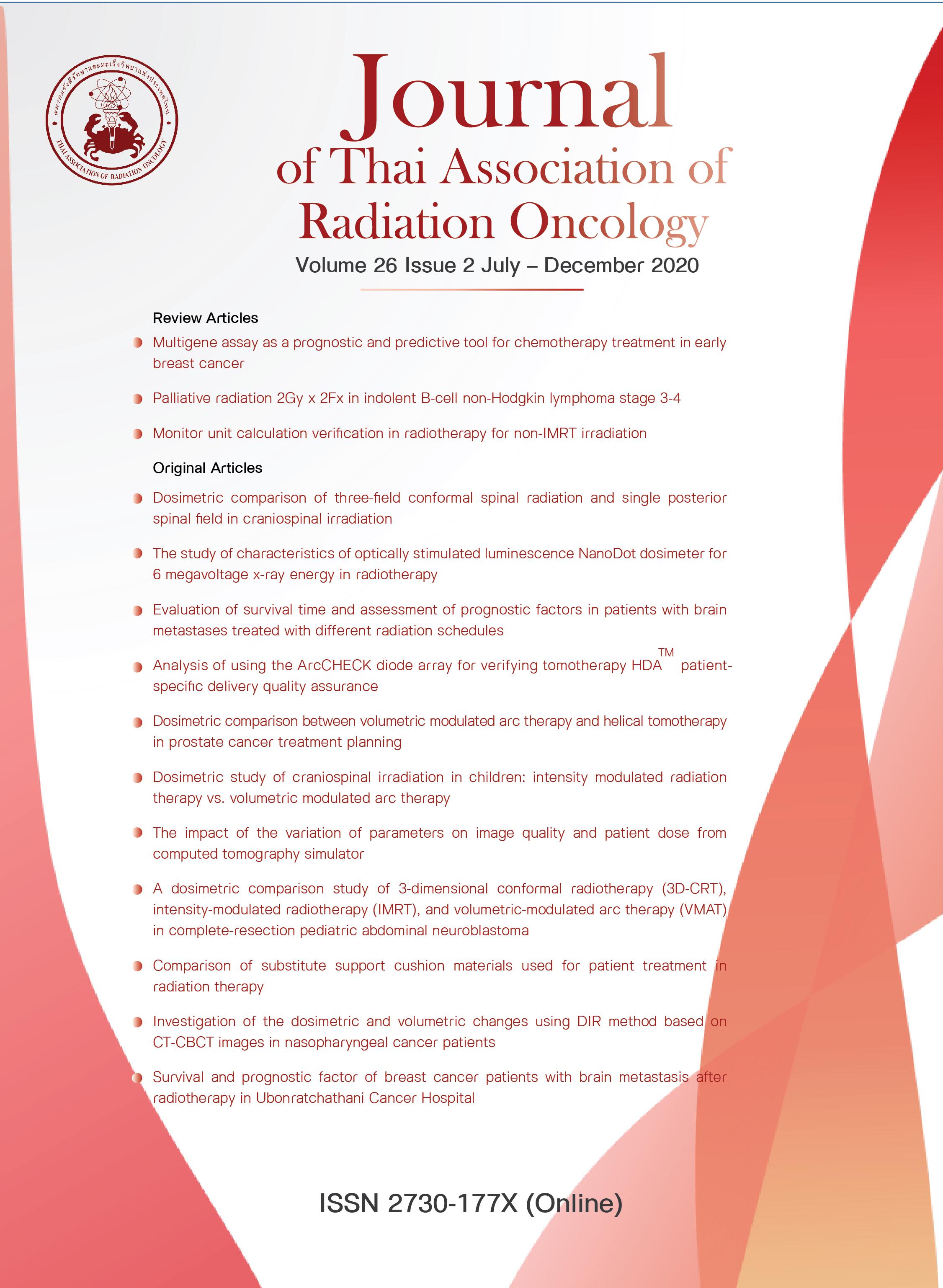
การประเมินปริมาณรังสีและปริมาตรที่เปลี่ยนแปลงจากการซ้อนทับภาพเอกซเรย์คอมพิวเตอร์และภาพเอกซเรย์คอมพิวเตอร์โคนบีมแบบยืดหยุ่นในผู้ป่วยโรคมะเร็งหลังโพรงจมูก
คำสำคัญ:
มะเร็งหลังโพรงจมูก, การซ้อนทับภาพโดยกำหนดตำแหน่งแบบยืดหยุ่น, ภาพเอกซเรย์คอมพิวเตอร์แบบโคนบีม, การวางแผนการรักษาและคำนวณปริมาณรังสีใหม่ในช่วงฉายรังสีบทคัดย่อ
หลักการและเหตุผล
การฉายรังสีเป็นหนึ่งในวิธีการรักษาโรคมะเร็งหลังโพรงจมูก ระหว่างช่วงการรักษาอาจเกิดการเปลี่ยนแปลงปริมาตร ทำให้ปริมาณรังสีที่ก้อนมะเร็งและอวัยวะข้างเคียงแตกต่างจากแผนการรักษาเริ่มต้น โปรแกรมซ้อนทับภาพโดยกำหนดตำแหน่งแบบยืดหยุ่น (Deformable image registration; DIR) แสดงปริมาณรังสีและปริมาตรที่เปลี่ยนแปลงจากแหล่งข้อมูลภาพต่างกันได้
วัตถุประสงค์
เพื่อพิจารณาการนำโปรแกรม DIR และภาพเอกซเรย์คอมพิวเตอร์แบบโคนบีม (Cone-beam CT; CBCT) มาใช้ประเมินปริมาณรังสีและปริมาตรที่เปลี่ยนแปลงของก้อนมะเร็งและอวัยวะข้างเคียงระหว่างช่วงการฉายรังสี
วัสดุและวิธีการ
นำข้อมูลภาพเอกซเรย์คอมพิวเตอร์ (Computed tomography; CT) ภาพ CBCT แต่ละสัปดาห์และแผนการกระจายรังสีของผู้ป่วยมะเร็งหลังโพรงจมูก จำนวน 15 ราย เข้าโปรแกรม VelocityAl รุ่น 4.0 เพื่อซ้อนทับภาพ CT ภาพ CBCT และแผนการรักษาแบบยืดหยุ่น ประเมินปริมาณรังสีและปริมาตรที่ได้จากการซ้อนทับจากกราฟความสัมพันธ์ระหว่างปริมาณรังสีและความถี่ปริมาตร (Dose volume histogram; DVH) และค่าดัชนีความเหมือน (Dice similarity coefficient; DSC)
ผลการศึกษา
ปริมาณรังสีสูงสุดที่ก้อนมะเร็งลดลง ขณะที่ปริมาณรังสีเฉลี่ยที่ช่องปากและต่อมน้ำลายพาโรติดเพิ่มขึ้น พบการลดลงของปริมาตรช่องปากและต่อมน้ำลายพาโรติดทั้งสองข้าง โดยค่า DSC ของต่อมน้ำลายพาโรติดที่ลดลงสัมพันธ์กับช่วงการฉายรังสีที่ค่าสัมประสิทธิ์สหสัมพันธ์ 0.743
ข้อสรุป
โปรแกรม DIR และข้อมูลภาพ CBCT สามารถนำมาใช้ประเมินปริมาณรังสีและปริมาตรที่เปลี่ยนแปลงระหว่างช่วงการฉายรังสีในผู้ป่วยโรคมะเร็งหลังโพรงจมูกได้
เอกสารอ้างอิง
Wang ZH, Yan C, Zhang ZY, Zhang CP, Hu HS, Kirwan J, et al. Radiation-induced volume changes in parotid and submandibular glands in patients with head and neck cancer: receiving postoperative radiotherapy: a longitudinal study. Laryngoscope. 2009; 119: 1966-1974.
Ajani AA, Qureshi MM, Kovalchuk N, Orlina L, Sakai O, Truong MT. A quantitative assessment of volumetric and anatomic changes of the parotid gland during intensity-modulated radiotherapy for head and neck cancer using serial computed tomography. Med Dosim. 2013; 38: 238-242.
Wang X, Lu J, Xiong X, Zhu G, Ying H, He S, et al. Anatomic and dosimetric changes during the treatment course of intensity-modulated radiotherapy for locally advanced nasopharyngeal carcinoma. Med Dosim. 2010; 35: 151-157.
Ahn PH, Chen CC, Ahn AI, Hong L, Scripes PA, Shen J, et al. Adaptive planning in intensity-modulated radiation therapy for head and neck cancers: single-institution experience and clinical implications. Int J Radiat Oncol Biol Phys. 2011; 80: 677-685.
Reali A, Anglesio AM, Mortellaro G, Allis S, Bartoncini S, Redda MGR, et al. Volumetric and positional changes of planning target volumes and organs at risk using computed tomography imaging during intensity-modulated radiation therapy for head-neck cancer: an “old” adaptive radiation therapy approach. Radiol med. 2014; 119: 714-720.
Zhang X, Li M, Cao J, Luo JW, Xu GZ, Gao L, et al. Dosimetric variations of target volumes and organs at risk in nasopharyngeal carcinoma intensity-modulated radiotherapy. Br J Radio. 2012; 85: e506-e513.
Sonke JJ, Aznar M, Rasch C. Adaptive radiotherapy for anatomical changes. Semin Radiat Oncol. 2019; 29: 249-257.
Hu YC, Tsai KW, Lee CC, Peng NJ, Chien JC, Tseng HH, et al. Which nasopharyngeal cancer patients need adaptive radiotherapy? BMC Cancer. 2018; 18:1234: 1-8.
Brock KK, Mutic S, McNutt TR, Li H, Kessler ML. Use of image registration and fusion algorithms and techniques in radiotherapy: Report of the AAPM Radiation Therapy Committee Task Group No.132. Med Phys. 2017; 44: e43-e76.
Oh S, Kim S. Deformable image registration in radiation therapy. Radiat Oncol J. 2017; 35: 101-111.
Jaffray DA. Image-guided radiotherapy: from current concept to future perspectives. Nat Rev Clin Oncol. 2012; 9: 688-699.
Nabavizadeh N, Elliott DA, Chen Y, Kusano AS, Mittin T, Thomas CR, et al. Image guided radiation therapy (IGRT) practice patterns and IGRT’s impact on workflow and treatment planning; results from a national survey of American Society for Radiation Oncology members. Int J Radiat Oncol Biol Phys. 2016; 94: 850-857.
Stankiewicz M, Li W, Rosewall T, Tadic T, Dickie C, Velec M. Patterns of practice of adaptive re-planning for anatomic variances during cone-beam CT guided radiotherapy. Tech Innov Patient Support Radiat Oncol. 2019; 12: 50-55.
Liu J, Lyman KM, Ding Z, Zhou L. Assessment of the therapeutic accuracy of cone beam computed tomography-guided nasopharyngeal carcinoma radiotherapy. Oncol Lett. 2019; 18: 1071-1080.
Ho KF, Marchant T, Moore C, Webster G, Rowbottom C, Penington H, et al. Monitoring dosimetric impact of weight loss with kilovoltage (KV) cone beam CT (CBCT) during parotid-sparing IMRT and concurrent chemotherapy. Int J Radiat Oncol Biol Phys. 2012; 82: e375-e382.
Wu RY, Liu AY, Williamson TD, Yang J, Wisdom PG, Zhu XR, et al. Quantifying the accuracy of deformable image registration for cone-beam computed tomography with a physical phantom. J Appl Clin Med Phys. 2019; 20: 92-100.
Velocity instructions for use. Varian Medical System; 2018.
Kumarasiri A, Siddiqui F, Liu C, Yechieli R, Shah M, Pradhan D, et al. Deformable image registration based automatic CT-to-CT contour propagation for head and neck adaptive radiotherapy in the routine clinical setting. Med Phys. 2014; 41: 121712-1-121712-10.
Mattiucci GC, Boldrini L, Chiloiro G, D’Agostino GR, Chiesa S, Rose FD, et al. Automatic delineation for replanning in nasopharynx radiotherapy: What is the agreement among experts to be considered as benchmark? Acta Oncol. 2013; 52: 1417-1422.
Tanooka M, Doi H, Ishida T, Katajima K, Wakayama T, Sakai T, et al. Usability of deformable image registration for adaptive radiotherapy in head and neck cancer and an automatic prediction of replanning. Int J Med Phys Clin Eng Radiat Oncol. 2017; 6: 10-20.
ดาวน์โหลด
เผยแพร่แล้ว
รูปแบบการอ้างอิง
ฉบับ
ประเภทบทความ
สัญญาอนุญาต
บทความที่ได้รับการตีพิมพ์เป็นลิขสิทธิ์ของวารสารมะเร็งวิวัฒน์ ข้อความที่ปรากฏในบทความแต่ละเรื่องในวารสารวิชาการเล่มนี้เป็นความคิดเห็นส่วนตัวของผู้เขียนแต่ละท่านไม่เกี่ยวข้องกับ และบุคคลากรท่านอื่น ๆ ใน สมาคมฯ แต่อย่างใด ความรับผิดชอบองค์ประกอบทั้งหมดของบทความแต่ละเรื่องเป็นของผู้เขียนแต่ละท่าน หากมีความผิดพลาดใดๆ ผู้เขียนแต่ละท่านจะรับผิดชอบบทความของตนเองแต่ผู้เดียว