
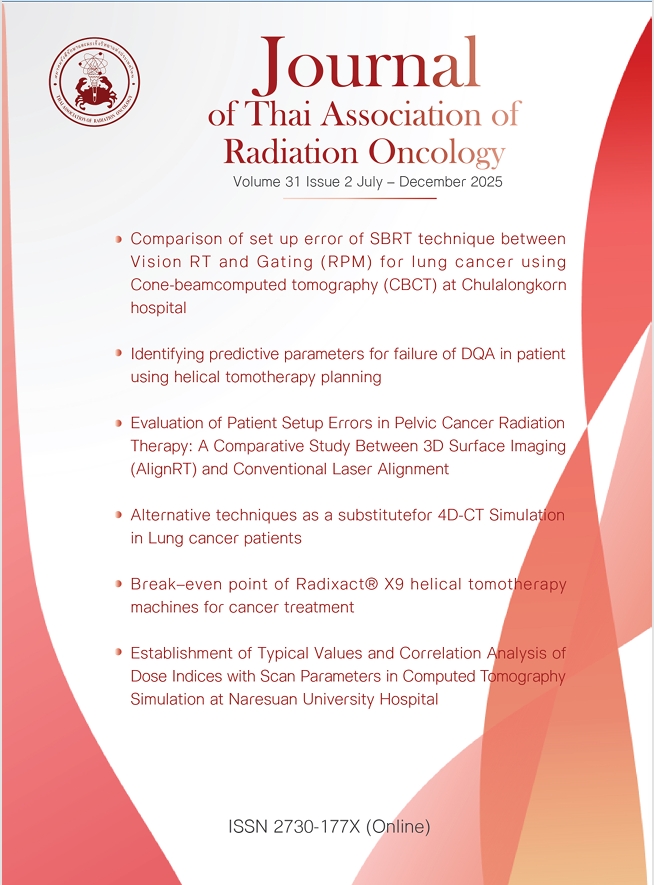
Establishment of Typical Values and Correlation Analysis of Dose Indices with Scan Parameters in Computed Tomography Simulation at Naresuan University Hospital
Keywords:
Computed tomography simulator, Volume CT dose index (CTDIvol), Diagnostic reference levels (DRLs), Dose length product (DLP)Abstract
Backgrounds: The Department of Medical Sciences of Thailand has established national diagnostic reference levels (NDRLs) for computed tomography (CT) examinations to guide radiation dose optimization. However, each hospital should define its own institutional diagnostic levels (typical values) to reflect actual clinical practice.
Objectives: This study aimed to establish typical values for CT simulation at Naresuan University Hospital. In addition, the study sought to analyze the correlations between radiation dose indices and scan parameters together with patient-related factors.
Materials and Methods: Patient data were retrospectively collected between 2021 and 2023. Radiation dose metrics, including the volume CT dose index (CTDIvol) and dose length product (DLP), were analyzed for four anatomical regions: brain, head and neck, chest, and pelvis. Typical values were calculated as the median of the dose distributions. Correlations between radiation dose and both imaging parameters and patient characteristics were also evaluated.
Results: The median CTDIvol values for brain, head and neck, chest, and pelvis regions were 41.6, 21.5, 14.8, and 17.8 mGy, respectively. The corresponding median DLP values were 1,279.3, 929.7, 644.2, and 674.8 mGy·cm. Compared with the NDRLs, the CTDIvol values obtained in this study were lower, whereas the DLP values were higher. Overall, these typical values were generally consistent with previous reports, particularly those involving CT simulators. Among the examined parameters, scan length showed a strong positive correlation with DLP (r > 0.960), whereas patient factors such as age, weight, and height exhibited weak correlations.
Conclusion: The institutional CTDIvol values derived from this study were lower than the Thai NDRLs, whereas DLP values were higher. but in line with other published findings. These results provide useful benchmarks for local optimization of CT simulator protocols, supporting radiation dose management and patient safety while maintaining adequate image quality for diagnosis and radiotherapy treatment planning.
References
Osman H, Raafat BM, Faizo NL, Ahmed RM, Alamri S, Alghamdi AJ, et al. Exposure levels of CT and conventional X-ray procedures for radiosensitive pelvic organ in Saudi Arabia. J Radiat Res Appl Sci 2021;14:449–55.
International Commission on Radiological Protection. The 2007 Recommendations of the International Commission on Radiological Protection (ICRP Publication 103). Ann ICRP 2007;37(2–4):1332.
Author on behalf of ICRP. Diagnostic Reference Levels in Medical Imaging (ICRP Publication 135). Ann ICRP [Internet] 2017;46:1–144.
International Atomic Energy Agency. Dosimetry in Diagnostic Radiology: An International Code of Practice, Technical Reports Series No. 457. Vienna: International Atomic Energy Agency; 2007.
กรมวิทยาศาสตร์การแพทย์ กระทรวงสาธารณสุข. ค่าปริมาณรังสีอ้างอิงในการถ่ายภาพรังสีวินิจฉัยทางการแพทย์ ของประเทศไทย 2566. นนทบุรี: บริษัท บียอนด์ พับลิสซิ่ง จำกัด; 2566.
Donmoon T, Chusin T. Establishment of typical dose levels for computed tomography of the pelvis region in radiotherapy simulation procedures. J. Thai Assoc Radiol Oncol 2023;29:R23-33.
Zalokar N, Žager Marciuš V, Mekiš N. Establishment of national diagnostic reference levels for radiotherapy computed tomography simulation procedures in Slovenia. Eur J Radiol 2020;127:108979
กรมวิทยาศาสตร์การแพทย์ กระทรวงสาธารณสุข. ค่าปริมาณรังสีอ้างอิงในการถ่ายภาพรังสีวินิจฉัยทางการแพทย์ ของประเทศไทย 2564. นนทบุรี: บริษัท บียอนด์ พับลิสซิ่ง จำกัด; 2564.
International Atomic Energy Agency. Quality Assurance Programme for Computed Tomography: Diagnostic and Therapy Applications [Internet]. No. 19. Vienna: International Atomic Energy Agency; 2012. Available from: http://www.iaea.org/Publications/index.html
Hinkle D, Wiersma W, Jurs S. Solutions manual: Applied statistics for the behavioral sciences. Houghton Mifflin; 1988.
Kanda R, Akahane M, Koba Y, Chang W, Akahane K, Okuda Y, et al. Developing diagnostic reference levels in Japan. Jpn J Radiol 2021;39:307–14.
Sanderud A, England A, Hogg P, Fosså K, Svensson SF, Johansen S. Radiation dose differences between thoracic radiotherapy planning CT and thoracic diagnostic CT scans. Radiog 2016;22:107–11.
Downloads
Published
How to Cite
Issue
Section
License
Copyright (c) 2025 Thai Association of Radiation Oncology

This work is licensed under a Creative Commons Attribution-NonCommercial-NoDerivatives 4.0 International License.
บทความที่ได้รับการตีพิมพ์เป็นลิขสิทธิ์ของวารสารมะเร็งวิวัฒน์ ข้อความที่ปรากฏในบทความแต่ละเรื่องในวารสารวิชาการเล่มนี้เป็นความคิดเห็นส่วนตัวของผู้เขียนแต่ละท่านไม่เกี่ยวข้องกับ และบุคคลากรท่านอื่น ๆ ใน สมาคมฯ แต่อย่างใด ความรับผิดชอบองค์ประกอบทั้งหมดของบทความแต่ละเรื่องเป็นของผู้เขียนแต่ละท่าน หากมีความผิดพลาดใดๆ ผู้เขียนแต่ละท่านจะรับผิดชอบบทความของตนเองแต่ผู้เดียว