ปัจจัยทำนายการคลอดก่อนกำหนดในหญิงตั้งครรภ์เดี่ยวที่ได้รับการยับยั้งการเจ็บครรภ์คลอด
คำสำคัญ:
การยับยั้งเจ็บครรภ์คลอด กลุ่มเจ็บครรภ์คลอดก่อนกำหนด การคลอดก่อนกำหนดบทคัดย่อ
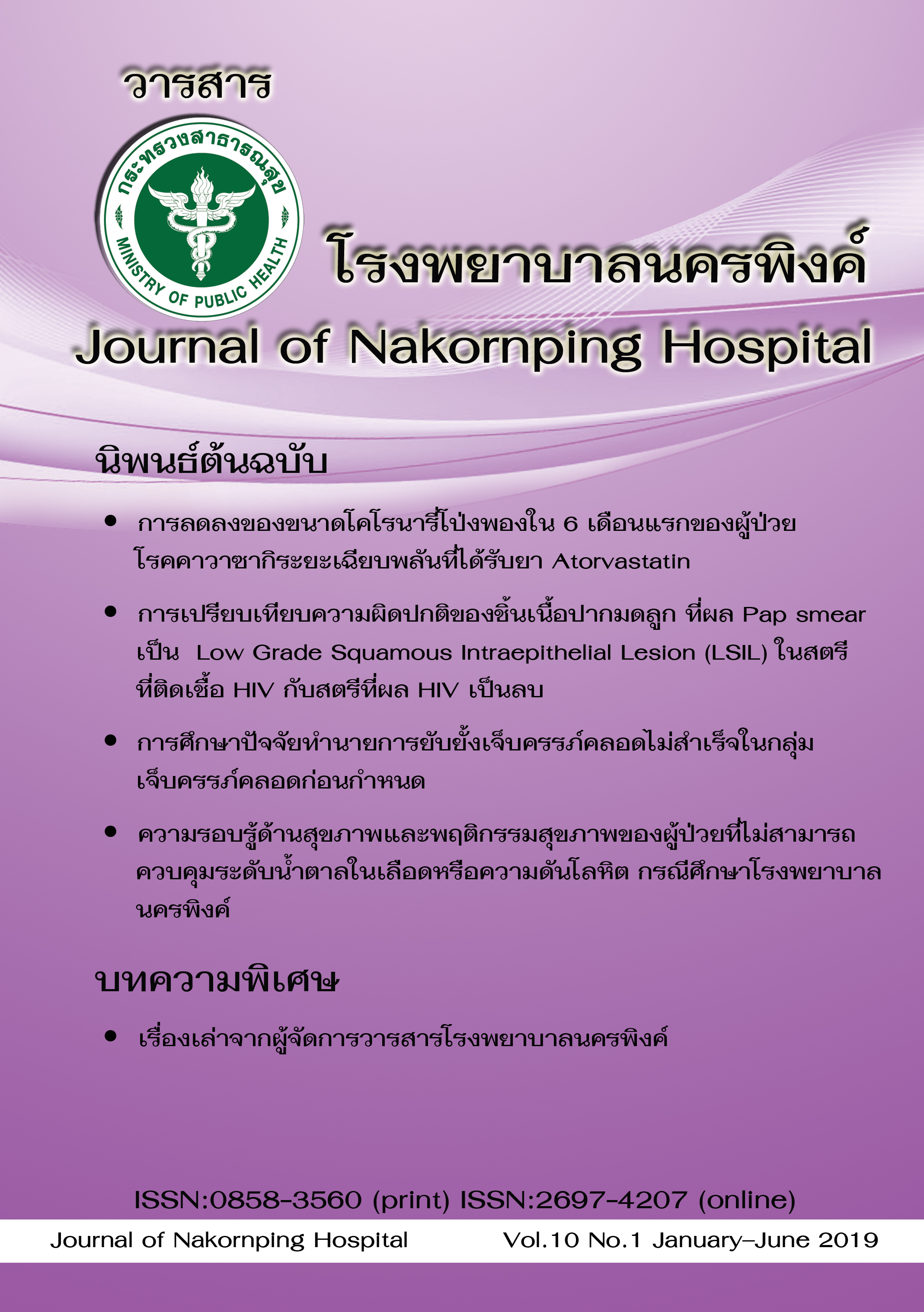
การคลอดก่อนกำหนดยังคงเป็นปัญหาสำคัญของงานอนามัยแม่และเด็ก การยับยั้งการหดรัดตัวของมดลูกจึงเป็นเป้าหมายสำคัญของการดูแลหญิงตั้งครรภ์ที่มีภาวะเจ็บครรภ์คลอดก่อนกำหนด การวิจัยครั้งนี้จึงมีวัตถุประสงค์ เพื่อศึกษาปัจจัยทำนายการคลอดก่อนกำหนดในหญิงตั้งครรภ์เดี่ยวที่ได้รับการยับยั้งการเจ็บครรภ์คลอดก่อนกำหนดในโรงพยาบาลนครพิงค์ จังหวัดเชียงใหม่โดยเก็บข้อมูลแบบ retrospective cohort study จากฐานข้อมูลของโรงพยาบาลและเวชระเบียนของผู้ป่วยในช่วงวันที่ 1 มกราคม พ.ศ. 2560 ถึง 31 ธันวาคม พ.ศ. 2562กลุ่มตัวอย่างเป็นหญิงตั้งครรภ์เดี่ยวที่ได้รับการยับยั้งการเจ็บครรภ์คลอดก่อนกำหนด จำนวน 460 คน แบ่งเป็นกลุ่มศึกษาที่ไม่สามารถคงการตั้งครรภ์จนคลอดครบกำหนดได้ และกลุ่มเปรียบเทียบที่สามารถคงการตั้งครรภ์จนคลอดครบกำหนดได้ วิเคราะห์ข้อมูลโดยใช้สถิติเชิงพรรณนา univariable และ multivariable binary regression โดยกำหนดนัยสำคัญทางสถิติที่ระดับ 0.05 ผลการศึกษาพบว่า กลุ่มตัวอย่างที่เข้าการศึกษาทั้งหมดจำนวน 460 คน มีอุบัติการณ์การคลอดก่อนกำหนด 212 คน (ร้อยละ 46.1) และคลอดครบกำหนด 248 คน (ร้อยละ 53.9) โดยกลุ่มศึกษามีอายุมารดาเฉลี่ย 27.08±6.60 ปี อายุครรภ์เฉลี่ยเมื่อเจ็บครรภ์ครั้งแรก 32.15±2.75 สัปดาห์ ดัชนีมวลกายเฉลี่ยก่อนตั้งครรภ์ 22.83±3.67 kg/m2 ปัจจัยที่สามารถทำนายการคลอดก่อนกำหนดในหญิงตั้งครรภ์เดี่ยวที่ได้รับการยับยั้งการเจ็บครรภ์คลอดก่อนกำหนด ได้แก่ อายุครรภ์ขณะเจ็บครรภ์คลอดครั้งแรก 28-31+6 สัปดาห์ (RR 1.51, 95% CI 1.20-1.89) และภาวะถุงน้ำคร่ำแตกก่อนกำหนด (RR 1.91, 95%CI 1.60-2.28) โดยสรุป อายุครรภ์ขณะเจ็บครรภ์คลอดครั้งแรกและภาวะถุงน้ำคร่ำแตกก่อนกำหนดเป็นปัจจัยทำนายการคลอดก่อนกำหนดในหญิงตั้งครรภ์เดี่ยวที่ได้รับการยับยั้งการเจ็บครรภ์คลอด
เอกสารอ้างอิง
2. Murphy DJ. Epidemiology and environmental factors in preterm labour. Best Practice & Research Clinical Obstetrics & Gynaecology. 2007;21(5):773-89.
3. Cunningham FG, Bloom S, Spong CY, Dashe JS. et al. Willams Obstretics. 24th ed, New York:McGraw-Hill Education; 2014.
4. Su D, Samson K, Garg A, Hanson C, Anderson Berry AL, Lin G, et al. Birth history as a predictor of adverse birth outcomes: Evidence from state vital statistics data. Preventive Medicine Reports. 2018;11:63-8.
5. McClure EM, Goldenberg RL. Use of antibiotics to reduce preterm birth. The Lancet Global Health. 2019;7(1):e18-e9.
6. Norman JE, Marlow N, Messow C-M, Shennan A, Bennett PR, Thornton S, et al. Vaginal progesterone prophylaxis for preterm birth (the OPPTIMUM study): a multicentre, randomised, double-blind trial. The Lancet. 2016;387(10033):2106-16.
7. Simcox R, Shennan A. Cervical cerclage: A review. International Journal of Surgery. 2007;5(3):205-9.
8. Appiah-Sakyi K, Konje JC. Prevention of preterm labour. Obstetrics, Gynaecology & Reproductive Medicine. 2015;25(9):255-60.
9. Morisaki N, Nagata C, Jwa SC, Sago H, Saito S, Oken E, et al. Pre-pregnancy BMI-specific optimal gestational weight gain for women in Japan. Journal of Epidemiology. 2017;27(10):492-8.
10. Newnham JP, White SW, Meharry S, Lee H-S, Pedretti MK, Arrese CA, et al. Reducing preterm birth by a statewide multifaceted program: an implementation study. American Journal of Obstetrics and Gynecology. 2017;216(5):434-42.
11. Ioakeimidis N, Vlachopoulos C, Katsi V, Tousoulis D [Internet]. Smoking cessation strategies in pregnancy: Current concepts and controversies. Hellenic Journal of Cardiology; 2018 [updated 2018 Oct 5; cited 26 May 2019 ] Available from doi.org/10.1016/j.hjc.2018.09.001
12. You S-H, Chang Y-L, Yen C-F. Rupture of the scarred and unscarred gravid uterus: Outcomes and risk factors analysis. Taiwanese Journal of Obstetrics and Gynecology. 2018;57(2):248-54.
13. Shin JE, Shin JC, Kim SJ, Lee Y, Park IY, Lee S. Early midtrimester serum insulin-like factors and cervical length to predict preterm delivery. Taiwanese Journal of Obstetrics and Gynecology. 2016;55(1):45-9.
14. Xiang L-J, Wang Y, Lu G-Y, Huang Q. Association of the presence of microangiopathy with adverse pregnancy outcome in type 1 diabetes: A meta-analysis. Taiwanese Journal of Obstetrics and Gynecology. 2018;57(5):659-64.
15. Hosny AE-DMS, El-khayat W, Kashef MT, Fakhry MN. Association between preterm labor and genitourinary tract infections caused by Trichomonas vaginalis, Mycoplasma hominis, Gram-negative bacilli, and coryneforms. Journal of the Chinese Medical Association. 2017;80(9):575-81.
16. Tellapragada C, Eshwara VK, Bhat P, Kamath A, Aletty S, Mukhopadhyay C. Screening of vulvovaginal infections during pregnancy in resource constrained settings: Implications on preterm delivery. Journal of Infection and Public Health. 2017;10(4):431-7.
17. Chen K-J, Chang Y-L, Chang H, Su S-Y, Peng H-H, Chang S-D, et al. Long-term outcome of pregnancy complicating with severe aplastic anemia under supportive care. Taiwanese Journal of Obstetrics and Gynecology. 2017;56(5):632-5.
18. Li Y, Wei Q-f, Meng D-h, Pan X-n, Mo Y, Yao L-p, et al. Treatment outcomes and associated factors among extremely preterm infants in a major children hospital in Guangxi, China. Pediatrics & Neonatology. 2018;59(3):263-6.
19. Chandra I, Sun L. Third trimester preterm and term premature rupture of membranes: Is there any difference in maternal characteristics and pregnancy outcomes?. Journal of the Chinese Medical Association. 2017;80(10):657-61.
20. Lu L, Qu Y, Tang J, Chen D, Mu D. Risk factors associated with late preterm births in the underdeveloped region of China: A cohort study and systematic review. Taiwanese Journal of Obstetrics and Gynecology. 2015;54(6):647-53.
21. Boelig RC, Orzechowski KM, Berghella V. Cervical length, risk factors, and delivery outcomes among women with spontaneous preterm birth. The Journal of Maternal-Fetal & Neonatal Medicine. 2016;29(17):2840-4.
22. Youssef A, Al-Eissa HSBA. Risk factors for spontaneous preterm birth in a Saudi population. European Journal of Obstetrics & Gynecology and Reproductive Biology. 1994;57:19-24
ดาวน์โหลด
เผยแพร่แล้ว
รูปแบบการอ้างอิง
ฉบับ
ประเภทบทความ
สัญญาอนุญาต
บทความที่ได้รับการตีพิมพ์เป็นลิขสิทธิ์ของโรงพยาบาลนครพิงค์ จังหวัดเชียงใหม่
ข้อความที่ปรากฏในบทความแต่ละเรื่องบทความในวารสารวิชาการและวิจัยเล่มนี้เป็นความคิดเห็นส่วนตัวของผู้เขียนแต่ละท่านไม่เกี่ยวข้องกับโรงพยาบาลนครพิงค์ และบุคลากรท่านอื่นๆ ในโรงพยาบาลฯ ความรับผิดชอบเกี่ยวกับบทความแต่ละเรื่องผู้เขียนจะรับผิดชอบของตนเองแต่ละท่าน