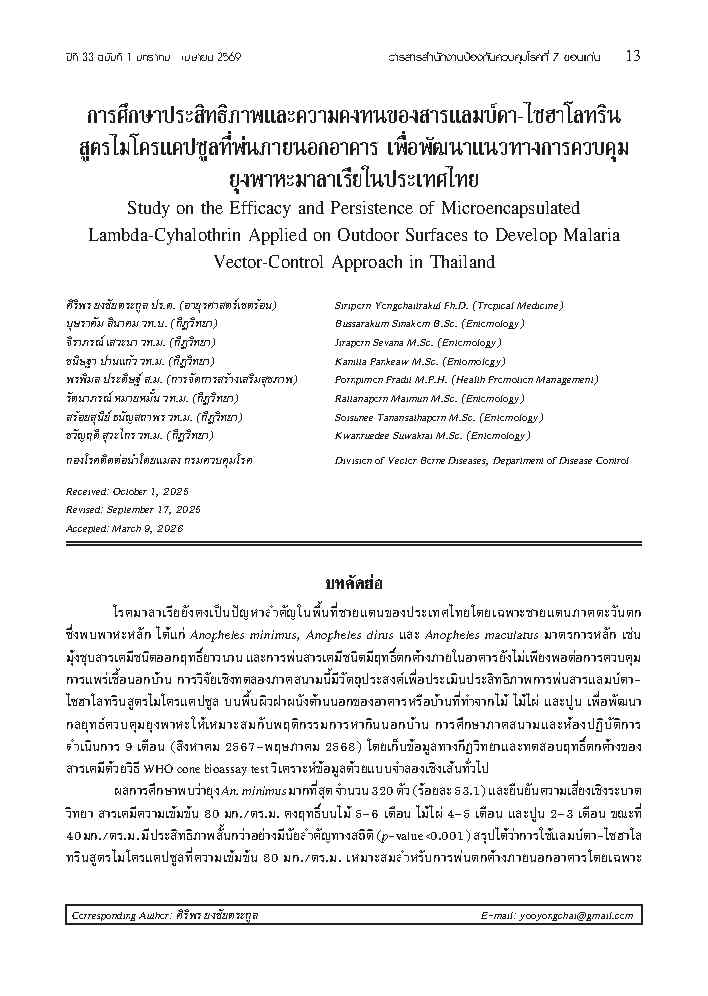
Study on the Efficacy and Persistence of Microencapsulated Lambda-Cyhalothrin Applied on Outdoor Surfaces to Develop Malaria Vector-Control Approach in Thailand
Keywords:
Malaria, Outdoor Residual Spraying, Lambda-cyhalothrin microcapsuleAbstract
Malaria remains a significant public health problem in Thailand’s border areas, particularly along the western frontier, where the primary vectors are Anopheles minimus, Anopheles dirus, and Anopheles maculatus. Core interventions, including long-lasting insecticidal nets and indoor residual spraying, remain effective but are insufficient to control transmission occurring outdoors. This field experimental research aimed to assess the efficacy of outdoor residual spraying with a lambda-cyhalothrin microcapsule applied to the outer wall surfaces of houses made of wood, bamboo, and cement, to develop vector control strategies tailored to outdoor biting behavior. A combined field and laboratory study was conducted over nine months (August 2024–May 2025). Entomological data were collected, and the residual activity of the insecticide was evaluated using the WHO cone bioassay test. Data were analyzed using Generalized Linear Models.
The study found that Anopheles minimus was the most abundant species (53.1%), confirming the epidemiological risk in the area. At 80 mg/m², residual activity persisted for 5–6 months on wood, 4–5 months on bamboo, and 2–3 months on cement, while at 40 mg/m² it lasted 3–4 months, 2–3 months, and 1–2 months, respectively. Efficacy declined significantly over time (p-value<0.001). In conclusion, the use of a lambda-cyhalothrin microcapsule formulation at 80 mg/m² is appropriate for outdoor residual spraying, particularly on wooden surfaces, and should be considered as a complementary measure alongside indoor residual spraying and long-lasting insecticidal nets to enhance the effectiveness of outdoor malaria vector control and to strengthen the sustainability of malaria prevention and control strategies in Thailand.
Downloads
References
กรมควบคุมโรค. ยุทธศาสตร์การกำจัดโรคมาลาเรียแห่งชาติ พ.ศ. 2560-2569. กรุงเทพฯ: โรงพิมพ์ชุมนุมสหกรณ์การเกษตรแห่งประเทศไทย; 2560.
World Health Organization. Global technical strategy for malaria 2016-2030. Geneva: World Health Organization; 2015.
Protopopoff N, Mosha JF, Lukole E, Charlwood JD, Wright A, Mwalimu CD, et al. Effectiveness of a long-lasting piperonyl butoxide-treated insecticidal net and indoor residual spray interventions, separately and together, against malaria transmitted by pyrethroid-resistant mosquitoes: a cluster, randomised controlled, two-by-two factorial design trial. Lancet 2018; 391(10130): 1577-88. doi: 10.1016/S0140-6736(18)30427-6.
Rowland M, Boko P, Odjo A, Asidi A, Akogbeto M, N'Guessan R. A new long-lasting indoor residual formulation of the organophosphate insecticide pirimiphos methyl for prolonged control of pyrethroid-resistant mosquitoes: an experimental hut trial in Benin. PLoS One 2013; 8(7): e69516. doi: 10.1371/journal.pone.0069516.
World Health Organization. Guidelines for testing mosquito adulticides for indoor residual spraying and treatment of mosquito nets. Geneva: World Health Organization; 2006.
World Health Organization. Equipment for vector control: specification guidelines. 4th ed. Geneva: World Health Organization; 2019.
World Health Organization. Manual for indoor residual spraying: application of residual sprays for vector control. 3rd ed. Geneva: World Health Organization; 2015.
Rattanarithikul R, Harrison BA, Harbach RE, Panthusiri P, Coleman RE. Illustrated keys to the mosquitoes of Thailand. IV. Anopheles. Southeast Asian J Trop Med Public Health 2006; 37(Suppl 2): 1-128.
World Health Organization. Test procedures for insecticide resistance monitoring in malaria vector mosquitoes. 2nd ed. Geneva: World Health Organization; 2022.
World Health Organization. Guidelines for malaria vector control. Geneva: World Health Organization; 2019.
Chaumeau V, Cerqueira D, Zadrozny J, Kittiphanakun P, Andolina C, Chareonviriyaphap T, et al. Insecticide resistance in malaria vectors along the Thailand-Myanmar border. Parasit Vectors 2017; 10(1): 165. doi: 10.1186/s13071-017-2102-z.
Mutagahywa J, Ijumba JN, Pratap HB, Molteni F, Mugarula FE, Magesa SM, et al. The impact of different sprayable surfaces on the effectiveness of indoor residual spraying using a microencapsulated formulation of lambda-cyhalothrin against Anopheles gambiae s.s. Parasit Vectors 2015; 8: 79. doi: 10.1186/s13071-015-0795-4.
Yu F, Wang Y, Zhao Y, Chou J, Li X. Preparation of polyurea microcapsules by interfacial polymerization of isocyanate and chitosan oligosaccharide. Materials 2021; 14(13): 3753. doi: 10.3390/ma14133753.
Mmbando AS, Ngowo HS, Kilalangongono M, Abbas S, Matowo NS, Moore SJ, et al. Small-scale field evaluation of push-pull system against early-and outdoor-biting malaria mosquitoes in an area of high pyrethroid resistance in Tanzania. Wellcome Open Res 2017; 2: 112. doi: 10.12688/wellcomeopenres.13006.1.
Wong ML, Chua TH, Leong CS, Khaw LT, Fornace K, Wan-Sulaiman WY, et al. Seasonal and spatial dynamics of the primary vector of Plasmodium knowlesi within a major transmission focus in Sabah, Malaysia. PLoS Negl Trop Dis 2015; 9(10): e0004135. doi: 10.1371/journal.pntd.0004135.
Downloads
Published
How to Cite
Issue
Section
License
Copyright (c) 2026 สำนักงานป้องกันควบคุมโรคที่7จังหวัดขอนแก่น

This work is licensed under a Creative Commons Attribution-NonCommercial-NoDerivatives 4.0 International License.
ความรับผิดชอบ
บทความที่ลงพิมพ์ในวารสารสำนักงานป้องกันควบคุมโรคที่ 7 ขอนแก่น ถือเป็นผลงานทางวิชาการหรือวิจัย และวิเคราะห์ตลอดจนเป็นความเห็นส่วนตัวของผู้เขียน ไม่ใช่ความเห็นของวารสารสำนักงาน ป้องกันควบคุมโรคที่ 7 จังหวัดขอนแก่น หรือ ของกองบรรณาธิการแต่ประการใด ผู้เขียนต้องรับผิดชอบต่อบทความของตนเอง
ลิขสิทธ์บทความ
บทความที่ได้รับการตีพิมพ์จะถือเป็นลิขสิทธิ์ของสำนักงานป้องกันตวบคุมโรคที่ 7 จังหวัดขอนแก่น