Predicting Factors of the Risk of Atrial Fibrillation among People Aged 60 Years and Over in Pattani Province
Keywords:
Atrial fibrillation, Older adults, Predictors, Screening, Pattani provinceAbstract
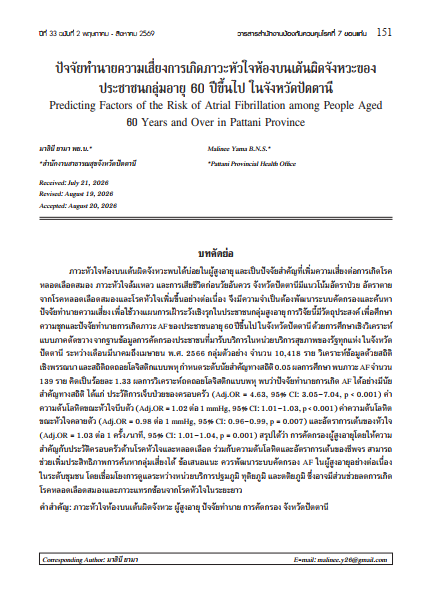
Atrial fibrillation is commonly found in the elderly and is a major factor increasing the risk of stroke, heart failure, and premature death. Pattani province has a continuously increasing trend of morbidity and mortality rates from stroke and heart disease. Therefore, there is a need to develop a screening system and identify predictors of AF risk to inform planning for proactive surveillance in the elderly population. This research aims to 1) study the prevalence of AF in the population aged 60 years and over in Pattani province, and 2) study the predictors of AF in this population group. This is a cross-sectional analytical study from the screening database of people receiving services at all public health service units and communities in Pattani province between March and April 2023. The sample consisted of 10,418 individuals. Data were analyzed using descriptive statistics and multiple logistic regression. The level of statistical significance was set at 0.05. The study results found 139 cases of AF, accounting for 1.33%. The multiple logistic regression analysis revealed that the factors capable of significantly predicting the occurrence of AF included family history of heart disease/arrhythmia/stroke (Adj.OR = 4.63, 95% CI: 3.05–7.04, p < 0.001), systolic blood pressure (Adj.OR = 1.02 per 1 mmHg, 95% CI: 1.01–1.03, p < 0.001), diastolic blood pressure (Adj.OR = 0.98 per 1 mmHg, 95% CI: 0.96–0.99, p = 0.007), and heart rate (Adj.OR = 1.03 per 1 beat/min, 95% CI: 1.01–1.04, p = 0.001). In conclusion, screening the elderly by prioritizing family history of cardiovascular disease, along with blood pressure and pulse rate, can help increase the efficiency of identifying the AF risk group. Recommendations: An AF screening system for the elderly should be continuously developed at the community level by linking care across primary, secondary, and tertiary care units, which may contribute to reducing the long-term occurrence of stroke and heart disease complications.
References
Amin A, Houmsse A, Ishola A, Tyler J, Houmsse M. The current approach of atrial fibrillation management. Avicenna J Med 2016;6(1):8-16. doi: 10.4103/2231-0770.173580.
McManus DD, Rienstra M, Benjamin EJ. An update on the prognosis of patients with atrial fibrillation. Circulation 2012;126(10):e143-6. doi: 10.1161/CIRCULATIONAHA.112.129759.
Fuster V, Rydén LE, Cannom DS, Crijns HJ, Curtis AB, Ellenbogen KA, et al. ACC/AHA/ESC 2006 guidelines for the management of patients with atrial fibrillation-executive summary: a report of the American College of Cardiology/American Heart Association Task Force on Practice Guidelines and the European Society of Cardiology Committee for Practice Guidelines (Writing Committee to Revise the 2001 Guidelines for the Management of Patients With Atrial Fibrillation): developed in collaboration with the European Heart Rhythm Association and the Heart Rhythm Society. Circulation. 2006;114(7):e257-354. doi: 10.1161/CIRCULATIONAHA.106.177292.
ชมรมช่างไฟฟ้าหัวใจแห่งประเทศไทย ภายใต้สมาคมแพทย์โรคหัวใจแห่งประเทศไทย ในพระบรมราชูปถัมภ์. แนวทางเวชปฏิบัติสำหรับการวินิจฉัยและการดูแลรักษาผู้ป่วยหัวใจเต้นผิดจังหวะชนิด atrial fibrillation พ.ศ.2568. กรุงเทพฯ: ปัญจมิตรการพิมพ์; 2568.
Van Gelder IC, Rienstra M, Bunting KV, Casado-Arroyo R, Caso V, Crijns HJGM, et al. 2024 ESC Guidelines for the management of atrial fibrillation developed in collaboration with the European Association for Cardio-Thoracic Surgery (EACTS). Eur Heart J 2024;45(36):3314-414. doi: 10.1093/eurheartj/ehae176.
สำนักงานสาธารณสุขจังหวัดปัตตานี. เอกสารประกอบการตรวจราชการและนิเทศงานกรณีปกติ รอบที่ 2 ปีงบประมาณ พ.ศ. 2569 จังหวัดปัตตานี ระหว่างวันที่ 20–22 พฤษภาคม 2569. ปัตตานี: สำนักงานสาธารณสุขจังหวัดปัตตานี; 2569. [ไม่ได้ตีพิมพ์]
Cooke G, Doust J, Sanders S. Is pulse palpation helpful in detecting atrial fibrillation? A systematic review. J Fam Pract 2006;55(2):130-4.
Phrommintikul A, Detnuntarat P, Prasertwitayakij N, Wongcharoen W. Prevalence of atrial fibrillation in Thai elderly. J Geriatr Cardiol 2016;13(3):270-3. doi: 10.11909/j.issn.1671-5411.2016.03.002.
Suwanwela NC, Chutinet A, Autjimanon H, Ounahachok T, Decha-umphai C, Chockchai S, et al. Atrial fibrillation prevalence and risk profile from novel community-based screening in Thailand: A prospective multi-centre study. Int J Cardiol Heart Vasc 2021;32:100709. doi: 10.1016/j.ijcha.2020.100709.
Lee DSM, Damrauer SM, Levin MG. Genetics of atrial fibrillation. Curr Opin Cardiol 2023;38(3):162-8. doi: 10.1097/HCO.0000000000001031.
Doehner W, Boriani G, Potpara T, Blomstrom-Lundqvist C, Passman R, Sposato LA, et al. Atrial fibrillation burden in clinical practice, research, and technology development: a clinical consensus statement of the European Society of Cardiology Council on Stroke and the European Heart Rhythm Association. Europace 2025;27(3):euaf019. doi: 10.1093/europace/euaf019.
Tan S, Zhang Z, Lin Q, Tu T, Zhu J, Zeng G, et al. Burden and age-specific trends of atrial fibrillation/atrial flutter from 1990 to 2023: A growing challenge among younger and middle-aged adults. Europace 2026;28(4):euag036. doi: 10.1093/europace/euag036.
Downloads
Published
How to Cite
Issue
Section
License
Copyright (c) 2026 สำนักงานป้องกันควบคุมโรคที่7จังหวัดขอนแก่น

This work is licensed under a Creative Commons Attribution-NonCommercial-NoDerivatives 4.0 International License.
ความรับผิดชอบ
บทความที่ลงพิมพ์ในวารสารสำนักงานป้องกันควบคุมโรคที่ 7 ขอนแก่น ถือเป็นผลงานทางวิชาการหรือวิจัย และวิเคราะห์ตลอดจนเป็นความเห็นส่วนตัวของผู้เขียน ไม่ใช่ความเห็นของวารสารสำนักงาน ป้องกันควบคุมโรคที่ 7 จังหวัดขอนแก่น หรือ ของกองบรรณาธิการแต่ประการใด ผู้เขียนต้องรับผิดชอบต่อบทความของตนเอง
ลิขสิทธ์บทความ
บทความที่ได้รับการตีพิมพ์จะถือเป็นลิขสิทธิ์ของสำนักงานป้องกันตวบคุมโรคที่ 7 จังหวัดขอนแก่น