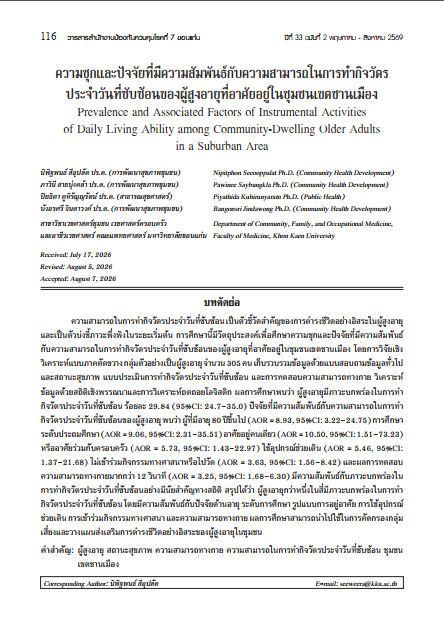
Prevalence and Associated Factors of Instrumental Activities of Daily Living Ability among Community-Dwelling Older Adults in a Suburban Area
Keywords:
Elderly, Health status, Physical ability, Instrumental activities of daily living, Suburban areaAbstract
Instrumental Activities of Daily Living (IADL) is an important indicator of independent living among older adults and an early marker of functional dependence. This study aimed to determine the prevalence of IADL impairment and identify factors associated with IADL among suburban community-dwelling older adults. A cross-sectional analytical study was conducted among 305 older adults residing in suburban communities. Data were collected using a structured questionnaire on sociodemographic characteristics and health status, the Lawton IADL Scale, and the Timed Up and Go (TUG) test. Descriptive statistics and multiple logistic regression analysis were performed. The results of the study found that the prevalence of IADL impairment was 29.84% (95% CI: 24.7–35.0). After adjustment for potential confounders, advanced age ≥ 80 years (AOR = 8.93, 95% CI: 3.22–24.75), primary education (AOR = 9.06, 95% CI: 2.31–35.51), living alone (AOR = 10.50, 95% CI: 1.51–73.23) or living with family members (AOR = 5.73, 95% CI: 1.43–22.97), use of a walking aid (AOR = 5.46, 95% CI: 1.37–21.68), non-participation in religious activities (AOR = 3.63, 95% CI: 1.56–8.42), and a TUG time >12 seconds (AOR = 3.25, 95% CI: 1.68–6.30) were independently associated with IADL impairment. In conclusion, more than a quarter of elderly individuals experience impairments in performing complex activities of daily living. Age, education level, living arrangement, use of walking aids, participation in religious activities, and physical ability are associated with this condition. The study results can be used to screen at-risk groups and plan initiatives to promote independent living among elderly individuals in the community.
References
กรมกิจการผู้สูงอายุ. สถานการณ์ผู้สูงอายุไทย พ.ศ. 2567. กรุงเทพฯ: โกโกพริ้นท์ (ไทยแลนด์); 2568.
Lawton MP, Brody EM. Assessment of older people: Self-maintaining and instrumental activities of daily living. Gerontologist 1969;9(3):179-86.
World Health Organization. World report on ageing and health. Geneva: World Health Organization; 2015.
Fong JH. Rasch analysis highlighted relative importance of walking and transferring disabilities among elderly in developing countries. J Clin Epidemiol 2021;139:121-9. doi: 10.1016/j.jclinepi.2021.07.020.
Pengpid S, Peltzer K, Anantanasuwong D. Bidirectional association between functional disability and multimorbidity among middle-aged and older adults in Thailand. Front Public Health 2022;10:1055699. doi: 10.3389/fpubh.2022.1055699.
Pengpid S, Peltzer K, Hajek A, Anantanasuwong D, Kaewchankha W. Sociodemographic, lifestyle and psychological factors associated with healthy ageing in a national longitudinal study of middle-aged and older adults in Thailand. Psychol Health Med 2025;30(6):1069-82. doi: 10.1080/13548506.2024.2439134.
Moon S, Oh E, Chung D, Hong GS. Changes in instrumental activities of daily living limitations and their associated factors according to gender in community-residing older adults: A longitudinal cohort study. PLoS One 2024;19(1):e0296796. doi: 10.1371/journal.pone.0296796.
Zhang F, Ferrucci L, Culham E, Metter EJ, Guralnik J, Deshpande N. Performance on five times sit-to-stand task as a predictor of subsequent falls and disability in older persons. J Aging Health 2013;25(3):478-92. doi: 10.1177/0898264313475813.
Albalwi AA, Alharbi AA. Optimal procedure and characteristics in using five times sit to stand test among older adults: A systematic review. Medicine (Baltimore) 2023;102(26):e34160. doi: 10.1097/MD.0000000000034160.
Collin C, Wade DT, Davies S, Horne V. The Barthel ADL Index: a reliability study. Int Disabil Stud 1988;10(2):61-3. doi: 10.3109/09638288809164103.
กรมสุขภาพจิต กระทรวงสาธารณสุข. คู่มือแบบประเมินคัดกรองผู้ที่มีปัญหาพฤติกรรมการฆ่าตัวตาย (2Q plus, 9Q, 8Q, MIND-6, ASSIST-LITE) [อินเทอร์เน็ต]. 2567 [เข้าถึงเมื่อ 5 ธ.ค. 2567]. เข้าถึงได้จาก: https://dmhpd.dmh.go.th/คู่มือแบบประเมินคัดกรอ/.
Lotrakul M, Sumrithe S, Saipanish R. Reliability and validity of the Thai version of the PHQ-9. BMC Psychiatry 2008;8:46. doi: 10.1186/1471-244X-8-46.
Podsiadlo D, Richardson S. The Timed "Up & Go": A test of basic functional mobility for frail elderly persons. J Am Geriatr Soc 1991;39(2):142-8. doi: 10.1111/j.1532-5415.1991.tb01616.x.
Ismail NR, Abdul Hamid A, Ab Razak A, Hamid NA. Factors influencing instrumental activities of daily living disability among elderly attending health clinics in Kelantan. Malays Appl Biol 2021;50(2):37-45. doi: 10.55230/mabjournal.v50i2.2015.
Bischoff HA, Stähelin HB, Monsch AU, Iversen MD, Weyh A, von Dechend M, et al. Identifying a cut-off point for normal mobility: A comparison of the Timed Up and Go test in community-dwelling and institutionalised elderly women. Age Ageing 2003;32(3):315-20. doi: 10.1093/ageing/32.3.315.
Pengpid S, Peltzer K, Hajek A, Gyasi RM. Determinants of limitations in activities of daily living among community-dwelling persons aged 80 years and older: Longitudinal national evidence from the Health, Aging and Retirement in Thailand study, 2015-2022. Geriatr Gerontol Int 2025;25(3):403-10. doi: 10.1111/ggi.15090.
Marbaniang SP, Chungkham HS. Latent class of multidimensional dependency in community-dwelling older adults: evidence from the longitudinal ageing study in India. BMC Geriatr 2024;24(1):203. doi: 10.1186/s12877-024-04813-9.
Pedersen AK, Ernstsen L. Instrumental activities of daily living and self-rated health in community-dwelling older adults: cross-sectional findings from the HUNT Study (HUNT4 Trondheim 70+). BMC Geriatr 2025;25(1):334. doi: 10.1186/s12877-025-05983-w.
Nguyen VC, Moon S, Oh E, Hong GS. Factors associated with functional limitations in daily living among older adults in Korea: A cross-sectional study. Int J Public Health 2022;67:1605155. doi: 10.3389/ijph.2022.1605155.
Hu Q, Xu J, Ren Y, Ding J, Chu T. Intrinsic capacity and instrumental activity of daily living among community-dwelling elderly in China: the mediating effect of two-way social support and sense of coherence. Public Health Nurs 2024;42(2):762-70. doi: 10.1111/phn.13505.
Shin J, Kim GS. Patterns of change and factors associated with IADL function decline in community-dwelling older adults with arthritis. Sci Rep 2022;12(1):16840. doi: 10.1038/s41598-022-19791-4.
Donoghue OA, Savva GM, Cronin H, Kenny RA, Horgan NF. Using timed up and go and usual gait speed to predict incident disability in daily activities among community-dwelling adults aged 65 years and older. Arch Phys Med Rehabil 2014;95(10):1954-61. doi: 10.1016/j.apmr.2014.06.008.
Balicki P, Sołtysik BK, Borowiak E, Kostka T, Kostka J. Activities of daily living limitations in relation to the presence of pain in community-dwelling older adults. Sci Rep 2025;15:15027. doi: 10.1038/s41598-025-00241-w.
Downloads
Published
How to Cite
Issue
Section
License
Copyright (c) 2026 สำนักงานป้องกันควบคุมโรคที่7จังหวัดขอนแก่น

This work is licensed under a Creative Commons Attribution-NonCommercial-NoDerivatives 4.0 International License.
ความรับผิดชอบ
บทความที่ลงพิมพ์ในวารสารสำนักงานป้องกันควบคุมโรคที่ 7 ขอนแก่น ถือเป็นผลงานทางวิชาการหรือวิจัย และวิเคราะห์ตลอดจนเป็นความเห็นส่วนตัวของผู้เขียน ไม่ใช่ความเห็นของวารสารสำนักงาน ป้องกันควบคุมโรคที่ 7 จังหวัดขอนแก่น หรือ ของกองบรรณาธิการแต่ประการใด ผู้เขียนต้องรับผิดชอบต่อบทความของตนเอง
ลิขสิทธ์บทความ
บทความที่ได้รับการตีพิมพ์จะถือเป็นลิขสิทธิ์ของสำนักงานป้องกันตวบคุมโรคที่ 7 จังหวัดขอนแก่น