Diagnostic Accuracy of Repeat Fecal Immunochemical Test for Colorectal Cancer Screening at Mae Ramat Hospital, Tak Province
Keywords:
Colorectal cancer, Screening, Fecal immunochemical test, Colonoscopy, Diagnostic accuracy, TriageAbstract
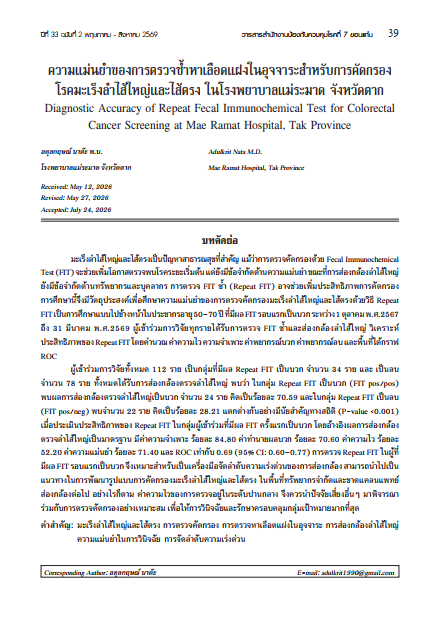
Colorectal cancer remains a major public health concern worldwide. Although screening with the Fecal Immunochemical Test (FIT) improves the detection of early-stage disease, its diagnostic accuracy remains limited. Additionally, colonoscopy-based screening is constrained by limited resources and shortages of endoscopists. Repeat fecal immunochemical testing (Repeat FIT) may improve the performance of colorectal cancer screening. This study aimed to evaluate the diagnostic accuracy of colorectal cancer screening using Repeated FIT. A prospective study was conducted among individuals aged 50–70 years who had a positive initial FIT result between October 1, 2024, and March 31, 2026. All participants underwent Repeat FIT testing followed by colonoscopy. The diagnostic performance of Repeat FIT was assessed by calculating sensitivity, specificity, positive predictive value (PPV), negative predictive value (NPV), accuracy, and the area under the receiver operating characteristic curve (AUC-ROC).
A total of 112 participants were enrolled, including 34 individuals with positive Repeat FIT results and 78 with negative Repeat FIT results. All participants subsequently underwent colonoscopy. Among the Repeat FIT–positive group (FIT pos/pos), 24 participants had positive colonoscopy findings, accounting for 70.59%. In the Repeat FIT–negative group (FIT pos/neg), positive colonoscopy findings were observed in 22 participants (28.21%). The difference between the two groups was statistically significant (p<0.001). The diagnostic performance of Repeat FIT was evaluated among participants with an initial positive FIT result, using colonoscopy findings as the reference standard. Repeat FIT demonstrated a specificity of 84.80%, PPV of 70.60%, sensitivity of 52.20%, accuracy of 71.40%, and an AUC-ROC of 0.69 (95%CI: 0.60–0.77). Repeat FIT in individuals with an initial positive FIT result may therefore serve as a triage tool for prioritizing colonoscopy and may help support the development of colorectal cancer screening strategies in resource-limited settings with shortages of endoscopists. However, the sensitivity of Repeat FIT was only moderate; therefore, additional clinical risk factors should be considered alongside screening results to improve diagnostic coverage and reduce missed diagnoses.
References
Roshandel G, Ghasemi-Kebria F, Malekzadeh R. Colorectal cancer: epidemiology, risk factors, and prevention. Cancers (Basel) 2024;16(8):1-20. doi: 10.3390/cancers16081530.
Morgan E, Arnold M, Gini A, Lorenzoni V, Cabasag CJ, Laversanne M, et al. Global burden of colorectal cancer in 2020 and 2040: incidence and mortality estimate from GLOBOCAN. Gut 2023;72(2):338-44. doi: 10.1136/gutjnl-2022-327736.
Lohsiriwat V, Chaisomboon N, Pattana-Arun J. Current colorectal cancer in Thailand. Ann Coloproctol 2020;36(2):78-82. doi: 10.3393/ac.2020.01.07.
สถาบันมะเร็งแห่งชาติ. ทะเบียนมะเร็งระดับโรงพยาบาล พ.ศ. 2563 (Hospital-based cancer registry 2020) [อินเทอร์เน็ต]. 2564 [เข้าถึงเมื่อ 2 พ.ค. 2569]. เข้าถึงได้จาก: https://www.nci.go.th/Cancer_Statistics.
สถาบันมะเร็งแห่งชาติ. แนวทางการดำเนินงานและการบันทึกข้อมูลโครงการคัดกรองมะเร็งลำไส้ใหญ่และไส้ตรงด้วยวิธี FIT test [อินเทอร์เน็ต]. 2566 [เข้าถึงเมื่อ 2 พ.ค. 2569]. เข้าถึงได้จาก: https://nci.go.th/Colorectal_Cancer.
Tiankanon K, Aniwan S, Rerknimitr R. Current status of colorectal cancer and its public health burden in Thailand. Clin Endosc 2021;54(4):499-504. doi: 10.5946/ce.2020.245-IDEN.
สุรวุฒิ เจริญขจรชัย, ศุลีพร แสงกระจ่าง, โศรยา ธรรมรักษ์. การตรวจคัดกรองมะเร็งลำไส้ใหญ่และทวารหนักของระบบสาธารณสุขไทย. วารสารโรคมะเร็ง 2565;42(2):86-103.
Randel KR, Schult AL, Botteri E, Hoff G, Bretthauer M, Ursin G, et al. Colorectal cancer screening with repeated fecal immunochemical test versus sigmoidoscopy: baseline results from a randomized trial. Gastroenterology 2021;160(4):1085-96. doi: 10.1053/j.gastro.2020.11.037.
Oort FA, van Turenhout ST, Coupé VMH, van der Hulst RWM, Wesdorp EIC, Terhaar sive Droste JS, et al. Double sampling of a faecal immunochemical test is not superior to single sampling for detection of colorectal neoplasia: a colonoscopy-controlled prospective cohort study. BMC Cancer 2011;11:434. doi: 10.1186/1471-2407-11-434.
Farkas NG, Fraser CG, Maclean W, Jourdan I, Rockall T, Benton SC. Replicate and repeat faecal immunochemical tests in symptomatic patients: a systematic review. Ann Clin Biochem 2023;60(1):27-36. doi: 10.1177/00045632221096036.
ศีลวัต คูนชัยนนท์. ผลลัพธ์จากการคัดกรองมะเร็งลำไส้ใหญ่และไส้ตรงในโรงพยาบาลกันทรลักษ์ จังหวัดศรีสะเกษ. วารสารวิจัยและพัฒนาสุขภาพศรีสะเกษ 2566;2(พิเศษ 2):59-72.
Wayne WD. Biostatistics: a foundation of analysis in the health sciences. 6th ed. New York: John Wiley&Sons; 1995. p. 180.
Gerrard AD, Maeda Y, Miller J, Gunn F, Theodoratou E, Noble C, et al. Double faecal immunochemical testing in patients with symptoms suspicious of colorectal cancer. Br J Surg 2023;110(4):471-80. doi:10.1093/bjs/znad016.
Lee JK, Liles EG, Bent S, Levin TR, Corley DA. Accuracy of fecal immunochemical tests for colorectal cancer: systematic review and meta-analysis. JAMA Intern Med 2014;160(3):171. doi: 10.7326/M13-1484.
Schreuders EH, Grobbee EJ, Nieuwenburg SAV, Kapidzic A, van Roon AHC, van Vuuren AJ, et al. Multiple rounds of one sample versus two sample faecal immunochemical test-based colorectal cancer screening: a population-based study. Lancet Gastroenterol Hepatol 2019;4(8):622-31. doi: 10.1016/S2468-1253(19)30176-1.
van Roon AH, Goede SL, van Ballegooijen M, van Vuuren AJ, Looman CW, Biermann K, et al. Random comparison of repeated faecal immunochemical testing at different intervals for population-based colorectal cancer screening. Gut 2013;62(3):409-15. doi: 10.1136/gutjnl-2011-301583.
Downloads
Published
How to Cite
Issue
Section
License
Copyright (c) 2026 สำนักงานป้องกันควบคุมโรคที่7จังหวัดขอนแก่น

This work is licensed under a Creative Commons Attribution-NonCommercial-NoDerivatives 4.0 International License.
ความรับผิดชอบ
บทความที่ลงพิมพ์ในวารสารสำนักงานป้องกันควบคุมโรคที่ 7 ขอนแก่น ถือเป็นผลงานทางวิชาการหรือวิจัย และวิเคราะห์ตลอดจนเป็นความเห็นส่วนตัวของผู้เขียน ไม่ใช่ความเห็นของวารสารสำนักงาน ป้องกันควบคุมโรคที่ 7 จังหวัดขอนแก่น หรือ ของกองบรรณาธิการแต่ประการใด ผู้เขียนต้องรับผิดชอบต่อบทความของตนเอง
ลิขสิทธ์บทความ
บทความที่ได้รับการตีพิมพ์จะถือเป็นลิขสิทธิ์ของสำนักงานป้องกันตวบคุมโรคที่ 7 จังหวัดขอนแก่น