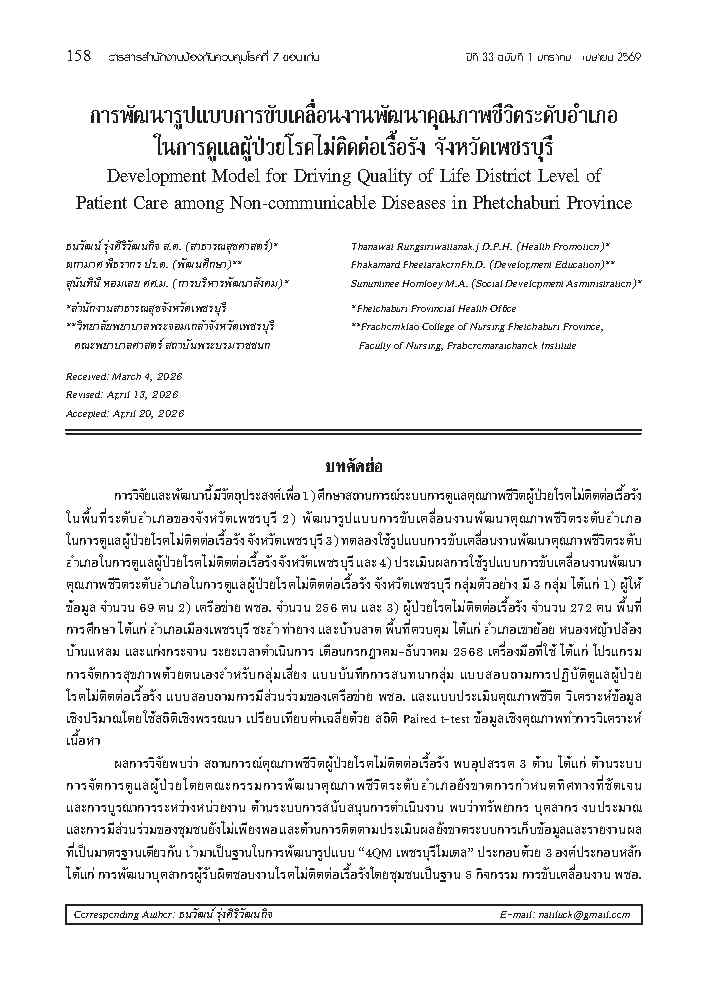
Development Model for Driving Quality of Life District Level of Patient Care among Non-communicable Diseases in Phetchaburi Province
Keywords:
Driving quality of life improvement, Patient care, Non-communicable diseasesAbstract
This research and development study aimed to: 1) study the current situation of the quality of life care system for patients with non-communicable diseases (NCDs) at the district level in Phetchaburi Province; 2) develop a district-level quality of life driving model for NCD patient care in Phetchaburi Province; 3) implement the developed model; and 4) evaluate the effectiveness of the model. The sample consisted of three groups: 1) sixty-nine key informants, 2) two hundred and fifty-six members of the District Quality of Life Development Board (DHB) network, and 3) two hundred and seventy-two NCD patients. The study areas included Mueang Phetchaburi, Cha-am, Tha Yang, and Ban Lat districts, while the control areas included Khao Yoi, Nong Ya Plong, Ban Laem, and Kaeng Krachan districts. The study was conducted between July and December 2025. The research instruments included a self-health-management program for at-risk groups, a focus group discussion recording form, questionnaires on NCD patient care practices and DHB network participation, and a quality-of-life assessment form. Quantitative data were analyzed using descriptive statistics and paired t-tests, while qualitative data were analyzed using content analysis.
The results revealed that a situational analysis of the quality of life of NCD patients, based on focus group discussions with 69 target individuals, identified obstacles in three main areas. First, regarding the patient care management system, the District Quality of Life Development Committee lacked clear direction and inter-agency integration. Second, regarding the operational support system, there were insufficient resources, personnel, budget, and community participation. Third, regarding the monitoring and evaluation system, there was a lack of standardized data collection and reporting. This information was utilized as the foundation for developing the “4QM Phetchaburi Model”, consists of three main components: 1) five community-based capacity-building activities for personnel responsible for NCDs; 2) seven measures for driving DHB operations (encompassing leadership development, strategic management, citizen focus, professional management development, human resource development, network participation building, and the development of an integrated health management system) and 3) a five-issue self-health management program for patients. The model's content validity was verified by three experts.
The implementation results demonstrated that, after the intervention, the personnel had a significantly higher overall level of NCD patient care practice than before the intervention (p <0.001). The DHB network showed a statistically significant increase in overall patient care participation across all aspects (pre, =107.24, post,
=110.28,
=3.04, 95% CI = 1.93–4.15, p <0.001). Furthermore, the proportion of NCD patients in the experimental group with a "fair" quality of life increased from 67.6% to 81.6%, a significant increase compared with the control group. Additionally, the incidence rates of new diabetes and hypertension cases decreased from 22.97% and 8.25% to 20.69% and 7.89%, respectively.
References
World Health Organization. Noncommunicable diseases [Internet]. 2025 [cited 2025 Jun 21]. Available from: https://www.who.int/health-topics/noncommunicable-diseases.
ระบบคลังข้อมูลด้านการแพทย์และสุขภาพ กระทรวงสาธารณสุข. NCD ClinicPlus 2568 [อินเทอร์เน็ต]. 2568 [เข้าถึงเมื่อ 7 เม.ย. 2568]. เข้าถึงได้จาก: https://hdc.moph.go.th/center/public/kpi/9/2025.
สำนักโรคไม่ติดต่อ กรมควบคุมโรค. คู่มือการดำเนินงานป้องกันควบคุมโรคไม่ติดต่อเรื้อรัง โดยยึดชุมชนเป็นฐาน: ชุมชนลดเสี่ยง ลดโรคไม่ติดต่อเรื้อรัง (CBI-NCDs). กรุงเทพฯ: อิโมชั่นอาร์ต; 2561.
กรมควบคุมโรค. กรมควบคุมโรคเดินหน้ารณรงค์วันเบาหวานโลก ปี 2568 ชวนวัยทำงานใส่ใจสุขภาพ สร้างพฤติกรรมสุขภาพที่ดี ลดเสี่ยงเบาหวาน [อินเทอร์เน็ต]. 2568 [เข้าถึงเมื่อ 7 เม.ย. 2568] เข้าถึงได้จาก: https://www.ddc.moph.go.th/brc/news.php?news=56850&deptcode=brc&news_views=184
ทัศนา บุญทอง, อรพรรณ โตสิงห์, ประภา ยุทธไตร, วิไลวรรณ ทองเจริญ, โสพรรณ โพทะยะ, มัตติกา ใจจันทร์ และคณะ. สถานการณ์โรคไม่ติดต่อเรื้อรังของผู้ใหญ่และผู้สูงอายุในชุมชนเมือง เขตกรุงเทพมหานคร. วารสารสภาการพยาบาล 2567; 39(2): 163-77.
สำนักงานสาธารณสุขจังหวัดเพชรบุรี. กลยุทธการดำเนินงานการเฝ้าระวังป้องกันและควบคุมผู้ป่วยโรคไม่ติดต่อเรื้อรัง. เพชรบุรี: สำนักงานสาธารณสุขจังหวัดเพชรบุรี; 2568. ไม่ได้ตีพิมพ์.
นวลนิตย์ ไชยเพชร, อุดมศิลป์ แก้วกล่ำ, สิทธิพงษ์ สอนรัตน์, ยุวดี วิทยพันธ์. ประสิทธิผลของโปรแกรมปรับเปลี่ยนพฤติกรรมสุขภาพต่อพฤติกรรมสุขภาพของกลุ่มเสี่ยงโรคไม่ติดต่อเรื้อรังชุมชนโพหวาย ตำบลบางกุ้ง อำเภอเมือง จังหวัดสุราษฎร์ธานี. วารสารเครือข่ายวิทยาลัยพยาบาลและการสาธารณสุขภาคใต้ 2560; 4(2): 45-62.
วิภาพร สิทธิสาตร์, จันทิมา นวะมะวัฒน์, อัญชลี รุ่งฉาย, สมาภรณ์ เทียนขาว, เปี่ยมศักดิ์ พึ่งโพธิ์, นพรัตน์ เพชรกลอง. ผลของโปรแกรมการปรับเปลี่ยนพฤติกรรมสร้างเสริมสุขภาพโดยการมีส่วนร่วมของชุมชนในกลุ่มเสี่ยงโรคไม่ติดต่อเรื้อรัง. วารสารการพยาบาลและการศึกษา 2565; 15(1): 15-26.
กานต์ชัชพิสิฐ คงเสถียรพงษ์, ศิวิไลซ์ วนรัตน์วิจิตร. คณะกรรมการพัฒนาคุณภาพชีวิตระดับอำเภอ: ความท้าทายและการพัฒนา. วารสารวิทยาลัยพยาบาลบรมราชชนนี อุตรดิตถ์. 2564; 13(2): 275-86.
อารมณ์ ร่มเย็น. ผลของการพัฒนาระบบการจัดการดูแลผู้ป่วยโรคไม่ติดต่อเรื้อรัง โดยใช้กลไกคณะกรรมการพัฒนาคุณภาพชีวิตระดับอำเภอ. วารสารวิจัยและพัฒนาระบบสุขภาพ 2565; 15(3): 301-14.
World Health Organization. The World Health Report 2008: Primary Health Care - Now More Than Ever. Geneva: WHO; 2008.
ปัญญา พละศักดิ์. การศึกษาและพัฒนารูปแบบการดำเนินงานพัฒนาคุณภาพชีวิตระดับอำเภอ ของอำเภอเมืองศรีสะเกษ จังหวัดศรีสะเกษ. วารสารสภาการสาธารณสุขชุมชน 2564; 3(2): 40-53.
ราม รังสินธุ์, มฑิรุทธ มุ่งถิ่น, ปนัดดา หัตถโชติ, บุญทรัพย์ ศักดิ์บุญญารัตน์, ยุภาพร ศรีจันทร์. การพัฒนารูปแบบบริการปฐมภูมิสำหรับผู้ป่วยโรคไม่ติดต่อเรื้อรัง โดยใช้นวัตกรรมเครือข่ายผู้ช่วยเหลือผู้ป่วยที่บ้าน [รายงานการวิจัย]. สถาบันวิจัยระบบสาธารณสุข; 2563.
กองสนับสนุนระบบสุขภาพปฐมภูมิ. คู่มือคุณภาพมาตรฐานบริการสุขภาพปฐมภูมิ พ.ศ. 2568-2570. นนทบุรี: กระทรวงสาธารณสุข; 2568.
กีระติ เวียงนาค. การพัฒนาคุณภาพชีวิตผู้สูงอายุแบบมีส่วนร่วมโดยใช้กลไกคณะกรรมการพัฒนาคุณภาพชีวิต อำเภอสูงเม่น จังหวัดแพร่. วารสารวิจัยและวิชาการสาธารณสุขจังหวัดพิจิตร 2563; 1(1): 49-55.
บัณฑิต ศรไพศาล, ยงยุทธ วงศ์ภิรมย์ศานติ์, คำนวณ อึ้งชูศักดิ์, สมศักดิ์ ชุณหรัศมิ์, ไพโรจน์ เสาน่วม.โมเดลพลังสี่ภาคส่วนสู่การยกระดับการทำงานป้องกันและควบคุมโรคไม่ติดต่อเรื้อรัง. วารสารวิชาการสาธารณสุข 2563; 29(4): 747-64.
Cohen JM, Uphoff NT. Rural development participation: Concept and measure for project design, implementation and evaluation. New York: Rural Development Committee, Center for international Studies, Cornell University; 1977.
กานต์ชัชพิสิฐ คงเสถียรพงษ์, ศิวิไลซ์ วนรัตน์วิจิตร. คณะกรรมการพัฒนาคุณภาพชีวิตระดับอำเภอ: ความท้าทายและการพัฒนา. วารสารวิทยาลัยพยาบาลบรมราชชนนี อุตรดิตถ์. 2564; 13(2): 275-86.
ศุภชาติ เขมวุฒิพงษ์. ผลของรูปแบบการสร้างเสริมสุขภาพต่อคุณภาพชีวิตของผู้สูงอายุที่ป่วยด้วยโรคไม่ติดต่อเรื้อรังในจังหวัดตรัง. วารสารสาธารณสุข มหาวิทยาลัยบูรพา 2566; 18(1): 51-63.
Downloads
Published
How to Cite
Issue
Section
License
Copyright (c) 2026 สำนักงานป้องกันควบคุมโรคที่7จังหวัดขอนแก่น

This work is licensed under a Creative Commons Attribution-NonCommercial-NoDerivatives 4.0 International License.
ความรับผิดชอบ
บทความที่ลงพิมพ์ในวารสารสำนักงานป้องกันควบคุมโรคที่ 7 ขอนแก่น ถือเป็นผลงานทางวิชาการหรือวิจัย และวิเคราะห์ตลอดจนเป็นความเห็นส่วนตัวของผู้เขียน ไม่ใช่ความเห็นของวารสารสำนักงาน ป้องกันควบคุมโรคที่ 7 จังหวัดขอนแก่น หรือ ของกองบรรณาธิการแต่ประการใด ผู้เขียนต้องรับผิดชอบต่อบทความของตนเอง
ลิขสิทธ์บทความ
บทความที่ได้รับการตีพิมพ์จะถือเป็นลิขสิทธิ์ของสำนักงานป้องกันตวบคุมโรคที่ 7 จังหวัดขอนแก่น