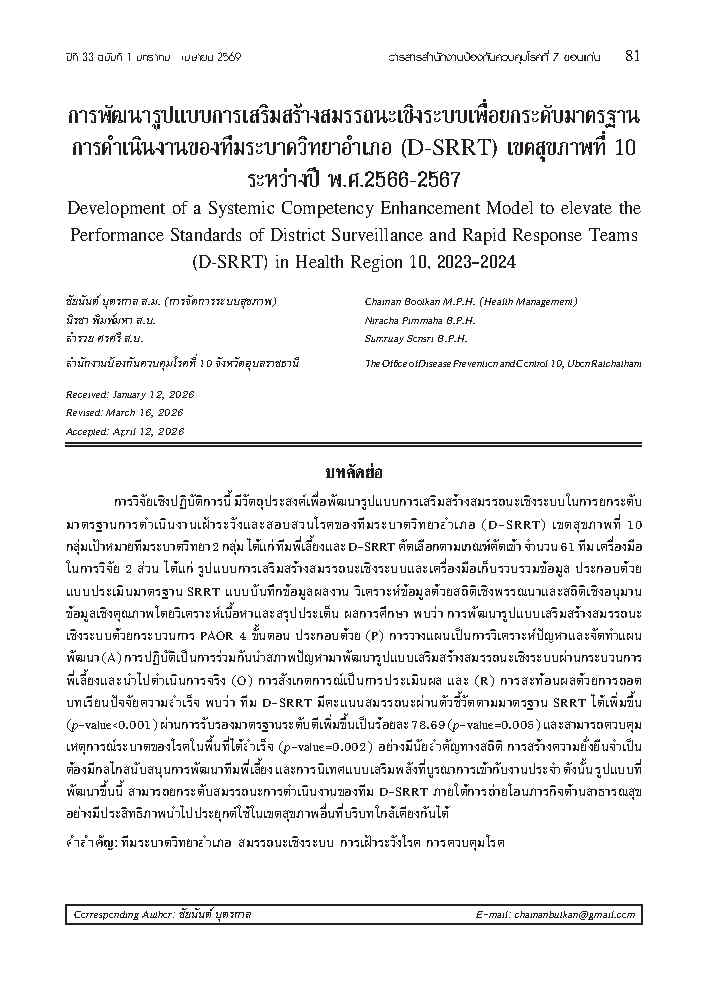
Development of a Systemic Competency Enhancement Model to elevate the Performance Standards of District Surveillance and Rapid Response Teams (D-SRRT) in Health Region 10,2023–2024
Keywords:
D-SRRT, Systemic Competency, Surveillance, Disease ControlAbstract
This action research aimed to develop a systemic competency enhancement model to elevate the operational standards for disease surveillance and investigation of District Surveillance and Rapid Response Teams (D-SRRT) in Health Region 10. The participants were divided into two groups: 1) the mentorship team and 2) the D-SRRT, consisting of 61 teams selected based on inclusion criteria. Research instruments used in this study consisted of two main components: 1) The Systemic Competency Enhancement Model, which included the mentors, operational support toolkits, and a digital disease surveillance system. Data Collection Tools, comprising the SRRT Standard Evaluation Form and performance record forms. Quantitative data were analyzed using descriptive and inferential statistics, while qualitative data were gathered through descriptive records and analyzed using content analysis and synthesis. The results showed that after implementing the systemic competency enhancement model using the PAOR process—consisting of (P) Planning, analyzing problems and formulating development plans, (A) Acting, feedback data, developing, and implementing a systemic competency model by the mentors process, (O) Observing, evaluating outcomes, and (R) Reflecting, conducting lessons learned to synthesize success factors. Found that the D-SRRT competency scores increased significantly across all standard SRRT indicators (p<0.001). The proportion of D-SRRTs passing the Special standard increased to 78.69% (p=0.005). and the success rate of local outbreak control (p=0.002) significantly improved. To ensure sustainability, it is essential to establish supporting mechanisms for mentor development and integrate empowering supervision into routine operations. In conclusion, this systemic competency development model effectively enhances the capabilities of D-SRRT staff amidst the decentralization of public health missions. The model can be applied to other health regions with similar contexts.
References
World Health Organization. Summary of probable SARS cases with onset of illness from 1 November 2002 to 31 July 2003 [Internet]. 2015 [cited 2025 Dec 29]. Available from: https://www.who.int/publications/m/item/summary-of-probable-sars-cases-with-onset-of-illness-from-1-november-2002-to-31-july-2003.
Dawood FS, Iuliano AD, Reed C, Melzer MI, Shay DK, Cheng PY, et al. Estimated global mortality associated with the first 12 months of 2009 pandemic influenza A H1N1 virus circulation: a modelling study. Lancet Infect Dis 2012; 12(9): 687-95. doi: 10.1016/S1473-3099(12)70121-4.
World Health Organization. Middle East respiratory syndrome coronavirus–Kingdom of Saudi Arabia [Internet]. 2024 [cited 2025 Dec 29]. Available from: https://www.who.int/emergencies/disease-outbreak-news/item/2024-DON516.
World Health Organization. COVID-19 cases, world [Internet]. 2025 [cited 2025 Dec 29]. Available from: https://data.who.int/dashboards/covid19/cases.
World Health Organization. Tuberculosis [Internet]. 2025 [cited 2025 Dec 29]. Available from: https://www.who.int/southeastasia/health-topics/tuberculosis.
Guzman MG, Gubler DJ, Izuaierdo A, Martinez E, Halstead SB. Dengue infection. Nat Rev Dis Primers 2016; 2: 16055. doi: 10.1038/nrdp.2016.55.
World Health Organization. Global Polio Surveillance Status Report 2019. Geneva: World Health Organization; 2019.
Carlson CJ, Kracalik IT, Ross N, Alexander KA, Hugh-Jones ME, Fegan M, et al. The global distribution of Bacillus anthracis and associated anthrax risk to humans, livestock, and wildlife. Nat Microbiology 2019; 4(8): 1337-43. doi: 10.1038/s41564-019-0435-4.
Costa F, Hagan JE, Calcagno J, Kane M, Torgerson P, Martinez-Silveira MS, et al. Global morbidity and mortality of Leptospirosis: A systematic review. PLOS Negl Trop Dis 2015; 9(9): e0003898. doi: 10.1371/journal.pntd.0003898.
กองระบาดวิทยา. ลำดับโรคที่พบบ่อยประจำสัปดาห์ (สำหรับเจ้าหน้าที่) [อินเทอร์เน็ต]. 2568 [เข้าถึงเมื่อ 29 ธ.ค. 2568]. เข้าถึงได้จาก: https://ddsdoe.ddc.moph.go.th/ddss/#dashboard.
Sokat KY, Armbruster B. Modelling and controlling epidemic outbreaks: The role of population size, model heterogeneity and fast response in the case of Measles. Mathematics 2020; 8(11): 1892. doi:10.3390/math8111892.
Cui A, Hamdani S, Woldetsadik MA, Clerville JW, Hu A, Abedi AA, et al. The field epidemiology training program’s contribution to essential public health function in seven national public health institutes. Int J Public Health 2023; 68: 1606191. doi: 10.3389/ijph.2023.1606191.
Potter C, Brough R. Systemic capacity building: a hierarchy of needs. Health Policy Plan 2004; 15(5): 336-45 doi: 10.1093/heapol/czh038.
Woo K, Jung S, Byun H, Yoo K. Development of Standard Operating Procedures for Infectious Disease Disaster Response in Healthcare Institutions. Quality Improvement in Health Care 2025; 31(1): 46-64. doi: 10.14371/QIH.2025.31.1.46.
Sapkota S, Dhakal A, Rushton S, Teijlingen E, Marahatta SB, Balen J, et al. The impact of decentralization on health systems: a systematic review of reviews. BMJ Glob Health 2023; 8(12): e013317. doi:10.1136/bmjgh-2023-013317.
Manzi A, Hirschhorn LR, Sherr K, Chirwa C, Baynes C, Awoonor-Williams JK, et al. Mentorship and coaching to support strengthening healthcare systems: lessons learned across the five Population Health Implementation and Training partnership projects in sub-Sahatan Africa. BMC Health Service Research 2017; 17(Suppl 3): 831. doi: 10.1186/s12913-017-2656-7.
Kemmis S, McTaggart R. The Action Research Planner. 3rd ed. Victoria: Deakin University Press; 1988.
กองระบาดวิทยา. มาตรฐานและแนวทางปฏิบัติงานทีมเฝ้าระวังสอบสวนควบคุมโรคและภัยสุขภาพ 2563. กรุงเทพฯ: แคนนากราฟฟิก; 2563.
สำนักงานคณะกรรมการผู้ทรงคุณวุฒิ กรมควบคุมโรค. แนวทางพัฒนา MENTORING PROGRAM ในองค์กร. นนทบุรี: สำนักงานคณะกรรมการผู้ทรงคุณวุฒิ กรมควบคุมโรค; 2563.
กองระบาดวิทยา. คลังความรู้สำหรับทีม JIT [อินเทอร์เน็ต]. 2568 [เข้าถึงเมื่อ 29 ธ.ค. 2568]. เข้าถึงได้จาก: https://sites.google.com/view/jit-ddc?usp=sharing.
กองระบาดวิทยา. แพลตฟอร์มเฝ้าระวังทางระบาดวิทยา [อินเทอร์เน็ต]. 2568 [เข้าถึงเมื่อ 29 ธ.ค. 2568]. เข้าถึงได้จาก: https://ddsdoe.ddc.moph.go.th/ddss/#dds-intro.
Manzi A, Hirschhorn LR, Sherr K, Chirwa C, Baynes C, Awoonor-Williams JK, et al. Mentorship and coaching to support strengthening healthcare systems: lessons learned across the five Population Health Implementation and Training partnership projects in sub-Saharan Africa. BMC Health Serv Res 2017; 17(Suppl 3): 831. doi: 10.1186/s12913-017-2656-7.
จมาภรณ์ ใจภักดี, วนิดา สายรัตน์, ณิชชาภัทร ยอดแคล้ว. การพัฒนาตัวชี้บ่งสมรรถนะด้านการสอบสวนควบคุมโรคติดต่ออันตราย ของเจ้าหน้าที่ในหน่วยปฏิบัติการควบคุมโรคติดต่อ (CDCU) เขตสุขภาพที่ 7. วารสารสำนักงานป้องกันควบคุมโรคที่ 7 ขอนแก่น 2565; 29(3): 38-50.
Wongsanuphat S, Malaikham J, Suriya S, Prommongkhol J, Khampha N, Kempetch T. Enhancing Digital Disease Surveillance in Thailand Using Information Technology, Data Engineering, Data Science and Artificial Intelligence. OSIR 2025; 18(1): 52-60. doi: 10.59096/osir.v18i1.272056.
นันทนา แต้ประเสริฐ, กรรณิการ์ หมอนพังเทียม, ประภาศรี สามใจ. ประสิทธิผลของรูปแบบการพัฒนาสมรรถนะการสอบสวนโรคแก่โรงพยาบาลส่งเสริมสุขภาพตำบลโดยการฝึกปฏิบัติภาคสนาม เขตสุขภาพที่ 9. วารสารสำนักงานป้องกันควบคุมโรคที่ 7 ขอนแก่น 2568; 32(3): 109-22.
Plowright RK, Parrish CR, McCallum H, Hudson PJ, Ko AI, Graham AL, et al. Pathways to zoonotic spillover. Nat Rev Microbiol 2017; 15(8): 502-10. doi: 10.1038/nrmicro.2017.45.
Downloads
Published
How to Cite
Issue
Section
License
Copyright (c) 2026 สำนักงานป้องกันควบคุมโรคที่7จังหวัดขอนแก่น

This work is licensed under a Creative Commons Attribution-NonCommercial-NoDerivatives 4.0 International License.
ความรับผิดชอบ
บทความที่ลงพิมพ์ในวารสารสำนักงานป้องกันควบคุมโรคที่ 7 ขอนแก่น ถือเป็นผลงานทางวิชาการหรือวิจัย และวิเคราะห์ตลอดจนเป็นความเห็นส่วนตัวของผู้เขียน ไม่ใช่ความเห็นของวารสารสำนักงาน ป้องกันควบคุมโรคที่ 7 จังหวัดขอนแก่น หรือ ของกองบรรณาธิการแต่ประการใด ผู้เขียนต้องรับผิดชอบต่อบทความของตนเอง
ลิขสิทธ์บทความ
บทความที่ได้รับการตีพิมพ์จะถือเป็นลิขสิทธิ์ของสำนักงานป้องกันตวบคุมโรคที่ 7 จังหวัดขอนแก่น