Development of Passive Surveillance for Pesticide Poisoning in Healthcare Facilities in Health Region 7, Thailand
Keywords:
Passive surveillance, Pesticide poisoning, ICD-10 coding, Occupational diseasesAbstract
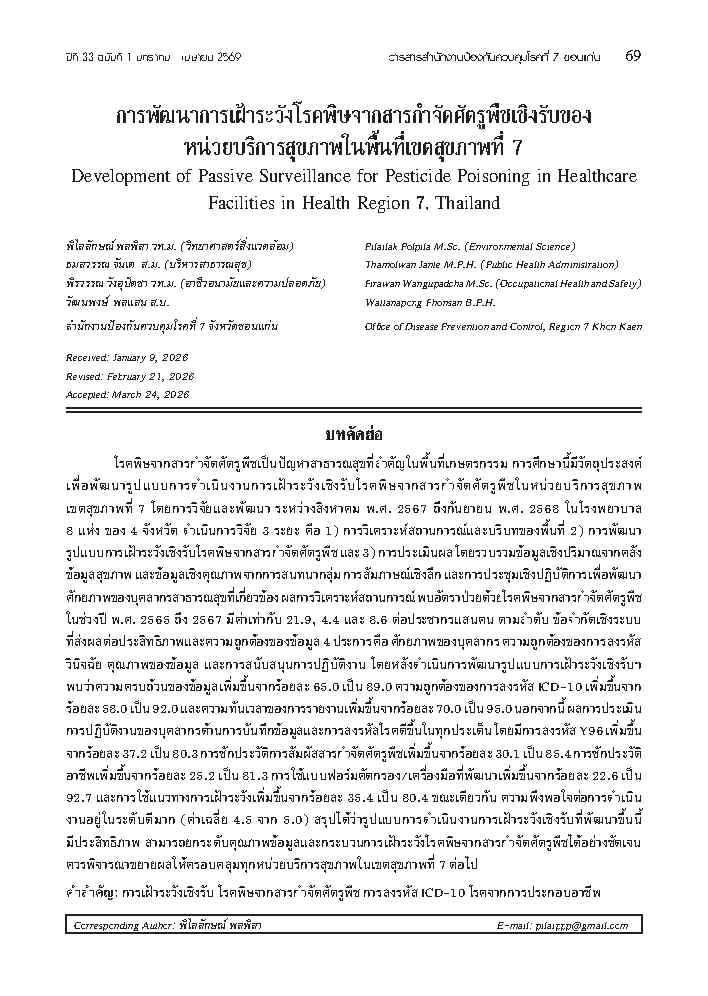
Pesticide poisoning remains a major public health problem in agricultural areas. This study aimed to develop a passive surveillance implementation model for pesticide poisoning in health service units within health region 7. A developmental research design was conducted from August 2024 to September 2025 in eight hospitals across four provinces. The study consisted of three phases: (1) analysis of the situation and local context, (2) development of a passive surveillance model, and (3) evaluation of the implementation. Quantitative data were obtained from the Health Data Center, while qualitative data were collected through focus group discussions, in-depth interviews, and capacity-building workshops for public health personnel. The results showed that the incidence rates of pesticide poisoning during 2022–2024 were 21.9, 4.4, and 8.6 per 100,000 population, respectively. Four major system-level limitations were identified: personnel capacity, accuracy of diagnostic coding, data quality, and operational support. Following implementation of the developed model, data completeness increased from 65.0 to 89.0%, the accuracy of ICD-10 coding improved from 58.0 to 92.0%, and reporting timeliness increased from 70.0 to 95.0%. In addition, significant improvements were observed in personnel practices related to data recording and coding. The use of Y96 coding increased from 37.2 to 80.3%, documentation of pesticide exposure history from 30.1 to 85.4%, occupational history taking from 25.2 to 81.3%, utilization of developed forms/tools from 22.6 to 92.7%, and adherence to surveillance guidelines from 35.4 to 80.4%. Overall satisfaction with the surveillance implementation was rated at a very high level (mean score 4.5 out of 5.0). In conclusion, the developed passive surveillance model was effective in improving both data quality and the surveillance process for pesticide poisoning. This model should be considered for scale-up across all health service units within health region 7.
References
กองโรคจากการประกอบอาชีพและสิ่งแวดล้อม กรมควบคุมโรค กระทรวงสาธารณสุข. แนวทางเฝ้าระวังและสอบสวนโรคหรืออาการสำคัญของพิษจากสารกำจัดศัตรูพืช ภายใต้พระราชบัญญัติควบคุมโรคจากการประกอบอาชีพและโรคจากสิ่งแวดล้อม พ.ศ. 2562 [อินเทอร์เน็ต]. 2562 [เข้าถึงเมื่อ 1 ก.ย. 2568]. เข้าถึงได้จาก: https://online.fliphtml5.com/bcbgj/pita/.
Queiroz PR, Lima KC, Oliveira TC, Santos MMD, Jacob JF, Oliveira AMBM. Notifiable Diseases Information System and human poisoning by pesticide in Brazil. Rev Bras Epidemiol 2019; 22: e190033. doi: 10.1590/1980-549720190033.
Faria BLS, Raposo LM. Identification of distinct pesticide poisoning patterns in Brazil: a cross-sectional cluster analysis of epidemiological data. Int Arch Occup Environ Health 2025; 98(2): 191–202. doi: 10.1007/s00420-025-02122-1.
Carvalho KP, Corassa RB, Petarli GB, Cattafesta M, Zandonade E, Salaroli LB. Exogenous pesticide poisoning in the state of Espírito Santo, Brazil, 2007–2016: spatial distribution and temporal trend in the incidence rate and case fatality ratio of notified cases. Epidemiol Serv Saude 2022; 31(2): e2021424. doi:10.1590/S2237-96222022000200008.
Santana MFS, Nunes EN, Batista KS, Leite Filho MT, Sant’ana V, Chaves VM, et al. Health surveillance of populations exposed to pesticides: analysis of reports from Paraíba State, Brazil. Scientia Plena 2024; 20(6): 067501. doi: 10.14808/sci.plena.2024.067501.
สำนักควบคุมพืชและวัสดุการเกษตร กรมวิชาการเกษตร กระทรวงเกษตรและสหกรณ์. รายงานสรุปการนำเข้าวัตถุอันตรายทางการเกษตร ปี พ.ศ. 2560–2564 [อินเทอร์เน็ต]. 2565 [เข้าถึงเมื่อ 12 ธ.ค. 2568]. เข้าถึงได้จาก: https://www.doa.go.th/ard/?page_id=386.
สำนักงานเศรษฐกิจการเกษตร กระทรวงเกษตรและสหกรณ์. สถิติสิ่งแวดล้อมของประเทศไทย พ.ศ. 2567: การนำเข้าวัตถุอันตรายทางการเกษตร พ.ศ. 2557–2566 [อินเทอร์เน็ต]. 2567 [เข้าถึงเมื่อ 12 ธ.ค. 2568]. เข้าถึงได้จาก: https://www.nso.go.th/public/e-book/Indicators-Environment/Environment-Indicators-2567/128-129.
คลังข้อมูลด้านการแพทย์และสุขภาพ กระทรวงสาธารณสุข. รายงานมาตรฐาน สถานะสุขภาพ โรคจากการประกอบอาชีพและสิ่งแวดล้อม โรคจากพิษสารกำจัดศัตรูพืช [อินเทอร์เน็ต]. 2567 [เข้าถึงเมื่อ 10 ธ.ค. 2568]. เข้าถึงได้จาก: https://hdc.moph.go.th/center/public/standard-subcatalog/f16421e617aed29602f9f09d951cce68.
สุพาพร แสนศรี, มธุลดา อนันต์สวัสดิ์, นคร บัวคำโคก, ประภาส จีบโพธิ์. การศึกษาคุณภาพข้อมูลการรายงานผู้ป่วยโรคจากพิษสารกำจัดศัตรูพืชจากระบบรายงาน 43 แฟ้ม จังหวัดนครราชสีมา ปี พ.ศ. 2562. วารสารสำนักงานป้องกันควบคุมโรคที่ 9 2564; 27(1): 68–77.
วโรดม ศรสุรินทร์, ศิโรรัตน์ เชียวบ้านยาง, ตะวัน ทองสว่าง, กนกการญจน์ สว่างศรีสุทธิกุล, ศรันย์ สุจินพรัหม, กาญจนา ชัยวรรณ และคณะ. การประเมินระบบเฝ้าระวังโรคพิษสารกำจัดศัตรูพืชในพื้นที่เกษตรกรรม อำเภอชุมพลบุรี จังหวัดสุรินทร์ ปี พ.ศ. 2562–2564. วารสารวิชาการสาธารณสุข 2566; 32(5): 814–27.
สำนักงานสถิติแห่งชาติ. การสำรวจแรงงานนอกระบบ ปี 2567 [อินเทอร์เน็ต]. 2567 [เข้าถึงเมื่อ 12 ม.ค. 2569]. เข้าถึงได้จาก: https://www.nso.go.th/nsoweb/nso/survey_detail/Jb#gsc.tab=0.
Sapbamrer R, Thammachai A. Factors affecting use of personal protective equipment and pesticide safety practices: a systematic review. Environ Res 2020; 185: 109444. doi: 10.1016/j.envres.2020.109444.
Chaiklieng S, Suggaravetsiri P, Poochada W, Thinkhamrop W, Dacherngkhao T. The burden of work-related diseases and injuries among agriculturists: a three-year retrospective study in Thailand. Safety 2022; 8(4): 78. doi: 10.3390/safety8040078.
Chaiklieng S, Chagkornburee C, Suggaravetsiri P. Situations of work-related diseases and injuries among agriculturists in the upper northeast regions of Thailand. F1000Research 2023; 11: 145. doi: 10.12688/f1000research.73221.3.
Kyung M, Lee SJ, Dancu C, Hong O. Underreporting of workers' injuries or illnesses and contributing factors: a systematic review. BMC Public Health 2023; 23(1): 558. doi: 10.1186/s12889-023-15487-0.
Sahani MK, Maat H, Balabanova D, Woldie M, Richards P; PARES Research Group, et al. Engaging communities as partners in health crisis response: a realist-informed scoping review for research and policy. Health Res Policy Syst 2024; 22(1): 56. doi: 10.1186/s12961-024-01139-1.
Ohlander J, Fuhrimann S, Basinas I, Cherrie JW, Galea KS, Povey AC, et al. Systematic review of methods used to assess exposure to pesticides in occupational health studies, 1993-2017. Occup Environ Med 2020; 77(6): 357–65. doi: 10.1136/oemed-2019-106055.
Kongtip P, Nankongnab N, Mahaboonpeeti R, Bootsikeaw S, Batsungnoen K, Hanchenlaksh C, et al. Differences among Thai agricultural workers’ health, working conditions, and pesticide use by farm type. Ann Work Expo Health 2018; 62(2): 167–81. doi:10.1093/annweh/wxx099.
Los FS, Hulshof CTJ, Sluiter JK. The view and policy of management of occupational health services on the performance of workers’ health surveillance: a qualitative exploration. BMC Health Serv Res 2019; 19(1): 473. doi: 10.1186/s12913-019-4296-6.
Downloads
Published
How to Cite
Issue
Section
License
Copyright (c) 2026 สำนักงานป้องกันควบคุมโรคที่7จังหวัดขอนแก่น

This work is licensed under a Creative Commons Attribution-NonCommercial-NoDerivatives 4.0 International License.
ความรับผิดชอบ
บทความที่ลงพิมพ์ในวารสารสำนักงานป้องกันควบคุมโรคที่ 7 ขอนแก่น ถือเป็นผลงานทางวิชาการหรือวิจัย และวิเคราะห์ตลอดจนเป็นความเห็นส่วนตัวของผู้เขียน ไม่ใช่ความเห็นของวารสารสำนักงาน ป้องกันควบคุมโรคที่ 7 จังหวัดขอนแก่น หรือ ของกองบรรณาธิการแต่ประการใด ผู้เขียนต้องรับผิดชอบต่อบทความของตนเอง
ลิขสิทธ์บทความ
บทความที่ได้รับการตีพิมพ์จะถือเป็นลิขสิทธิ์ของสำนักงานป้องกันตวบคุมโรคที่ 7 จังหวัดขอนแก่น