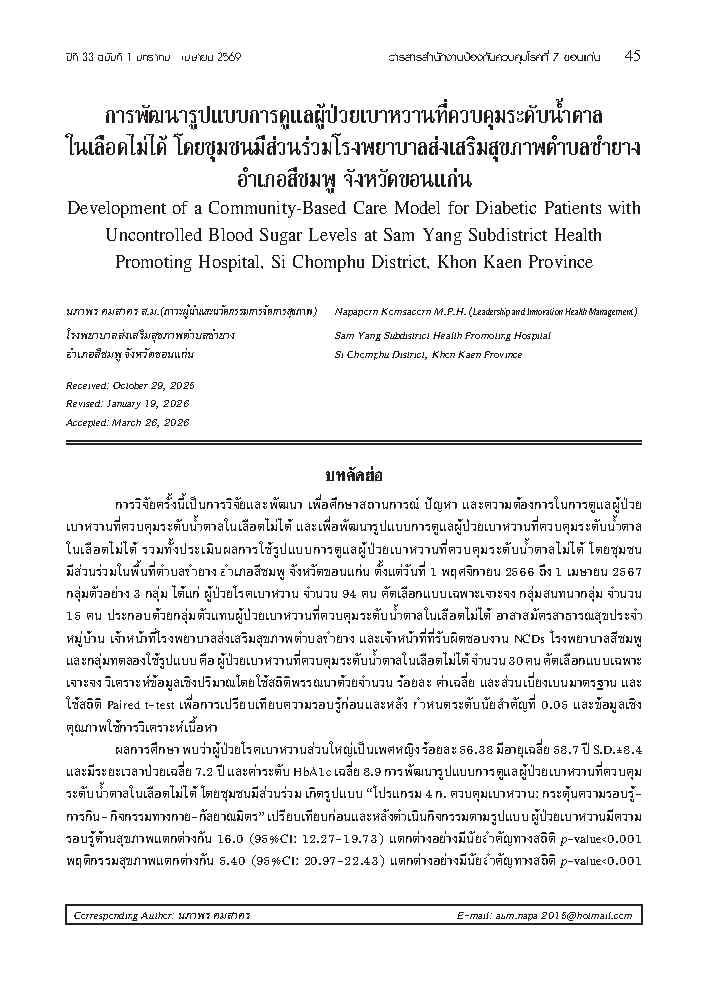
Development of a Community-Based Care Model for Diabetic Patients with Uncontrolled Blood Sugar Levels at Sam Yang Subdistrict Health Promoting Hospital, Si Chomphu District, Khon Kaen Province
Keywords:
Diabetic patients, Health literacy, Health behaviors, Community-based care, 4 Ks Diabetes Control ProgramAbstract
This research and development study aimed to examine the situation, problems, and needs in the care of patients with uncontrolled diabetes mellitus, to develop a community-participatory care model for patients with uncontrolled blood glucose levels, and to evaluate the effectiveness of the implemented care model. The study was conducted in Samyang Subdistrict, Sichomphu District, Khon Kaen Province, Thailand, from November 1, 2023, to April 1, 2024. The study samples were divided into three groups: (1) ninety-four patients with diabetes mellitus, selected by purposive sampling; (2) a focus group consisting of 15 participants, including representatives of patients with uncontrolled diabetes, village health volunteers, healthcare personnel from Samyang Subdistrict Health Promoting Hospital, and non-communicable disease (NCD) staff from Sichomphu Hospital; and (3) a pilot implementation group comprising 30 patients with uncontrolled diabetes mellitus, also selected by purposive sampling. Quantitative data were analyzed using descriptive statistics, including frequency, percentage, mean, and standard deviation, and paired t-tests were applied to compare health literacy before and after the intervention, with a significance level set at 0.05. Qualitative data were analyzed using content analysis.
The results showed that most diabetic patients were female (56.38%), with a mean age of 58.7 years, S.D.±8.4, an average duration of illness of 7.2 years, and a mean HbA1c level of 8.9%. The developed community-participatory care model, namely the “4K Diabetes Control Program: Enhancing Health Literacy, Diet, Physical Activity, and Social Support,” was effective in improving health literacy among patients with uncontrolled diabetes mellitus. After implementation of the model, patients demonstrated a statistically significant improvement in health literacy with a mean of 16.0 (95%CI: 12.27-19.73, p-value <0.001) and health-related behaviors 5.40 (95%CI: 20.97-22.43, p-value <0.001). Consequently, patients’ HbA1c levels showed a statistically significant reduction of 1.40 (95%CI: 1.01-1.79, p-value <0.001). Overall patient satisfaction with the care model was high (mean = 3.59, S.D.±1.04).
The findings indicate that improved access to health services, the establishment of supportive networks, and a continuous follow-up system are key factors in enhancing health literacy and health behaviors among patients with diabetes. These factors enable more effective glycemic control and high satisfaction with the care model. Moreover, community participation facilitates the integration of the model into everyday life, contributing to sustainable health outcomes.
Downloads
References
กรมควบคุมโรค กระทรวงสาธารณสุข.รายงานประจำปี 2565 กองโรคไม่ติดต่อ. กรุงเทพมหานคร: อักษรกราฟฟิคแอนด์ดีไซน์; 2565.
International Diabetes Federation. IDF Diabetes Atlas Seventh Edition [Internet]. 2015 [cited 2024 Jan 6]. Available form: https://diabetesatlas.org/resources/previous-editions/.
สุปรียา เสียงดัง. พฤติกรรมการดูแลสุขภาพตนเองของผู้ป่วยโรคเบาหวานที่ควบคุมระดับน้ำตาลในเลือดไม่ได้. วารสารเครือข่ายวิทยาลัยพยาบาลและการสาธารณสุขภาคใต้ 2560; 4(1): 191–204.
ขวัญเรือน ก๋าวิตู, ชนิดา มัททวางกูร. ปัจจัยที่มีความสัมพันธ์กับการควบคุมระดับน้ำตาลในเลือดของผู้สูงอายุที่เป็นโรคเบาหวานที่อาศัยในชุมชนรอบมหาวิทยาลัยสยาม. วารสารพยาบาลศาสตร์ มหาวิทยาลัยสยาม 2562; 20(38): 82-95.
กิเริ่น โซนี่, นลวันท์ เชื้อเมืองพาน, ภัทรี มณีรัตน์, อรทัย มหาวงศ์นันท์. ผลของการให้ความรู้โรคเบาหวานแก่ผู้ป่วยเบาหวานชนิดที่ 2 เป็นรายกลุ่มเทียบกับรายบุคคล ณ หน่วยบริการปฐมภูมิและคลินิกเบาหวานโรงพยาบาลเชียงรายประชานุเคราะห์. เชียงรายเวชสาร 2560; 9(2): 19-28.
ลักษณา พงษ์ภุมมา, ศุภรา หิมานันโต. ความรู้และพฤติกรรมการดูแลตนเองของผู้ป่วยเบาหวานชนิดที่ 2 ตำบลบางทราย อำเภอเมือง จังหวัดชลบุรี. วารสาร มฉก.วิชาการ 2560; 20(40): 67-76.
โรงพยาบาลสีชมพู. รายงานสถานการณ์โรคไม่ติดต่อเรื้อรังโรงพยาบาลสีชมพู; 2566. (เอกสารอัดสำเนา)
Ryan P, Sawin KJ. The individual and family self-management theory: background and perspectives on context, process, and outcomes. Nurs Outlook 2009; 57(4): 217–25.e6. doi: 10.1016/j.outlook.2008.10.004.
Glasgow RE, Funnell MM, Bonomi AE, Davis C, Beckham V, Wagner EH. Self-management aspects of the improving chronic illness care breakthrough series: implementation with diabetes and heart failure teams. Ann Behav Med 2002; 24(2): 80-7. doi: 10.1207/S15324796ABM2402_04.
Wagner EH, Austin BT, Davis C, Hindmarsh M, Schaefer J, Bonomi A. Improving chronic illness care: translating evidence into action. Health Aff (Millwood) 2001; 20(6): 64-78. doi: 10.1377/hlthaff.20.6.64.
Norris SL, Lau J, Smith SJ, Schmid CH, Engelgau MM. Self-management education for adults with type 2 diabetes: a meta-analysis of the effect on glycemic control. Diabetes Care 2002; 25(7): 1159-71. doi: 10.2337/diacare.25.7.1159.
กองสุขศึกษา กรมสนับสนุนบริการสุขภาพ. โปรแกรมสุขศึกษาเพื่อการเสริมสร้างความรอบรู้ด้านสุขภาพ ตามหลัก 2อ. (อาหาร ออกกำลังกาย) ในการป้องกันโรคเบาหวานและโรคความดัน โลหิตสูงสำหรับวัยทำงาน. นนทบุรี: กองสุขศึกษา; 2561.
Nutbeam D. Health literacy as a public health goal: A challenge for contemporary health education and communication strategies into the 21st century. Health Promotion International 2000; 15(3):259–67. doi: 10.1093/heapro/15.3.259.
Gibson CH. The process of empowerment in mothers of chronically ill children. J Adv Nurs 1995; 21(6): 1201–10. doi: 10.1046/j.1365-2648.1995.21061201.x.
พวงเพชร เหล่าประสิทธิ์. การพัฒนารูปแบบการดูแลผู้ป่วยเบาหวานที่ควบคุมระดับน้ำตาลในเลือดไม่ได้ ของโรงพยาบาลชุมชนและเครือข่าย. วารสารวิชาการแพทย์เขต11 2566; 37(1): 29-45.
เจษฎา บุญญานุภาพพงศ์, ภูวดล พลพวก, ฐาปนันทน์ อมรางกูร, ศิระ ปานแย้ม, นิภาวรรณ เนินเพิ่มพิสุทธิ์. การพัฒนารูปแบบการดูแลผู้ป่วยโรคเบาหวานชนิดที่ 2 ที่ควบคุมระดับน้ำตาลในเลือดไม่ได้ โดยใช้การปรับเปลี่ยนพฤติกรรมสุขภาพและระบบเทคโนโลยีการแพทย์ทางไกล. วารสารวิจัยระบบสาธารณสุข 2568; 19(2): 117-46.
World Health Organization, United Nations Children’s Fund (UNICEF). Community-based health care, including outreach and campaigns, in the context of the COVID-19 pandemic. Geneva: WHO Press; 2020.
Arnstein SR. A ladder of citizen participation. J Am Inst Planners 1969; 35(4): 216–24. doi: 10.1080/01944366908977225.
Karazivan P, Dumez V, Flora L, Pomey MP, Del Grande C, Ghadiri DP, et al. The patient-as-partner approach in health care: a conceptual framework for a necessary transition. Acad Med 2015; 90(4): 437–41. doi: 10.1097/ACM.0000000000000603.
Fisher EB, Boothroyd RI, Coufal MM, Baumann LC, Mbanya JC, Rotheram-Borus MJ, et al. Peer support for self-management of diabetes improved outcomes in international settings. Health Aff (Millwood) 2012; 32(1): 130–9. doi: 10.1377/hlthaff.2011.0914.
วันเพ็ญ นาสอนใจ. การพัฒนารูปแบบการดูแลผู้ป่วยเบาหวานที่ไม่สามารถควบคุมระดับน้ำตาลในเลือดได้ โรงพยาบาลชนแดน จังหวัดเพชรบูรณ์. วารสารวิชาการแพทย์เขต 11 2561; 32(2): 1005-13.
สุนันทา ทุมวงศ์. การพัฒนารูปแบบการดูแลผู้ป่วยโรคเบาหวานที่ไม่สามารถควบคุมระดับน้ำตาลในเลือดได้ โรงพยาบาลนาวังเฉลิมพระเกียรติ 80 พรรษา จังหวัดหนองบัวลำภู. วารสารโรงพยาบาลหนองคาย 2567; 1(2024): J2024-90.
Downloads
Published
How to Cite
Issue
Section
License
Copyright (c) 2026 สำนักงานป้องกันควบคุมโรคที่7จังหวัดขอนแก่น

This work is licensed under a Creative Commons Attribution-NonCommercial-NoDerivatives 4.0 International License.
ความรับผิดชอบ
บทความที่ลงพิมพ์ในวารสารสำนักงานป้องกันควบคุมโรคที่ 7 ขอนแก่น ถือเป็นผลงานทางวิชาการหรือวิจัย และวิเคราะห์ตลอดจนเป็นความเห็นส่วนตัวของผู้เขียน ไม่ใช่ความเห็นของวารสารสำนักงาน ป้องกันควบคุมโรคที่ 7 จังหวัดขอนแก่น หรือ ของกองบรรณาธิการแต่ประการใด ผู้เขียนต้องรับผิดชอบต่อบทความของตนเอง
ลิขสิทธ์บทความ
บทความที่ได้รับการตีพิมพ์จะถือเป็นลิขสิทธิ์ของสำนักงานป้องกันตวบคุมโรคที่ 7 จังหวัดขอนแก่น