Prevalence of Dementia Among Older Adults in the Long-Term Care System in Health Service Region 7
Keywords:
Dementia, Older adults, Long-Term CareAbstract
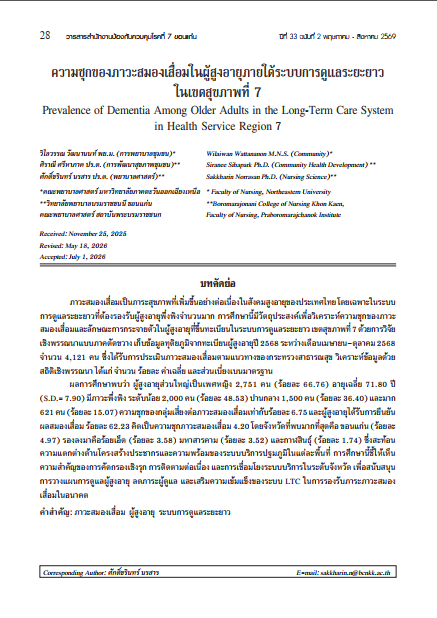
Dementia is an increasingly significant health burden in Thailand’s aging society, particularly within the Long-term Care system, which supports a large number of dependent older adults. This study aimed to examine the prevalence and distribution of dementia among older adults registered in the Long-term Care system in Health Service Region 7. A cross-sectional descriptive study design was employed utilizing secondary data from the 2025 LTC registry collected from April to October 2025, which comprises 4,121 older adults assessed for dementia according to the Ministry of Public Health’s screening protocols. Data were analyzed using descriptive statistics, including frequency, percentage, mean, and standard deviation.
The findings showed that most older adults were female, totaling 2,751 individuals (66.76 %), with a mean age of 71.80 years (S.D. = 7.90). Regarding dependency levels, 2,000 older adults (48.53 %) had mild dependency, 1,500 (36.40%) had moderate dependency, and 621 (15.07%) had severe dependency. The prevalence of older adults identified as being at risk for dementia was 6.75%, and 62.23% of those at risk were clinically confirmed, with a prevalence of confirmed 4.20%. Khon Kaen had the highest prevalence of confirmed dementia among older adults (4.97%), followed by Roi Et (3.58%), Maha Sarakham (3.52%), and Kalasin (1.74%). These findings reflect differences in population structure and the readiness of primary care service systems across provinces. This study highlights the importance of proactive screening, continuous monitoring, and strong linkage with provincial health services to support appropriate care planning, reduce caregiver burden, and strengthen the LTC system's readiness to address the growing burden of dementia among older adults.
References
Prince M, Comas-Herrera A, Knapp M, Guerchet M, Karagiannidou M. World Alzheimer Report 2016: Improving healthcare for people living with dementia. London: Alzheimer’s Disease International; 2016.
World Health Organization. Dementia: a public health priority. Geneva: WHO; 2012.
Alzheimer’s Disease International. From plan to impact: Progress towards targets of the global action plan on dementia. London: Alzheimer’s Disease International; 2021.
กรมควบคุมโรค กระทรวงสาธารณสุข. คู่มือการคัดกรองและประเมินสุขภาพผู้สูงอายุ พ.ศ. 2564. นนทบุรี: กรมควบคุมโรค กระทรวงสาธารณสุข; 2564.
คณะกรรมการจัดทำแบบทดสอบสภาพสมองเบื้องต้นฉบับภาษาไทย พ.ศ. 2542. แบบทดสอบสภาพสมองเบื้องต้นฉบับภาษาไทย =MMSE-Thai 2002. กรุงเทพฯ: สถาบันเวชศาสตร์ผู้สูงอายุ กรมการแพทย์ กระทรวงสาธารณสุข; 2545.
สถาบันประสาทวิทยา กรมการแพทย์. แนวทางเวชปฏิบัติภาวะสมองเสื่อม. กรุงเทพฯ: ธนาเพลส; 2564.
กระทรวงสาธารณสุข. ร้อยละของตำบลที่มีระบบการส่งเสริมสุขภาพดูแลผู้สูงอายุระยะยาว (Long Term Care: LTC) ในชุมชนผ่านเกณฑ์. นนทบุรี: กระทรวงสาธารณสุข; 2565.
Chuakhamfoo NN, Phanthunane P, Chansirikarnjana S, Pannarunothai S. Health and long-term care of the elderly with dementia in rural Thailand: A cross-sectional survey through their caregivers. BMJ Open 2020;10:e032637. doi:10.1136/bmjopen-2019-032637.
Tantanokit T, Bosittipichet T, Leesri T. The Study of Prevalence and Associated Factors of Dementia in the Elderly. Siriraj Med J 2021;73(4):224-35. doi:10.33192/Smj.2021.30.
World Health Organization. Global action plan on the public health response to dementia 2017–2025. Geneva: WHO; 2017.
Prorok JC, Horgan S, Seitz DP. Health care experiences of people with dementia and their caregivers: a meta-ethnographic analysis of qualitative studies. CMAJ 2013;185(14):E669–80.
ศิราณี ศรีหาภาค, รัศมี ลือฉาย, สุพัฒนา อรุณไพร, วิภาวดี บรรพบุตร, เพ็ญพักตร์ ไชยฤทธิ์, กุลนรี หาญพัฒนชัยกูร, และคณะ. การพัฒนาศักยภาพผู้ดูแลในการคัดกรองภาวะสมองเสื่อมผู้สูงอายุในชุมชนโดยเครื่องมือ IQCODE. วารสารมหาวิทยาลัยนราธิวาสราชนครินทร์ 2567;16(2): 295–313.
Glasgow RE, Vogt TM, Boles SM. Evaluating the public health impact of health promotion interventions: the RE-AIM framework. Am J Public Health 1999;89(9):1322–7. doi: 10.2105/ajph.89.9.1322.
Peters DH, Adam T, Alonge O, Agyepong IA, Tran N. Implementation research: what it is and how to do it. BMJ 2013;347:f6753. doi: 10.1136/bmj.f6753.
ศิราณี ศรีหาภาค, ธวัชชัย กฤษณะประกรกิจ. สมองเสื่อมกับการดูแลระดับปฐมภูมิ: คู่มือพัฒนาศักยภาพผู้จัดการดูแลและบุคลากรสุขภาพ การดูแลผู้สูงอายุสมองเสื่อมอย่างเพียงพอ (Sufficient Care for Dementia: SCD). นนทบุรี: มูลนิธิสังคมและสุขภาพ; 2565.
ดังการ พลลาภ, ศิราณี ศรีหาภาค, ประคอง ขันบำรุง. การพัฒนารูปแบบการดูแลผู้สูงอายุสมองเสื่อมอย่างเพียงพอของเครือข่ายบริการสุขภาพปฐมภูมิ อำเภอน้ำพอง จังหวัดขอนแก่น. วารสารอนามัยสิ่งแวดล้อมและสุขภาพชุมชน 2567;9(6):493–503.
Hinton L, Wang K, Levkoff S, Chuengsatiansup K, Srihapark S, Krisanaprakornkit T, et al. Dementia neuropsychiatric symptom frequency, severity, and correlates in community-dwelling Thai older adults. Am J Geriatr Psychiatry 2022;30(8):883–91. doi: 10.1016/j.jagp.2022.05.005.
Downloads
Published
How to Cite
Issue
Section
License
Copyright (c) 2026 สำนักงานป้องกันควบคุมโรคที่7จังหวัดขอนแก่น

This work is licensed under a Creative Commons Attribution-NonCommercial-NoDerivatives 4.0 International License.
ความรับผิดชอบ
บทความที่ลงพิมพ์ในวารสารสำนักงานป้องกันควบคุมโรคที่ 7 ขอนแก่น ถือเป็นผลงานทางวิชาการหรือวิจัย และวิเคราะห์ตลอดจนเป็นความเห็นส่วนตัวของผู้เขียน ไม่ใช่ความเห็นของวารสารสำนักงาน ป้องกันควบคุมโรคที่ 7 จังหวัดขอนแก่น หรือ ของกองบรรณาธิการแต่ประการใด ผู้เขียนต้องรับผิดชอบต่อบทความของตนเอง
ลิขสิทธ์บทความ
บทความที่ได้รับการตีพิมพ์จะถือเป็นลิขสิทธิ์ของสำนักงานป้องกันตวบคุมโรคที่ 7 จังหวัดขอนแก่น