Policy Recommendations Proposed from the Regional Situation of Seasonal Influenza and Various Outbreaks in Health Region 11
Keywords:
Influenza, Recommendations, Health PolicyAbstract
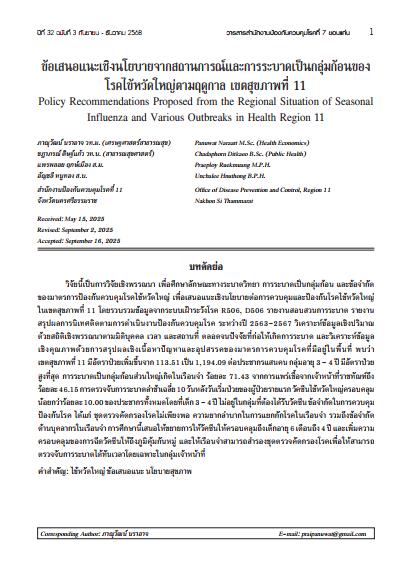
This descriptive study examined the epidemiological characteristics, outbreak clusters, and limitations of influenza prevention and control measures to propose policy recommendations for Health Region 11. Data were obtained from the R506 and D506 systems, cluster outbreak investigation reports, and reports on monitoring of prevention and control from 2020 to 2024. Descriptive statistics were applied to analyze quantitative data over person, time, and place, and outbreak-related factors, while qualitative data was summarized by content summary on the limitations of current control strategies. There was a sharp increase in morbidity rate from 113.51 to 1,194.09 per 100,000 population, while the highest rate was among children aged 3–4 years. Most outbreak clusters occurred in prisons (71.43%), with 46.15% linked to transmission from infected correctional officers. Outbreak detection was delayed, with a median of 10 days after symptom onset in the primary case. Vaccine coverage was below 10.00% of the total population, and children aged 3–4 years were not included in the target group. Major limitations included insufficient screening tests, difficulties in implementing isolation within prisons, and staff shortages. This study recommends that vaccination should be expanded to include children aged 6 months to 4 years, and achieve herd immunity. Prisons should also be equipped with sufficient screening tests to ensure timely outbreak detection, especially in staff-introduced clusters.
Downloads
References
World Health Organization. Influenza (seasonal) [Internet]. 2025 [cited 2025 Mar 11]. Available from: https://www.who.int/news-room/fact-sheets/detail/influenza-(seasonal).
อ้อยทิพย์ ยาโสภา, พรทิพย์ จอมพุก, นนท์ธิยา หอมขำ. ระบาดวิทยาของผู้ป่วยไข้หวัดใหญ่ในประเทศไทย ระหว่างปี พ.ศ. 2557 – 2564. วารสารสถาบันป้องกันควบคุมโรคเขตเมือง 2567; 9(2): 21-40.
Kiertiburanakul S, Phongsamart W, Tantawichien T, Manosuthi W, Kulchaitanaroaj P. Economic burden of Influenza in Thailand: a systematic review. Inquiry 2020; 57(6): 46958020982925. doi: 10.1177/0046958020982925.
กองยุทธศาสตร์และแผนงาน. แนวทางการดำเนินงานป้องกันควบคุมโรคและภัยสุขภาพ ประจำปีงบประมาณ พ.ศ. 2568 [อินเทอร์เน็ต]. 2568 [เข้าถึงเมื่อ 30 ส.ค. 2568]. เข้าถึงจาก: https://ddc.moph.go.th/dsp/journal_detail.php?publish=16253.
Health Intervention and Technology Assessment Program. Research report: Cost-utility analysis of seasonal influenza vaccine among school children in Thailand [Internet]. 2014 [cited 2025 Aug 30]. Available from: https://www.hitap.net/documents/20324.
Frieden TR, Lee CT, Bochn AF, Buissonnière M, McClelland A. 7-1-7: an organizing principle, target, and accountability metric to make the world safer from pandemics. Lancet 2021; 398(10300): 638-40. doi: 10.1016/S0140-6736(21)01250-2.
Chen X, Chen H, Tao F, Chen Y, Zhou Y, Cheng J, et al. Global analysis of influenza epidemic characteristics in the first two seasons after lifting the nonpharmaceutical interventions for COVID-19. Int J Infect Dis 2025; 151: doi: 10.1016/j.ijid.2024.107372.
Zeng H, Cai M, Li S, Chen X, Xu X, Xie W, et al. Epidemiological characteristics of seasonal influenza under implementation of zero-COVID-19 strategy in China. J Infect Public Health 2023; 16(8): 1158-66. doi: 10.1016/j.jiph.2023.05.014.
Beaudry G, Zhong S, Whiting D, Javid B, Frater J, Fazel S. Managing outbreaks of highly contagious diseases in prisons: a systematic review. BMJ global health 2020; 5(11): doi: 10.1136/bmjgh-2020-003201.
Balicer RD, Huerta M, Levy Y, Davidovitch N, Grotto I. Influenza outbreak control in confined settings. Emerg Infect Dis 2005; 11(4): 579–83. doi: 10.3201/eid1104.040845.
Kendig NE, Bur S, Zaslavsky J. Infection prevention and control in correctional settings. Emerg Infect Dis 2024; 30(13): S88–93. doi: 10.3201/eid3013.230705.
Chen C, Liu X, Yan D, Zhou Y, Ding C, Chen L, et al. Global influenza vaccination rates and factors associated with influenza vaccination. Int J Infect Dis 2022; 125: 153 - 63. doi: 10.1016/j.ijid.2022.10.038.
Staadegaard L, Del Riccio M, Wiegersma S, El Guerche-Séblain C, Dueger E, Akçay M, et al. The impact of the SARS-CoV-2 pandemic on global influenza surveillance: Insights from 18 National Influenza Centers based on a survey conducted between November 2021 and March 2022. Influenza Other Respir Viruses 2023; 17(5): e13140. doi: 10.1111/irv.13140.
Meeyai A, Praditsitthikorn N, Kotirum S, Kulpeng W, Putthasri W, Cooper BS, et al. Seasonal influenza vaccination for children in Thailand: a cost-effectiveness analysis. PLoS medicine 2015; 12(5): e1001829. doi: 10.1371/journal.pmed.1001829.
Plans-Rubió P. The vaccination coverage required to establish herd immunity against influenza viruses. Prev Med 2012; 55(1): 72–7. doi: 10.1016/j.ypmed.2012.02.015.
Yang KC, Hung HF, Chen MK, Chen SL, Fann JC, Chiu SY, et al. Cost-effectiveness analysis of universal influenza vaccination: Application of the susceptible-infectious-complication-recovery model. Int J Infect Dis 2018; 73(3): 102–108. doi: 10.1016/j.ijid.2018.05.024.
Downloads
Published
How to Cite
Issue
Section
License
Copyright (c) 2025 สำนักงานป้องกันควบคุมโรคที่7จังหวัดขอนแก่น

This work is licensed under a Creative Commons Attribution-NonCommercial-NoDerivatives 4.0 International License.
ความรับผิดชอบ
บทความที่ลงพิมพ์ในวารสารสำนักงานป้องกันควบคุมโรคที่ 7 ขอนแก่น ถือเป็นผลงานทางวิชาการหรือวิจัย และวิเคราะห์ตลอดจนเป็นความเห็นส่วนตัวของผู้เขียน ไม่ใช่ความเห็นของวารสารสำนักงาน ป้องกันควบคุมโรคที่ 7 จังหวัดขอนแก่น หรือ ของกองบรรณาธิการแต่ประการใด ผู้เขียนต้องรับผิดชอบต่อบทความของตนเอง
ลิขสิทธ์บทความ
บทความที่ได้รับการตีพิมพ์จะถือเป็นลิขสิทธิ์ของสำนักงานป้องกันตวบคุมโรคที่ 7 จังหวัดขอนแก่น