Development of a Total Worker Health Model for Employees in Large-Scale Enterprises in Health Region 7: A Case Study of a Meat Processing Factory
Keywords:
Model development, Total worker health, FactoryAbstract
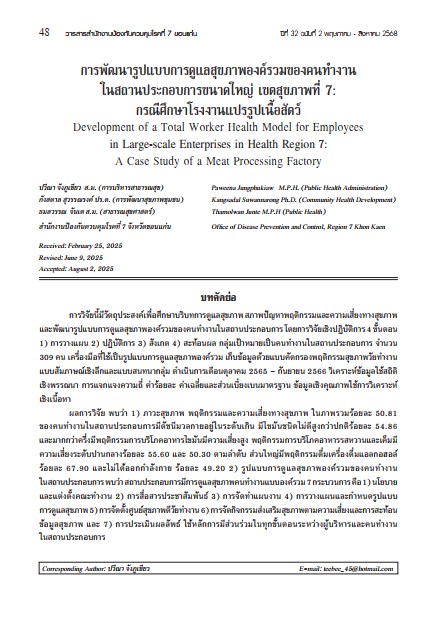
The research aimed to study the health care context, behavioral problems and health risks of employees in large-scale workplaces as well as develop a holistic health care model for workers. This study employed an action research approach with 4 steps: 1) planning 2) action 3) observation 4) reflection. The sample included 309 employees from a meat processing factory. The instruments consisted of working-age health behavior screening form, in-depth interview guidelines, and focus group discussion guidelines. The research was conducted from October 2022 to September 2023. Data were analyzed using descriptive statistics, including frequency, percentage, mean, and standard deviation. Qualitative data were analyzed using content analysis.
Results 1) Health status, behaviors, and risks, the findings revealed that 50.81% of employees had a body mass index (BMI) in the overweight range. There were 54.86% had higher than normal levels of bad fat. More than half had high-risk fatty food consumption behaviors. while 55.60% and 50.30% exhibited moderate risk in sugar and salty food consumption, respectively. A majority (67.9%) consumed alcoholic beverages, and 49.2% did not engage in physical exercise. 2) The holistic health care model of employees in the workplace found that the establishments implemented a holistic health care model comprising seven processes: 1) policy and appointment of a working group, 2) communication and public relations, 3) program planning 4) planning and determining the health care model 5) establishing a working-age health center 6) organizing health promotion activities according to risks and reflecting health information 7) results evaluation. The model emphasized the principle of participation at every stage, involving both executives and employees in the workplace.
The development process of a new workplace health care model in Health Region 7, There was a strong emphasis on health risk assessment through participatory collaboration among executives and stakeholders. This process involved jointly designing the health care model, workflows reviews, problems-solving, addressing limitations, process improvements, and outcomes evaluation. The holistic health care model developed for workers in industrial establishments showed strong potential for implementation in large-scale enterprises. A key strength of this development is the individualized health risk feedback workers, which enhances their awareness and enables enterprises to align health care planning with actual needs. This, in turn, clearly contributes to reducing negative impacts on productivity and business performance. Enterprises with similar contexts may also consider adapting this development model to suit their specific conditions.
Downloads
References
กรมควบคุมโรค กองโรคจากการประกอบอาชีพและสิ่งแวดล้อม. แผนงานพัฒนาระบบเฝ้าระวัง ป้องกัน ควบคุมโรคจากการประกอบอาชีพ; 2565. (เอกสารอัดสำเนา)
กรมสวัสดิการและคุ้มครองแรงงาน. ข้อมูลสถานประกอบกิจการ [อินเทอร์เน็ต]. 2565 [เข้าถึงเมื่อ 6 ม.ค. 2566]. เข้าถึงได้จาก: https://eform.labour.go.th/dlpwMapWeb/map/
ระบบคลังข้อมูลด้านการแพทย์และสุขภาพ (HDC). โรคจากการประกอบอาชีพและสิ่งแวดล้อม [อินเทอร์เน็ต]. 2565 [เข้าถึงเมื่อ 6 ม.ค. 2566]. เข้าถึงได้จาก:https://hdc.moph.go.th/center/public/standard-subcatalog/f16421e617aed29602f9f09d951cce68
ชื่นกมล สุขดี, ชวพรพรรณ จันทร์ประสิทธิ์, วันเพ็ญ ทรงคำ. ภาวะสุขภาพและพฤติกรรมปกป้องสุขภาพของ คนงานผลิตเครื่องเรือนไม้ในอุตสาหกรรมขนาดกลางและขนาดย่อม. วารสารสภาการพยาบาล 2553; 25(3): 121- 39.
สำนักโรคไม่ติดต่อ กรมควบคุมโรค. แผนยุทธศาสตร์การป้องกันและควบคุมโรคไม่ติดต่อระดับชาติ 5 ปี (พ.ศ. 2560 - 2564). กรุงเทพฯ: อิโมชั่นอาร์ต; 2560.
กรมสุขภาพจิต. รายงานประจำปี 2564 [อินเทอร์เน็ต]. 2565 [เข้าถึงเมื่อ 6 ม.ค. 2566]. เข้าถึงได้จาก: https://dmh.go.th/report/dmh/rpt_year/dl.asp?id=462
กานดา ตัณฑพันธ์, สุพัตรา จันทร์เทียน, ยินดี พานิชกุล, ทิวาวัน คําบันลือ. บรรณาธิการ. การศึกษาการสร้างเสริมสุขภาพในสถานประกอบการของไทย. การประชุมวิชาการของมหาวิทยาลัยเกษตรศาสตร์ ครั้งที่ 43; 1-4 กุมภาพันธ์ 2548. กรุงเทพมหานคร: มหาวิทยาลัยเกษตรศาสตร์; 2548. หน้า 368-75.
Kemmis and McTaggart. The Action Research Planner. Victoria: Deakin University Pres; 1988.
Taro Yamane. Statistics: an introductory analysis. New York: New York: Harper & Row; 1973.
กรมควบคุมโรค กองโรคจากการประกอบอาชีพ. แบบคัดกรองพฤติกรรมสุขภาพวัยทำงาน (แบบ TWH01) [อินเทอร์เน็ต]. 2564 [เข้าถึงเมื่อ 6 ม.ค. 2566]. เข้าถึงได้จาก: https://ddc.moph.go.th/uploads/publish/976020200130083101.pdf
ศรีสุดา วงศ์วิเศษกุล, เบ็ญจา เตากลํ่า, เนตรรัชนี ตั้งภาคภูมิ. การจัดการด้านสุขภาพ ความปลอดภัย และอาชีวอนามัยอย่างยั่งยืนในโรงงานอุตสาหกรรมกรณีศึกษาโรงงานในจังหวัดสมุทรสาคร. วารสารวิทยาลัยพยาบาลบรมราชชนนี นครราชสีมา 2556; 19(1): 42-56.
ณรงค์ฤทธิ์ คงสมาน, พยุง พุ่มกลิ่น. ปัจจัยที่มีความสัมพันธ์กับพฤติกรรมสร้างเสริมสุขภาพของ แรงงานในสถานประกอบการ อำเภอเขาย้อย จังหวัดเพชรบุรี. วารสารสำนักงานป้องกันควบคุมโรคที่ 7 ขอนแก่น 2559; 23(1): 62-75.
มงคล การุณงามพรรณ, สุดารัตน์ สุวาร, นันทนา น้ำฝน. พฤติกรรมสุขภาพและภาวะสุขภาพของคนทำงานในสถานประกอบการเขตเมืองใหญ่ กรณีศึกษาพื้นที่เขตสาทร กรุงเทพมหานคร. วารสารพยาบาลสงขลานครินทร์ 2555; 32(3): 51-66.
สถาบันวิจัยประชากรและสังคม มหาวิทยาลัยมหิดล. สถานการณ์กิจกรรมทางกายของประชากรไทย ปี 2565 และแนวทางส่งเสริมกิจกรรมทางกาย ปี 2566 [อินเทอร์เน็ต]. 2566 [เข้าถึงเมื่อ 10 ม.ค. 2566]. เข้าถึงได้จาก: https://tpak.or.th/th/article_print/647
ศรีเรือน แก้วกังวาล. ทฤษฎีจิตวิทยาบุคลิกภาพ (รู้เรา รู้เขา). พิมพ์ครั้งที่ 18. กรุงเทพมหานคร: หมอชาวบ้าน; 2562.
พรอนันต์ กิตติมั่นคง, ธีรวัฒน์ วลัยเสถียร, สินศักดิ์ชนม์ อุ่นพรมมี, นาตยานี เซียงหนู, ณิชกมล กรึ่มพิมาย, ศรีเสาวลักษณ์ อุ่นพรมมี. สถานะสุขภาพและพฤติกรรมของกลุ่มวัยทำงาน เขตสุขภาพที่ 9 นครชัยบุรินทร์. วารสารศูนย์อนามัยที่ 9 2560; 17(26): 192-205.
Downloads
Published
How to Cite
Issue
Section
License
Copyright (c) 2025 สำนักงานป้องกันควบคุมโรคที่7จังหวัดขอนแก่น

This work is licensed under a Creative Commons Attribution-NonCommercial-NoDerivatives 4.0 International License.
ความรับผิดชอบ
บทความที่ลงพิมพ์ในวารสารสำนักงานป้องกันควบคุมโรคที่ 7 ขอนแก่น ถือเป็นผลงานทางวิชาการหรือวิจัย และวิเคราะห์ตลอดจนเป็นความเห็นส่วนตัวของผู้เขียน ไม่ใช่ความเห็นของวารสารสำนักงาน ป้องกันควบคุมโรคที่ 7 จังหวัดขอนแก่น หรือ ของกองบรรณาธิการแต่ประการใด ผู้เขียนต้องรับผิดชอบต่อบทความของตนเอง
ลิขสิทธ์บทความ
บทความที่ได้รับการตีพิมพ์จะถือเป็นลิขสิทธิ์ของสำนักงานป้องกันตวบคุมโรคที่ 7 จังหวัดขอนแก่น