Efficacy of Endophytic Fungi Extracts on Aedes aegypti and Aedes albopictus Larvae
Keywords:
Efficacy, Endophytic fungi extracts, Aedes aegypti larvae, Aedes albopictus larvaeAbstract
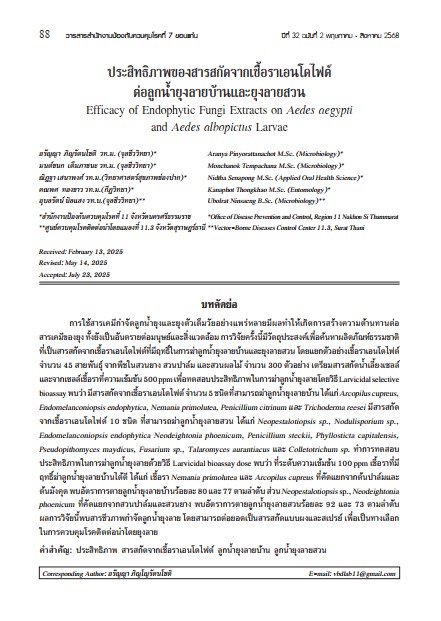
Chemical substances are commonly used to eliminate mosquito larvae and adult mosquitoes. However, their widespread use has led to the development of resistance in mosquito populations and poses risks to human health and the environment. This study aims to discover natural extracts from endophytic fungi that are effective in killing Aedes aegypti and Aedes albopictus larvae. A total of 300 plant samples were collected from rubber, palm, and fruit plantations. From these, 45 endophytic fungal species were isolated based on colony morphology, mycelial characteristics, and nucleotide sequencing of the ITS region. The fungi were cultured to prepare both cell culture and cell extracts at a concentration of 500 ppm. These extracts were tested for larvicidal activity using the larvicidal selective bioassay method. Results showed that five fungal species, including Arcopilus cupreus, Endomelanconiopsis endophytica, Nemania primolutea, Penicillium citrinum, and Trichoderma reesei were effective against Aedes aegyti larvae. Meanwhile, ten species were effective against Aedes albopictus larvae, including Neopestalotiopsis sp., Nodulisporium sp., Endomelanconiopsis endophytica, Neodeightonia phoenicum, Penicillium steckii, Phyllosticta capitalensis, Pseudopithomyces maydicus, Fusarium sp., Talaromyces aurantiacus and Colletotrichum sp. Further larvicidal bioassay dose testing at 100 ppm revealed that Nemania primolutea and Arcopilus cupreus, isolated from palm and mangosteen trees, achieved mortality rates of 80 and 77% against Aedes aegypti larvae, respectively. For Aedes albopictus, Neopestalotiopsis sp. and Neodeightonia phoenicum (from palm and rubber plantations) showed high efficacy with mortality rates of 92 and 73%. These findings highlight the potential of endophytic fungal extracts as eco-friendly alternatives to chemical larvicides. The identified extracts can be further developed into powder or spray formulations for mosquito-borne disease control programs.
Downloads
References
ขนิษฐา ปานแก้ว, บุษราคัม สินาคม, พรพิมล ประดิษฐ์, บุญเสริม อ่วมอ่อง. การศึกษาความไวต่อสารเคมีและสารเสริมฤทธิ์ของยุงลาย Aedes aegypti ประเทศไทย ปี พ.ศ.2562. วารสารวิชาการป้องกันควบคุมโรค สคร.2 พิษณุโลก 2564; 8(1): 69-83.
วรรณฤดี หิรัญรัตน์. สารออกฤทธิ์ทางชีวภาพจากราเอนโดไฟต์. วารสารมหาวิทยาลัยทักษิณ 2552; 12(2): 90 – 100.
Abbott WS. A method of computing the effectiveness of an insecticide. 1925. J Am Mosq Control Assoc 1987; 3(2): 302-3. PMID: 3333059.
Attitalla IH. Modified CTAB method for high quality genomic DNA extraction from medicinal Plants. Pak J Biol Sci 2011; 14(21): 998-9. PMID: 22514891.
Bücker A, Bücker NC, Souza AQ, Gama AM, Rodrigues-Filho E, Costa FM, et al. Larvicidal effects of endophytic and basidiomycete fungus extracts on Aedes and Anopheles larvae (Diptera, Culicidae). Rev Soc Bras Med Trop 2013; 46(4): 411-9. doi: https://doi.org/10.1590/0037-8682-0063-2013.
Bacon CW, White JF. An overview of endophytic microbes: Endophytism defined. New York: Boca Raton Publishers; 2000. p.28.
Majumder DR. Eradication of Mosquito Borne Disease by Entomopathogenic Fungi. World Journal of pharmaceutical research 2017; 6(8): 1420-50. doi: 10.20959/wjpr20178-9002.
Katoch M, Singh G, Sharma S, Gupta N, Sangwan PL, Saxena AK. Cytotoxic and antimicrobial activities of endophytic fungi isolated from Bacopa monnieri (L.) Pennell (Scrophulariaceae). BMC Complement Altern Med 2014; 14: 52. doi: 10.1186/1472-6882-14-52.
Abutaha N, Mashaly AMA, Al-Mekhlafi FA,Farooq M, Al-shami M, Wadaan MA. Larvicidal activity of endophytic fungal extract of Cochliobolus spicifer (Pleosporales: Pleosporaceae) on Aedes caspius and Culex pipiens (Diptera: Culidae). The Japanese of applied entomology snd zoology 2015; 50(1): 405-14. doi: https://doi.org/10.1007/s13355-015-0347-6.
Sathiyanathan M, Umarajan KM. Larvicidal activity of endophytic fungi isolated from selected medicinal plants on Aedes aegypti. J Pharmacogn Phytochem 2019; 8(2): 247-53.
Solarte F, Muñoz CG, Maharachchikumbura SSN, Álvarez E. Diversity of Neopestalotiopsis and Pestalotiopsis spp., causal agents of guava scab in Colombia. Plant Dis 2018; 102(1): 49-59. doi: 10.1094/PDIS-01-17-0068-RE.
Downloads
Published
How to Cite
Issue
Section
License
Copyright (c) 2025 สำนักงานป้องกันควบคุมโรคที่7จังหวัดขอนแก่น

This work is licensed under a Creative Commons Attribution-NonCommercial-NoDerivatives 4.0 International License.
ความรับผิดชอบ
บทความที่ลงพิมพ์ในวารสารสำนักงานป้องกันควบคุมโรคที่ 7 ขอนแก่น ถือเป็นผลงานทางวิชาการหรือวิจัย และวิเคราะห์ตลอดจนเป็นความเห็นส่วนตัวของผู้เขียน ไม่ใช่ความเห็นของวารสารสำนักงาน ป้องกันควบคุมโรคที่ 7 จังหวัดขอนแก่น หรือ ของกองบรรณาธิการแต่ประการใด ผู้เขียนต้องรับผิดชอบต่อบทความของตนเอง
ลิขสิทธ์บทความ
บทความที่ได้รับการตีพิมพ์จะถือเป็นลิขสิทธิ์ของสำนักงานป้องกันตวบคุมโรคที่ 7 จังหวัดขอนแก่น