Effects of a Behavioral Development Program for Preventing Hypertension among High-risk Groups at Nang Rong District, Buriram Province
Keywords:
Program, Preventive behavior, Hypertensive high-risk groups, PerceptionAbstract
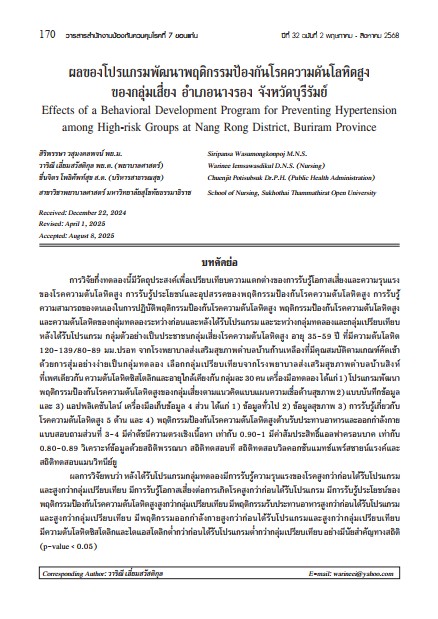
The objectives of this quasi-experimental research were to compare perceived risk of hypertension and severity of hypertension, perceived benefits and barriers of hypertensive preventive behaviors, perceived self-efficacy in hypertensive preventive behaviors, hypertensive preventive behaviors, and blood pressure of the experimental group between before and after the experiment, and between the experimental group and the comparison group after the experiment. The sample consisted of hypertensive high-risk groups, aged 35–59 years, who had blood pressure 120-139/80-89 mmHg. The sample from Ban Kan Lueang sub-district health promoting hospital, which had characteristics within the inclusion criteria, was selected by simple random sampling to be an experimental group, and from Ban Sing Sub-district health promoting hospital to be a comparison group, with similar sex, systolic blood pressure, and age, 30 persons in each group. The experimental tools were 1) the behavioral development program for preventing hypertension among high-risk groups based on the health belief model, 2) a record form, and 3) an application line. The data collection tools were a questionnaire with 4 parts: 1) general data, 2) health data, 3) perception about hypertension with 5 subsets, and 4) hypertensive preventive behaviors, including eating and exercise behaviors. The questionnaire part 3-4 had a content validity index of 0.90-1, and Cronbach’s alpha coefficient of 0.80-0.89. The data were analyzed by descriptive statistics, t-test, Wilcoxon matched pairs signed rank test, and Mann-Whitney U test.
The results founded as follows: after experiment, perceived the severity of hypertension of the experimental group were significantly higher than before experiment and the comparison group, perceived risks of hypertension of the experimental group was significantly higher than before experiment, perceived benefits of hypertensive preventive behaviors was significantly higher than the comparison group, eating behaviors of the experimental group were significantly higher than before experiment and increasing more than the comparison group, exercise behaviors of the experimental group were significantly higher than before experiment and the comparison group, and systolic and diastolic blood pressure of the experimental group were significantly lower than before experiment and the comparison group (p-value < 0.05).
Conclusion and recommendation, the behavioral development program for preventing hypertension among high-risk groups leads to effectiveness. It should be used at the district health-promoting hospital in Nang Rong district, Buriram Province.
Downloads
References
World Health Organization. Global NCD target: reduce high blood pressure. [Internet]. 2016 [cited 2018 Dec 25]. Available from: http://www.who.int/publications/i/item/global-ncd-target-reduce-high-blood-pressure.
กองโรคติดต่อ กรมควบคุมโรค. รายงานสถานการณ์โรค NCDs เบาหวาน ความดันโลหิตสูง และปัจจัยเสี่ยงที่เกี่ยวข้อง พ.ศ.2562. กรุงเทพฯ: อักษรกราฟฟิคแอนด์ดีไซน์; 2563.
วิชัย เอกพลาการ, หทัยชนก พรรคเจริญ, วราภรณ์ เสถียรนพเก้า. การสำรวจสุขภาพประชาชนไทยโดยการตรวจร่างกาย ครั้งที่ 6 พ.ศ. 2562 – 2563. กรุงเทพฯ: อักษรกราฟฟิกแอนด์ดีไซน์; 2564.
กองยุทธศาสตร์และแผนงาน สำนักงานปลัดกระทรวงสาธารณสุข. สถิติสาธารณสุข 2566. นนทบุรี: กระทรวงสาธารณสุข; 2566.
แรมจันทร์ ทรงทอง, วาริณี เอี่ยมสวัสดิกุล, ชื่นจิตร โพธิศัพท์สุข. ผลของโปรแกรมพัฒนาพฤติกรรมรับประทานอาหารของกลุ่มเสี่ยงโรคความดันโลหิตสูง อำเภอทุ่งสง จังหวัดนครศรีธรรมราช. [วิทยานิพนธ์พยาบาลศาสตรมหาบัณฑิต]. กรุงเทพฯ: สาขาวิชาพยาบาลศาสตร์ มหาวิทยาลัยสุโขทัยธรรมาธิราช; 2565.
สุบัน โสขวัญฟ้า, บรรณาธิการ. ผู้ป่วยโรคเรื้อรัง จาก HosXP PCU NCD Datacenter ปี 2560-2563. การประชุมประจำเดือนมีนาคม; 11 มกราคม 2564; ห้องประชุมโรงพยาบาลส่งเสริมสุขภาพตำบลบ้านก้านเหลือง. บุรีรัมย์: โรงพยาบาลส่งเสริมสุขภาพตำบลบ้านก้านเหลือง; 2564.
สุบัน โสขวัญฟ้า, บรรณาธิการ. พฤติกรรมสุขภาพของประชาชนอายุ 35 ปีขึ้นไป ตำบลก้านเหลือง อำเภอนางรอง จังหวัดบุรีรัมย์ ประจำปี 2564. การประชุมโรคไม่ติดต่อเรื้อรังแก้ไขปัญหาและปรับปรุงแนวทางการดำเนินงานโรคไม่ติดต่อเรื้อรังประจำปี 2565; 12 ตุลาคม 2565; ห้องประชุมโรงพยาบาลส่งเสริมสุขภาพตำบลบ้านก้านเหลือง. บุรีรัมย์: โรงพยาบาลส่งเสริมสุขภาพตำบลบ้านก้านเหลือง; 2564.
นพวรรณ เปียซื่อ. การพยาบาลอนามัยชุมชน:นโยบายและทฤษฎีสู่การปฏิบัติ. นครปฐม: มหาวิทยาลัยมหิดล; 2561. หน้า 32-35.
กองยุทธศาสตร์และแผนงาน สำนักงานปลัดกระทรวงสาธารณสุข. สถิติสาธารณสุข 2566. นนทบุรี: กระทรวงสาธารณสุข; 2566.
สำนักงานสาธารณสุขจังหวัดบุรีรัมย์. ร้อยละการตรวจติดตามยืนยันวินิจฉัยกลุ่มสงสัยป่วยความดันโลหิตสูง ตำบลก้านเหลือง อำเภอนางรอง 2565 [อินเทอร์เน็ต]. 2566 [เข้าถึงเมื่อ 7 ม.ค. 2566]. เข้าถึงได้จาก: https://hdc.moph.go.th/brm/public/standard-report-detail/b57439ff27302ade8c38d1dd189644a4
Bonwell CC, Eison JA. Active learning: creative excitement in the classroom 1991 ASHE-ERIC higher education reports. Washington, D.C: ERIC Clearinghouse on Higher Education, The George Washington University; 1991.
ลำพูน ศรีสังข์รัตน์, วาริณี เอี่ยมสวัสดิกุล, ชื่นจิต โพธิ์ศัพท์สุข. ผลของโปรแกรมพัฒนาพฤติกรรมบริโภคอาหารของผู้ป่วยความดันโลหิตสูง อำเภอโพธิ์ตาก จังหวัดหนองคาย. วารสารสำนักงานป้องกันควบคุมโรคที่ 7 ขอนแก่น 2566; 30(3): 181-93.
สำนักโภชนาการ กรมอนามัย กระทรวงสาธารณสุข. เกณฑ์มาตรฐานอาหารทางเลือกเพื่อสุขภาพสำหรับกลุ่มสี่ยง ผู้ป่วยโรคเบาหวาน และความดันโลหิตสูง. สมุทรสาคร: บอร์นทูบีพับลิชชิ่ง; 2556.
สมาคมความดันโลหิตสูงแห่งประเทศไทย. แนวทางการรักษาโรคความดันโลหิตสูงในเวชปฏิบัติทั่วไป พ.ศ.2562. เชียงใหม่: ทริคธิงค์; 2562.
Downloads
Published
How to Cite
Issue
Section
License
Copyright (c) 2025 สำนักงานป้องกันควบคุมโรคที่7จังหวัดขอนแก่น

This work is licensed under a Creative Commons Attribution-NonCommercial-NoDerivatives 4.0 International License.
ความรับผิดชอบ
บทความที่ลงพิมพ์ในวารสารสำนักงานป้องกันควบคุมโรคที่ 7 ขอนแก่น ถือเป็นผลงานทางวิชาการหรือวิจัย และวิเคราะห์ตลอดจนเป็นความเห็นส่วนตัวของผู้เขียน ไม่ใช่ความเห็นของวารสารสำนักงาน ป้องกันควบคุมโรคที่ 7 จังหวัดขอนแก่น หรือ ของกองบรรณาธิการแต่ประการใด ผู้เขียนต้องรับผิดชอบต่อบทความของตนเอง
ลิขสิทธ์บทความ
บทความที่ได้รับการตีพิมพ์จะถือเป็นลิขสิทธิ์ของสำนักงานป้องกันตวบคุมโรคที่ 7 จังหวัดขอนแก่น