Developing a Model of Promoting Behavior in Preventing Electronic Cigarette Consumption among Youth in Bangkok Metropolitan
Keywords:
Behavior in preventing electronic cigarette consumption, YouthAbstract
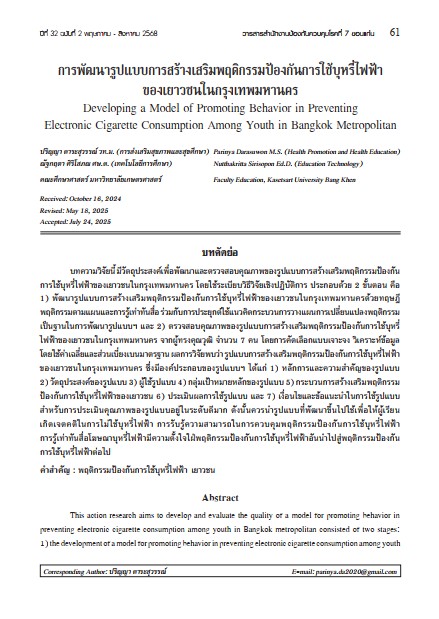
This action research aims to develop and evaluate the quality of a model for promoting behavior in preventing electronic cigarette consumption among youth in Bangkok metropolitan consisted of two stages: 1) the development of a model for promoting behavior in preventing electronic cigarette consumption among youth in Bangkok metropolitan area, based on the theory of planned behavior and media literacy, combined with the application of the intervention mapping process to guide the model development, and 2) an evaluation of the quality of the model by 7 experts, selected through purposive sampling. Data analysis was conducted using means and standard deviations. The research findings revealed that the model for promoting behavior in preventing electronic cigarette consumption among youth in Bangkok metropolitan comprised 7 components: 1) principles and significance of the model, 2) objectives of the model, 3) users of the model, 4) target group of the model, 5) the process of for promoting behavior in preventing electronic cigarette consumption among youth, 6) evaluation of model implementation, and 7) conditions and recommendations for model use. The model's quality was rated as excellent. Thus, the study recommends applying the developed model to instill attitudes against electronic cigarette consumption, enhance the perceived behavioral control in preventing electronic cigarette consumption, promote media literacy regarding electronic cigarette advertisements, and foster intentions to engage in preventive behaviors, ultimately leading to actual preventing electronic cigarette consumption.
Downloads
References
World Health Organization. WHO report on the global tobacco epidemic 2021: addressing new and emerging products [internet]. 2021 [cited 2023 Aug 1]; Available from: https://www.who.int/publications/i/item/9789240032095
Krüsemann EJZ, Boesveldt S, de Graaf K, Talhout R. An e-liquid flavor wheel: a shared vocabulary based on systematically reviewing e-liquid flavor classifications in literature. Nicotine Tob Res 2019; 21(10): 1310-9. doi: 10.1093/ntr/nty101.
World Health Organization. WHO report on the global tobacco epidemic, 2023: protect people from tobacco smoke [internet]. 2023. [cited 2023 Sep 30]; Available from: https://www.who.int/publications/i/item/9789240077164
Department of Disease Control Ministry of Public Health Thailand, World Health Organization, Mahidol university and US Centers for Disease Control and Prevention. 2022 Global Youth Tobacco Survey (GYTS) Thailand [internet]. 2021 [cited 2023 Sep 1]; Available from: https://cdn.who.int/media/docs/default-source/ncds/ncd-surveillance/data-reporting/thailand/thailand_gyts_-2022_fs_508.pdf?sfvrsn=444c170f_1
Doherty J, Davison J, McLaughlin M, Giles M, Dunwoody L, McDowell C, et al. Prevalence, knowledge and factors associated with e-cigarette use among parents of secondary school children. Public Health Pract (Oxf) 2022; 4: 100334. doi: 10.1016/j.puhip.2022.100334.
Dai HD, Ratnapradipa K, Michaud TL, King KM, Guenzel N, Tamrakar N, et al. Vaping media literacy, harm perception, and susceptibility of e-cigarette use among youth. Am J Prev Med 2022; 63(5): 852 – 60. doi: 10.1016/j.amepre.2022.05.012.
Simpson EEA, Davison J, Doherty J, Dunwoody L, McDowell C, McLaughlin M, et al. Employing the theory of planned behavior to design an e-cigarette education resource for use in secondary schools. BMC Public Health 2022; 22(276): 1-22. doi: 10.1186/s12889-022-12674-3.
Hershberger A, Connors M, Um M, Cyders MA. The theory of planned behavior and e-cig use: impulsive personality, e-cig attitudes, and e-cig use. Int J Ment Health Addict 2018; 16(2): 366 - 76. doi: 10.1007/s11469-017-9783-6.
Ajzen I, Fishbein M. The influence of attitudes on behavior [Internet]. 2005 [cited 2023 Sep 19]. Available from: https://psycnet.apa.org/record/2005-04648-005
Nutbeam D, Muscat DM. Health promotion glossary. Health Promot Int 2021; 36(6): 1578 - 98. doi: 10.1093/heapro/daaa157.
Eldredge LKB, Markham CM, Ruiter RAC, Fernández ME, Kok G, Parcel GS. Planning health promotion program: an intervention mapping approach. 4nd edn. San Francisco, CA: Jossey-Bass; 2006.
Ickes MJ, Zidzik O, Vanderford NL. Engaging rural high school youth in e-cigarette prevention and advocacy. J Interprof Health Promot 2021; 3(2): 3. PMID: 35814171.
Scheinfeld E, Crook B, Perry CL. Understanding young adults' e-cigarette use through the theory of planned behavior. Health Behav Policy Rev 2019; 6(2): 115-27. doi: 10.14485/hbpr.6.2.1.
Aljaberi FKD, Yao-Jr JJ. Predicting electronic cigarette use among adults in the Philippines. ACHSM 2021; 16(3): 243-8. doi: 10.24083/apjhm.v16i3.847.
Kelder SH, Mantey DS, Dusen DV, Case K, Haas A, Springer AE. A middle school program to prevent e-cigarette use: a pilot study of "CATCH My Breath". Public Health Rep 2020; 135(2): 220 - 9. doi: 10.1177/0033354919900887.
Kim S, Lee H, Lee JJ, Hong HC, Lim S, Kim J. Psychometric properties of the Korean version of the smoking media literacy scale for adolescents. Front Public Health 2021; 9: 675662. doi: 10.3389/fpubh.2021.675662.
สำนักงานคณะกรรมการการศึกษาขั้นพื้นฐาน กระทรวงศึกษาธิการ. แนวทางการนิเทศเพื่อพัฒนาและส่งเสริมการจัดการเรียนรู้เชิงรุก (Active Learning) ตามนโยบายลดเวลาเรียน เพิ่มเวลารู้. กรุงเทพมหานคร: สำนักงานคณะกรรมการการศึกษาขั้นพื้นฐาน; 2562.
Bledsoe KL, Graham JA. The use of multiple evaluation approaches in program evaluation. American Journal of Evaluation 2005; 26(3): 302-19. doi: https://doi.org/10.1177/1098214005278749.
เอมอัชฌา วัฒนบุรานนท์. การวิจัยพัฒนาโมเดลเลิฟเพื่อสร้างเสริมความเป็นมนุษย์ที่สมบูรณ์:ชุดโครงการวิจัยสำหรับนิสิตระดับอุดมศึกษา. พิมพ์ครั้งที่ 2. กรุงเทพมหานคร: โอเอสพริ้นติ้งเฮ้าส์; 2561.
Best JW. Research in education. 3rd ed. New Jersey: Prentice Hall; 1977.
Bandura A, National Inst of Mental Health. Social foundations of thought and action: A social cognitive theory. New York: Prentice-Hall; 1986.
ปริญญา ดาระสุวรรณ์, ณัฐกฤตา ศิริโสภณ. ปัจจัยเชิงสาเหตุที่ส่งผลต่อพฤติกรรมป้องกันการบริโภคบุหรี่อิเล็กทรอนิกส์ ของเยาวชน : การทบทวนวรรณกรรมอย่างเป็นระบบ. วารสารสำนักงานป้องกันควบคุมโรคที่ 7 จังหวัดขอนแก่น 2567; 37 (2): 101 – 9.
Downloads
Published
How to Cite
Issue
Section
License
Copyright (c) 2025 สำนักงานป้องกันควบคุมโรคที่7จังหวัดขอนแก่น

This work is licensed under a Creative Commons Attribution-NonCommercial-NoDerivatives 4.0 International License.
ความรับผิดชอบ
บทความที่ลงพิมพ์ในวารสารสำนักงานป้องกันควบคุมโรคที่ 7 ขอนแก่น ถือเป็นผลงานทางวิชาการหรือวิจัย และวิเคราะห์ตลอดจนเป็นความเห็นส่วนตัวของผู้เขียน ไม่ใช่ความเห็นของวารสารสำนักงาน ป้องกันควบคุมโรคที่ 7 จังหวัดขอนแก่น หรือ ของกองบรรณาธิการแต่ประการใด ผู้เขียนต้องรับผิดชอบต่อบทความของตนเอง
ลิขสิทธ์บทความ
บทความที่ได้รับการตีพิมพ์จะถือเป็นลิขสิทธิ์ของสำนักงานป้องกันตวบคุมโรคที่ 7 จังหวัดขอนแก่น