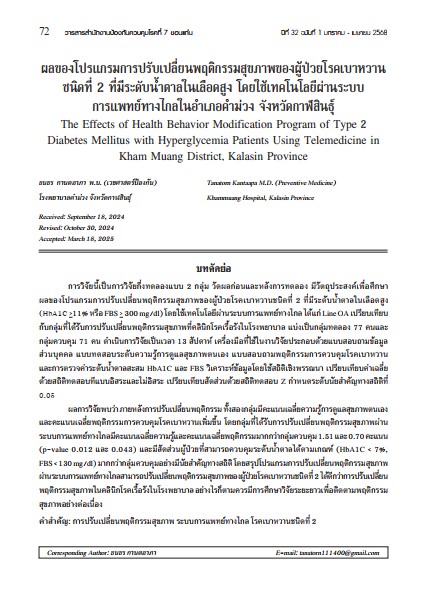
The Effects of Health Behavior Modification Program of Type 2 Diabetes Mellitus with Hyperglycemia Patients Using Telemedicine in Kham Muang District, Kalasin Province
Keywords:
Behavior modification, Telemedicine, Diabetes mellitus type 2Abstract
The two group, pre-posttest quasi experiment research aimed at studying the effects of a health behavior modification program of type 2 diabetes mellitus with hyperglycemia patients using telemedicine technology via LINE OA. The subjects were 148 type 2 diabetic mellitus patients (HbA1C > 11% or FBS > 300 mg/dl) divided into 2 groups: a control group (n=71) received behavior modification program through chronic care service system in Kham Muang hospital and an experimental group (n=77) participated in the health behavior modification program via LINE OA in 13 weeks period. The research instruments were personal information questionnaire, knowledge of self-care test, blood sugar control behavior questionnaire, HbA1C and FBS tests. Data were collected before and after the experiment, data were analyzed using descriptive statistics, dependent and independent t-test and Z-test for proportion at the level of p < 0.05.
The results indicated that the health behavior modification programs affecting the mean scores of knowledges and behavior of type 2 diabetic patients better than before using the programs in both groups. The average score of knowledges and behavior in the experimental group was higher than the control group for 1.51 and 0.70 point (p-value 0.012 and 0.043). The proportion of mean blood sugar level was also significantly different, the patients in experimental group could maintain normal blood-sugar levels (HbA1C < 7%, FBS < 130 mg/dl) better than control group statistically significant. Therefore, the health behavior modification program using technology via telemedicine had better effects on enhancing knowledge and behavior among diabetes patients comparing with chronic care service system. However, it should be further study on longitudinal research to monitor health behavior continuously.
Downloads
References
วิชัย เอกพลากร, หทัยชนก พรรคเจริญ, วราภรณ์ เสถียรนพเก้า. รายงานการสำรวจสุขภาพประชาชนไทยโดยการตรวจร่างกายครั้งที่ 6 พ.ศ.2562-2563. กรุงเทพมหานคร: อักษรกราฟฟิคแอนด์ดีไซน์; 2564.
World Health Organization. Diabetes [Internet]. 2009 [cited 2024 Jul 6]. Available from: https://www.who.int/health-topics/diabetes
Michie S, Stralen MM, West R. The behavior change wheel: a new method for characterizing and designing behavior change interventions. Implementation Sci 2011; 6: 42.
อรุณ จิรวัฒน์กุล. ชีวสถิติสำหรับงานวิจัยด้านวิทยาศาสตร์สุขภาพ. พิมพ์ครั้งที่ 3. ขอนแก่น: สำนักพิมพ์แห่งมหาวิทยาลัยขอนแก่น; 2551.
สมาคมโรคเบาหวานแห่งประเทศไทย. แนวทางเวชปฏิบัติสำหรับโรคเบาหวาน 2566. กรุงเทพฯ: ศรีเมืองการพิมพ์; 2566.
Sriklo M, Tamdee D, Aungwattana S, Kaewthummanukul T. Effects of enhance health literacy through transformative learning program on self-management and hemoglobin A1C level among adults with uncontrolled type 2 diabetes: a randomized controlled trial. PRIJNR 2023; 27(2): 317-33.
AI Ibrahem A, AI Omran AM, Alaithan DT, Aldandan KA, Al Shaghab MA, Alkhudhayr AM , et al. Effectiveness of telemedicine in controlling hyperglycemia among diabetic patients on insulin therapy in primary care: a systematic review and meta-analysis. Cureus 2023; 15(12): e50045.
De Groot J, Wu D, Flynn D, Robertson D, Grant G, Sun J. Efficacy of telemedicine on glycemic control in patients with type 2 diabetes: a meta-analysis. World J Diabetes 2021; 12(2):170-97.
วีรชัย ศรีวณิชชากร, เพชร รอดอารีย์. การป้องกันโรคเบาหวานในสภาพการณ์ของประเทศไทย. วารสารวิชาการกระทรวงสาธารณสุข 2565; 31(2): 363-75.
Pleus S, Freckmann G, Schauer S, Heinemann L, Ziegler R, Ji L, et al. Self-monitoring of blood glucose as an integral part in the management of people with type 2 diabetes mellitus. Diabetes Ther 2022; 13(5): 829-46.
Kesavadev J, Mohan V. Reducing the cost of diabetes care with telemedicine, smartphone, and home monitoring. J Indian Inst Sci 2023: 1-12.
Downloads
Published
How to Cite
Issue
Section
License
Copyright (c) 2025 สำนักงานป้องกันควบคุมโรคที่7จังหวัดขอนแก่น

This work is licensed under a Creative Commons Attribution-NonCommercial-NoDerivatives 4.0 International License.
ความรับผิดชอบ
บทความที่ลงพิมพ์ในวารสารสำนักงานป้องกันควบคุมโรคที่ 7 ขอนแก่น ถือเป็นผลงานทางวิชาการหรือวิจัย และวิเคราะห์ตลอดจนเป็นความเห็นส่วนตัวของผู้เขียน ไม่ใช่ความเห็นของวารสารสำนักงาน ป้องกันควบคุมโรคที่ 7 จังหวัดขอนแก่น หรือ ของกองบรรณาธิการแต่ประการใด ผู้เขียนต้องรับผิดชอบต่อบทความของตนเอง
ลิขสิทธ์บทความ
บทความที่ได้รับการตีพิมพ์จะถือเป็นลิขสิทธิ์ของสำนักงานป้องกันตวบคุมโรคที่ 7 จังหวัดขอนแก่น