
อุบัติการณ์และการวิเคราะห์เชิงพื้นที่ไข้เลือดออก จังหวัดร้อยเอ็ด
คำสำคัญ:
ไข้เลือดออก, อุบัติการณ์, การวิเคราะห์เชิงพื้นที่บทคัดย่อ
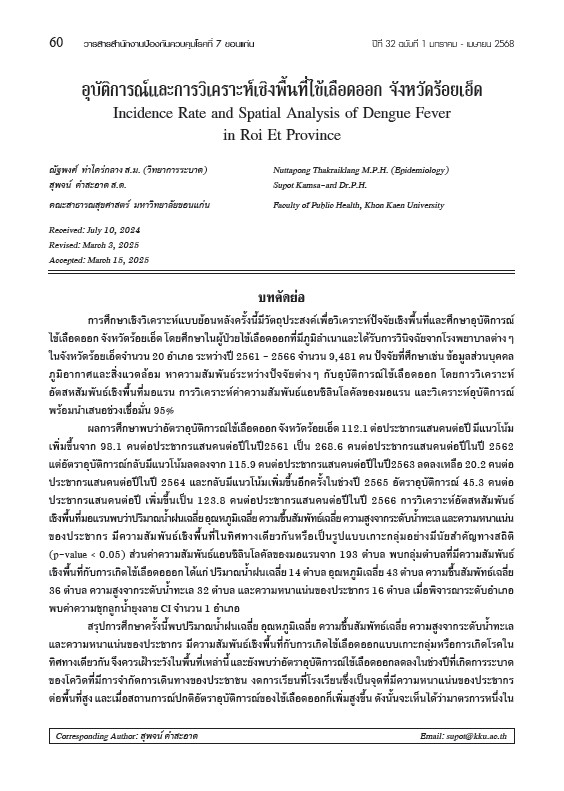
การศึกษาเชิงวิเคราะห์แบบย้อนหลังครั้งนี้มีวัตถุประสงค์เพื่อวิเคราะห์ปัจจัยเชิงพื้นที่และศึกษาอุบัติการณ์ไข้เลือดออก จังหวัดร้อยเอ็ด โดยศึกษาในผู้ป่วยไข้เลือดออกที่มีภูมิลำเนาและได้รับการวินิจฉัยจากโรงพยาบาลต่างๆ ในจังหวัดร้อยเอ็ดจำนวน 20 อำเภอ ระหว่างปี 2561 - 2566 จำนวน 9,481 คน ปัจจัยที่ศึกษาเช่น ข้อมูลส่วนบุคคล ภูมิอากาศและสิ่งแวดล้อม หาความสัมพันธ์ระหว่างปัจจัยต่างๆ กับอุบัติการณ์ไข้เลือดออก โดยการวิเคราะห์อัตสหสัมพันธ์เชิงพื้นที่มอแรน การวิเคราะห์ค่าความสัมพันธ์แอนซิลินโลคัลของมอแรน และวิเคราะห์อุบัติการณ์ พร้อมนำเสนอช่วงเชื่อมั่น 95%
ผลการศึกษาพบว่าอัตราอุบัติการณ์ไข้เลือดออก จังหวัดร้อยเอ็ด 112.1 ต่อประชากรแสนคนต่อปี มีแนวโน้มเพิ่มขึ้นจาก 98.1 คนต่อประชากรแสนคนต่อปีในปี2561 เป็น 268.6 คนต่อประชากรแสนคนต่อปีในปี 2562 แต่อัตราอุบัติการณ์กลับมีแนวโน้มลดลงจาก 115.9 คนต่อประชากรแสนคนต่อปีในปี2563 ลดลงเหลือ 20.2 คนต่อประชากรแสนคนต่อปีในปี 2564 และกลับมีแนวโน้มเพิ่มขึ้นอีกครั้งในช่วงปี 2565 อัตราอุบัติการณ์ 45.3 คนต่อประชากรแสนคนต่อปี เพิ่มขึ้นเป็น 123.8 คนต่อประชากรแสนคนต่อปีในปี 2566 การวิเคราะห์อัตสหสัมพันธ์เชิงพื้นที่มอแรนพบว่าปริมาณน้ำฝนเฉลี่ย อุณหภูมิเฉลี่ย ความชื้นสัมพัทธ์เฉลี่ย ความสูงจากระดับน้ำทะเล และความหนาแน่นของประชากร มีความสัมพันธ์เชิงพื้นที่ในทิศทางเดียวกันหรือเป็นรูปแบบเกาะกลุ่มอย่างมีนัยสำคัญทางสถิติ (p-value < 0.05) ส่วนค่าความสัมพันธ์แอนซิลินโลคัลของมอแรนจาก 193 ตำบล พบกลุ่มตำบลที่มีความสัมพันธ์เชิงพื้นที่กับการเกิดไข้เลือดอออก ได้แก่ ปริมาณน้ำฝนเฉลี่ย 14 ตำบล อุณหภูมิเฉลี่ย 43 ตำบล ความชื้นสัมพัทธ์เฉลี่ย 36 ตำบล ความสูงจากระดับน้ำทะเล 32 ตำบล และความหนาแน่นของประชากร 16 ตำบล เมื่อพิจารณาระดับอำเภอ พบค่าความชุกลูกน้ำยุงลาย CI จำนวน 1 อำเภอ
สรุปการศึกษาครั้งนี้พบปริมาณน้ำฝนเฉลี่ย อุณหภูมิเฉลี่ย ความชื้นสัมพัทธ์เฉลี่ย ความสูงจากระดับน้ำทะเล และความหนาแน่นของประชากร มีความสัมพันธ์เชิงพื้นที่กับการเกิดไข้เลือดออกแบบเกาะกลุ่มหรือการเกิดโรคในทิศทางเดียวกัน จึงควรเฝ้าระวังในพื้นที่เหล่านี้ และยังพบว่าอัตราอุบัติการณ์ไข้เลือดออกลดลงในช่วงปีที่เกิดการระบาดของโควิดที่มีการจำกัดการเดินทางของประชาชน งดการเรียนที่โรงเรียนซึ่งเป็นจุดที่มีความหนาแน่นของประชากรต่อพื้นที่สูง และเมื่อสถานการณ์ปกติอัตราอุบัติการณ์ของไข้เลือดออกก็เพิ่มสูงขึ้น ดังนั้นจะเห็นได้ว่ามาตรการหนึ่งในการควบคุมไข้เลือดออกคือ การจำกัดการออกนอกพื้นที่ของผู้ป่วย และป้องกันไม่ให้ยุงลายมากัด เพื่อป้องกันการระบาดของไข้เลือดออกในพื้นที่
Downloads
เอกสารอ้างอิง
WHO. Dengue and severe dengue [Internet]. 2023 [cited 2023 Aug 13]. Available from: https://www.who.int/news-room/fact-sheets/detail/dengue-and-severe-dengue
กรมควบคุมโรค. รายละเอียดโรคไข้เดงกี่ (Dengue) [อินเทอร์เน็ต]. 2566 [เข้าถึงเมื่อ 31 ส.ค. 2566]. เข้าถึงได้จาก: https://ddc.moph.go.th/disease_detail.php?d=44
กองระบาดวิทยา. แพลตฟอร์มเฝ้าระวังโรคดิจิทัล [อินเทอร์เน็ต]. 2566. [เข้าถึงเมื่อ 31 ส.ค. 2566]. เข้าถึงได้จาก: https://ddsdoe.ddc.moph.go.th/ddss/
สำนักงานสาธารณสุขจังหวัดร้อยเอ็ด. สถานการณ์โรคทางระบาดวิทยา ปี พ.ศ. 2566. ร้อยเอ็ด: สำนักงานสาธารณสุขจังหวัดร้อยเอ็ด; 2566.
สำนักโรคติดต่อนำโดยแมลง. คู่มือวิชาการโรคติดเชื้อเดงกีและโรคไข้เลือดออกเดงกีด้านการแพทย์และสาธารณสุข ปี พ.ศ. 2558. กรุงเทพฯ: อักษรกราฟฟิคแอนด์ดีไซน์; 2558.
ศิริลักษณ์ พิมมะสาร. ความสัมพันธ์ระหว่างรูปแบบการใช้ประโยชน์ที่ดินกับการระบาดเชิงพื้นที่ของโรคไข้เลือดออกในจังหวัดพะเยา. วารสารวิชาการเพื่อพัฒนานวัตกรรมเชิงพื้นที่ 2563; 1(1):10-8.
Phanitchat T, Zhao B, Haque U, Pientong C, Ekalaksananan T, Aromseree S, et al. Spatial and temporal patterns of dengue incidence in northeastern Thailand 2006–2016. BMC infect Dis 2019; 19: 743.
กิตติวิชญ์ ชวนินทวิสุทธิ์. ระบบพยากรณ์และควบคุมการระบาดของโรคไข้เลือดออกโดยใช้เหมืองข้อมูลและภูมิสารสนเทศ ในเขตอำเภอหนองบัวระเหว จังหวัดชัยภูมิ [การศึกษาอิสระปริญญาวิทยาศาสตรมหาบัณฑิต]. ขอนแก่น: มหาวิทยาลัยขอนแก่น; 2554.
Ryan SJ, Carlson CJ, Mordecai EA, Johnson LR. Global expansion and redistribution of Aedes borne virus transmission risk with climate change. PLOS Negl Trop Dis 2019; 13(3): e0007213.
กรมอุตุนิยมวิทยา. สรุปลักษณะอากาศรายปี [อินเทอร์เน็ต]. 2566 [เข้าถึงเมื่อ 25 ส.ค. 2566]. เข้าถึงได้จาก: https://tmd.go.th/climate/summaryyearly
Saita S, Maeakhian S, Silawan T. Temporal Variations and Spatial Clusters of Dengue in Thailand: Longitudinal Study before and during the Coronavirus Disease (COVID-19) Pandemic. Trop Med Infect Dis 2022; 7(8): 171.
อดุลย์ กล้าขยัน. การศึกษาปัจจัยสภาพแวดล้อมกับการเกิดโรคไข้เลือดออกในจังหวัดกาฬสินธุ์ โดยประยุกต์ใช้ระบบสารสนเทศภูมิศาสตร์ [วิทยานิพนธ์ปริญญาสาธารณสุขศาสตรมหาบัณฑิต]. มหาสารคาม: มหาวิทยาลัยมหาสารคาม; 2549.
จุฬาภรณ์ ชัยรัตน์. การประยุกต์ใช้ระบบสารสนเทศภูมิศาสตร์วิเคราะห์ระดับความเสี่ยงต่อการเกิดโรคไข้เลือดออกในจังหวัดหนองบัวลำภู [วิทยานิพนธ์ปริญญาสาธารณสุขศาสตรมหาบัณฑิต]. มหาสารคาม: มหาวิทยาลัยมหาสารคาม; 2549.
ดาวน์โหลด
เผยแพร่แล้ว
รูปแบบการอ้างอิง
ฉบับ
ประเภทบทความ
สัญญาอนุญาต
ลิขสิทธิ์ (c) 2025 สำนักงานป้องกันควบคุมโรคที่7 จังหวัดขอนแก่น

อนุญาตภายใต้เงื่อนไข Creative Commons Attribution-NonCommercial-NoDerivatives 4.0 International License.
ความรับผิดชอบ
บทความที่ลงพิมพ์ในวารสารสำนักงานป้องกันควบคุมโรคที่ 7 ขอนแก่น ถือเป็นผลงานทางวิชาการหรือวิจัย และวิเคราะห์ตลอดจนเป็นความเห็นส่วนตัวของผู้เขียน ไม่ใช่ความเห็นของวารสารสำนักงาน ป้องกันควบคุมโรคที่ 7 จังหวัดขอนแก่น หรือ ของกองบรรณาธิการแต่ประการใด ผู้เขียนต้องรับผิดชอบต่อบทความของตนเอง
ลิขสิทธ์บทความ
บทความที่ได้รับการตีพิมพ์จะถือเป็นลิขสิทธิ์ของสำนักงานป้องกันตวบคุมโรคที่ 7 จังหวัดขอนแก่น